


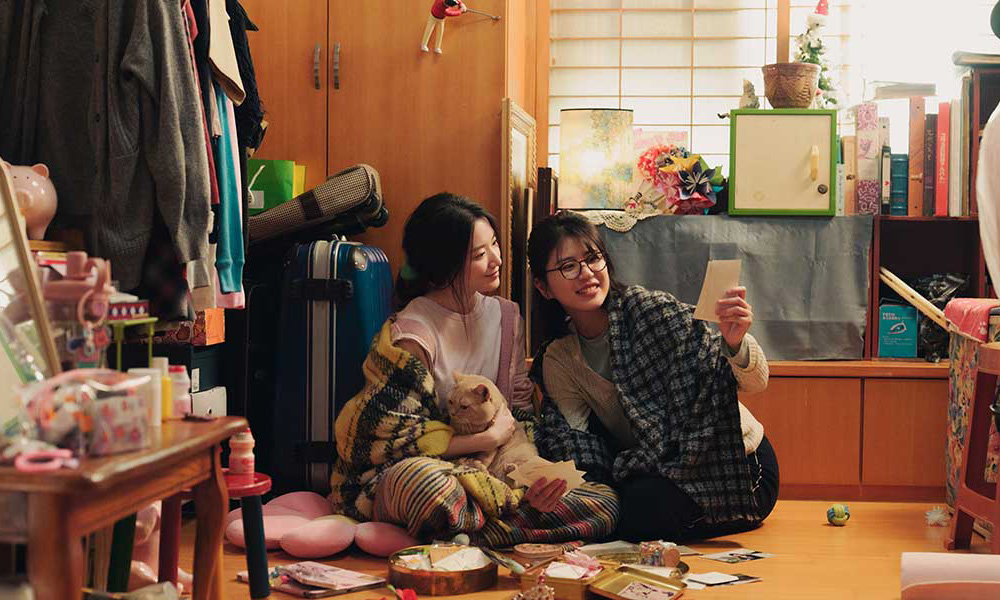

The “Sleepless in Seattle” shirt that Claire Lin (Xuan Chen) can often be seen wearing in the privacy of her own home in “Happily Ever After” is a tip off to the fact that both she and writer/director Feng-I Fiona Roan are romantics at heart, though at times it can seem like there’s not too much love in the air in the endearing drama. Certainly, there is less and less between Claire and her sister Kitty (Shuhua Yeh), who both are looking to leave their family home and have suitors that could offer them a way out as Claire considers marrying Ledo, a man who comes from a wealthy family with whom she doesn’t entirely seem to connect, and Claire is deeply in love with her girlfriend Shannie, she has been reluctant to come out to her old fashioned parents, whose precarious health has also been a reason that neither daughter has left the nest.
There aren’t any practical obstacles to an independent life for Claire and Kitty, both self-made women who appear to be well-prepared to be self-sustaining, but Roan sensitively draws out the entanglements that are largely invisible in a culture where tradition is hard to break as the two seek out seek out a partner. A bright, vibrant aesthetic to capture modern Taiwan can both burnish the film’s lighthearted sensibilities but also act as an ultimately damning facade of a world in which not so much has changed when it comes to fraught family dynamics rooted in history that occurred long before anyone you’re watching now was born.
Kitty and Claire are both very much millennials who have their whole futures ahead of them, with the latter introduced at a literary awards ceremony where she has picked up a prize for a novel that’s touted as already being adapted for the stage and the former in a less enviable position working as a shopgirl for a skincare store yet however modest her job may be, it’s clear she could have financial security should she want it as Ledo stages an elaborate proposal in a fancy restaurant, serenading her with a mandolin before getting on one knee. Although it gradually becomes clear that a marriage would be as much of convenience to Ledo as Shannie when he’d like to get his own family off his back about being single, that isn’t the relationship that Roan is most interested in as the sisters are both just one piece away from having ideal lives, but those pieces are very different from one another and leads to friction between them when they can’t understand why they can’t seem happy with all they already have or take the extra step required to get what they really want.
Yeh and Chen are disarming as the siblings who convincingly move from running across the streets late at night like kids to bickering at family dinners in coded language intended to arouse the suspicions of their parents without revealing anything directly and visually, Roan does well to contrast the different paths the two take upon leaving home. While Kitty curls up with Shannie, who is also her editor, Claire seems more untethered as she’s let loose amongst Ledo’s posh family, sitting at the outside edge of very long tables where it seems as if she’ll never feel as if she belongs. (Ironically, the same precarious perch belongs to Kitty at family dinners, given the relationship she’s loathe to reveal.) Although the film could seem a bit hypocritical in pushing the sisters to leave their own comfort zone to make progress when it sticks to a rather traditional formula itself, Roan strikes a balance between a pleasingly gentle narrative and something with real depth to it as the Lins struggle with their options when it seems like neither should have anything to worry about. When a truly happy ending would defy reality, Roan isn’t likely to give one, but the director still manages to bring a smile when the women stop chasing some notion of success that wasn’t theirs to begin with and start having their own ideas of what it looks like to them, with the film finding it on its own terms as well.
“Happily Ever After” does not yet have U.S. distribution.