


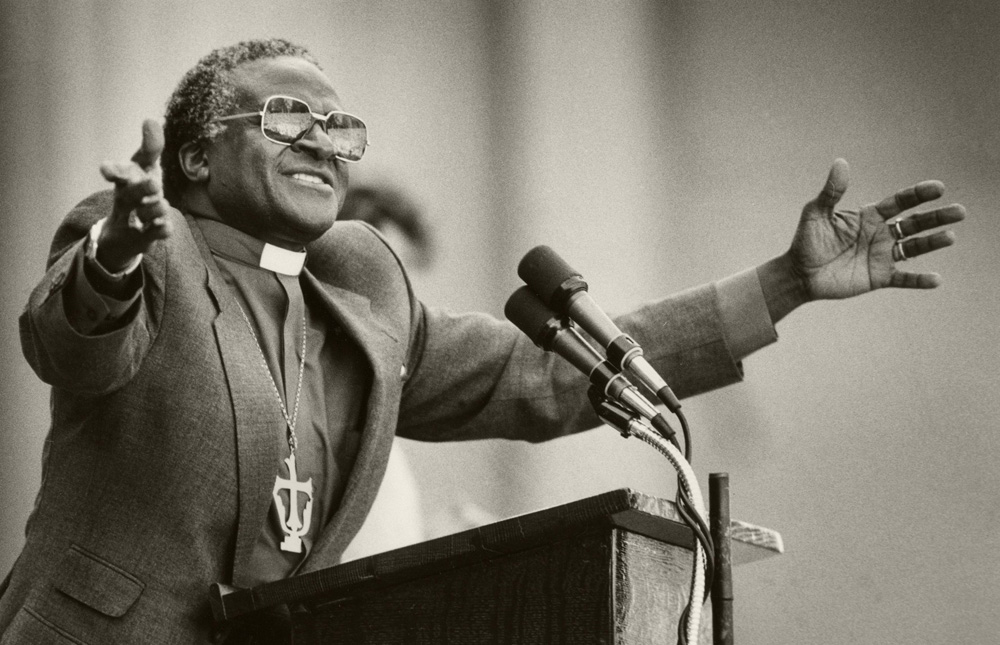

It has gotten to the point when a new biography boasting a treasure trove of rare, unseen footage can inspire a roll of the eyes rather than the promise of opening them, but leave it up to Sam Pollard (“MLK/FBI,” “Citizen Ashe”) to find something genuinely interesting to do with it in “Tutu.” The footage held onto by Roger Friedman and Benny Gool since the early 2000s from following around Desmond Tutu may not seem like much on the surface when his days of keeping a busy schedule of the archbishop meeting with various dignitaries around the world have slowed, though more than a few come to visit him in Soweto — he receives a casual visit from Barack Obama and enjoys telling Sharon Stone about the Israeli (Friedman) and the Palestinian (Gool) that have come together to film him. Early on in the film, Gool and Friedman explain how they earned such access over decades covering Tutu’s work of ending apartheid in South Africa, and their prominent position would suggest they’ve gotten him to say something truly revealing on camera in his golden years, but Pollard and crew recognize what’s most poignant about the footage that is laced throughout is to show the man of peace as a man at peace, having his indefatigable sense of hope affirmed and he can rest easy despite all the horror he witnessed when he was around long enough to see that things actually can improve.
Well before it’s noted that the Archbishop turned his attention to Gaza after devoting his life to fostering equality in his home country, “Tutu” feels as if it were made for right now, profiling a leader who found optimism to be a galvanizing force and pulling audiences along with the same spirit. When his accomplishments within South Africa are both well-known and individually worthy of their own films — becoming a rare Black Anglican priest in the region, bolstering the ascent of Steve Biko and Nelson Mandela and ultimately being put in charge of the Truth and Reconciliation Commission to bring healing to the country after succeeding in bringing an end to apartheid — Pollard and editor Paul Trewartha are emboldened to focus on attitude over achievements, briskly moving back and forth between more contemporary footage in the early aughts filmed by Friedman and Gool where Tutu and his wife Leah live in comfort, inviting over family and friends for house parties that might’ve been unimaginable decades earlier with so little to celebrate, and his tireless campaigning to reach such a point where all could enjoy the same quality of life.
As Dr. Mamphela Ramphele relates Biko’s famous quote, “The most potent weapon in the hands of the oppressor is the mind of the oppressed,” the film reframes the struggle for equality as a psychological one where the Archbishop’s enduring belief that those who want freedom can’t be denied gradually gained acceptance over time, though it puts the idea of progress within reach from the start when Tutu can be heard telling a highly skeptical journalist in 1990 that within five years Mandela would be the country’s prime minister and the casual dismissal as wishful thinking would seem insidiously insurmountable without knowing the outcome. While it’s fun to be the company of a warm, gregarious man (particularly when he’s with his wife Leah), his personality is envisioned as the key to his success, having just the right words to share in a eulogy when Biko was killed while in police custody in 1977 to prevent the country tipping over into chaos and slyly setting up the terms of engagement with Ronald Reagan when the U.S. president wanted to soft-pedal sanctions that would put pressure on then-Prime Minister P.W. Botha to reconsider his stance on apartheid during the ‘80s. The Archbishop may have been seen as putting more energy into words than action, upsetting some younger Black South African activists for being too appeasing to whites in seeking compromise while whites seemed to call him divisive simply due to the color of his skin, but in playing the long game, Tutu shows as much faith in humanity as any deity when never questioning that people’s better angels will prevail.
Although the film emphasizes the positivity that propelled him forward, it is neither uncritical of Tutu or blind to what he had to overcome and Pollard strikes a strong balance in recognizing that his subject’s superpower was seeing people for who they were and doesn’t dare to elevate him to sainthood when he’d hardly consider himself above the fray. The filmmaker also understands the raw power of the archival material that a well-funded production such as this can surface, featuring scenes from South Africa during some of their most turbulent times that is remarkable now to reflect on, and when those scenes resemble so many other places in the world currently where injustice has run rampant, “Tutu” inspires by demonstrating that simply remaining hopeful can be a powerful form of resistance.
“Tutu” will screen again at Berlinale on February 17th at 2 pm at Bali Kino and 4 pm at ADK am Hanseatenweg, February 20th at 9:45 pm at Colosseum 1 and February 21st at 1 pm at ADK am Hanseatenweg.