


If Petra Volpe hadn’t gone into filmmaking, it is easy to imagine her going into some kind of social work when there’s such care taken to consider what others are going through, but rather than connect with one person at a time, she’s found a way with a camera to do it on a mass scale.
“That’s what drives me in my filmmaking,” Volpe said recently. “Cinema is a medium of compassion and I think we desperately need more compassion. It’s also a medium of conversations, of dialogue, of connection and storytelling is essential to the human experience. It’s important to tell stories that are about things that are important in our world. I also do lighter movies. I’m working on comedies, but underneath there’s always something that I feel is a meaningful topic for human life. That’s definitely something that’s important to me.”
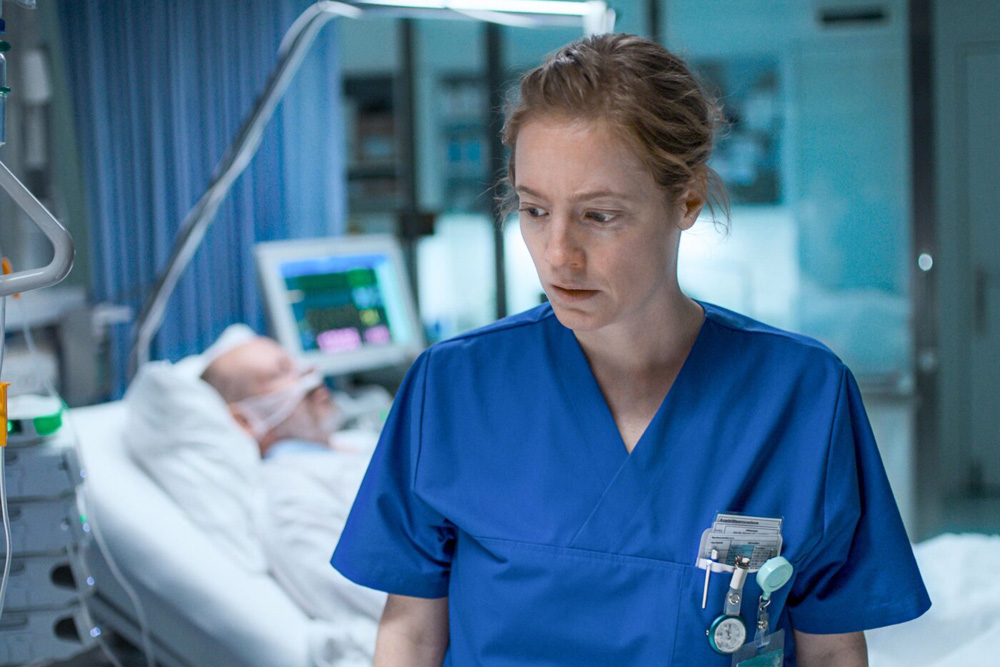
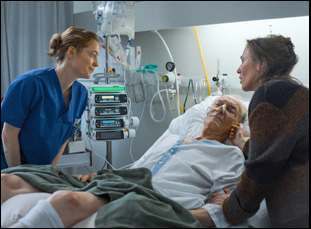
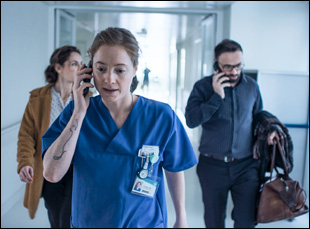
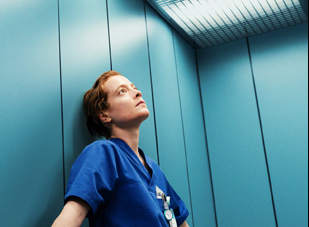
Volpe’s passion for telling such stories gives an extraordinary propulsion to them, following up her winning 2017 comedy “The Divine Order” about the push for women to get the vote in Switzerland during the 1970s with “Late Shift,” which spends a night with a nurse who goes about her regular routine tending to patients, with the fact that it’s average reflecting the ungodly amount of stress that’s put on hospital workers these days that are causing many to leave the profession. Leonie Benesch, the indefatigable star of “The Teacher’s Lounge,” appears as if she’s shouldering the weight of the world as Floria, who works graveyard hours when the hospital is actually a little more quiet than it is during the day, yet constantly wants to beat herself up when she can’t have as much time as she would like with everyone she’s treating, from cancer patients who simply would like some company to those who have checked in with mysterious maladies that it may take a while to diagnose. Any slip up could cause grave danger and Floria isn’t helped by the fact that her attention is pulled in every direction at all times, having to answer the phone to talk to relatives of patients, filling syringes with the proper medicine and drawn towards whatever need is most pressing at any given time, pulling her from one room to the next.
Benesch is magnetic as the overburdened nurse charged with making difficult snap judgments in the best interests of those she cares for and Volpe captures how much grace she has under pressure, essentially attaching a camera to her as she pirouettes through the hospital’s hallways where turning the corner brings a fresh set of issues to navigate. The adrenaline is addictive enough to see why Floria stays in the job beyond her sense of duty, yet so too is the potential for burnout, given how much the job asks of her and when Volpe also tucks into a hospital where those with private insurance are provided with greater amenities than those without, “Late Shift” paints a picture of a broken system on the verge of collapse without some immediate soul searching. The film is just one of two urgent dramas that Volpe has coming out in 2026, with her prison-set “Frank & Louis” recently making a splash at Sundance, and the filmmaker is quickly building a reputation for taking on subjects that society might want to turn a blind eye to yet become impossible to look away from, given her sensitive and undeniably engaging cinematic treatment. As “Late Shift” finds its way into theaters beginning this week, the director graciously took the time to talk about the personal inspiration to tell this story, finding the drama in a hospital’s natural rhythms and ambiance and recognizing an underappreciated profession.
 How did this come about?
It was many years in the making, even before COVID, because I lived with a nurse for many years and worked in a hospital as a nurse assistant for a few weeks, so I was just very aware of the political discussion about the nursing shortage. I just felt it’s one of those professions that is undervalued and underestimated because 80% are women who do this job. Then I was looking for a genre to tell this story about nurses and I read a book by a German nurse who describes just one shift. Just two pages in, I felt like this reads like a thriller and I thought “That’s the movie — it’s one nurse, one shift” and I pitched it to my producer and he [said] “I’m in.” That started a very long process of doing deep research and dozens of conversations with nurses in Switzerland, Germany and an American nurse. I was in the hospital myself shadowing nurses. so little by little the actual shift that we see in the movie came together and the nurse who wrote the book became a consultant [along with] a Swiss nurse because I had to learn to think like a nurse to build the shift.
Both of your films following “The Divine Order,” which was so big in scope, have been more confined. Is it a different way to approach a story when you keep it limited to one space?
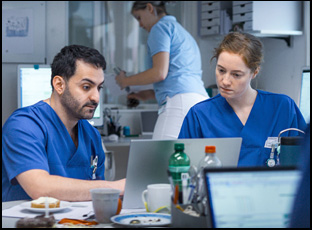
How to make that cinematic is always a very interesting challenge for the director of photography, the production designer, and me to figure out how to make it really a sensual and visceral experience. My new movie that just premiered at Sundance plays takes place in an American men’s prison and it’s also just one location, so now I’m done. [laughs] Next time I want to have a little bit more to play with. But with my production designer, we had a lot of metaphors for the hospital. Like we saw the the hallway like an ice rink. and Floria was like the high speed ice skater on it. For me, every room was almost a different kind of aquarium with a different kind of fish. Every room was a reflection of the patient and we worked very subtly with color and small things like curtains, trying to make this simple environment as rich as possible without stylizing it. We really didn’t want the place to draw any conscious attention for the audience because the antagonist is not the hospital. It’s not a dysfunctional place. It’s the time that’s lacking, so we put a lot of thought into this.
 What was it like to figure out who you wanted this nurse to visit throughout the day?
The patients and the illnesses were something that I built in the script over many drafts. They were inspired by research but also my personal life. For example, I have a dog and my biggest worry if I was in a hospital would be what would happen to my dog if I die or if I’m in a hospital for a long stretch? That’s also something that was confirmed when I talked to a doctor. He said people with pets, that’s their biggest worry. They might be dying, but they’re thinking about their pet. Or people heal faster who have pets because they want to go home. So this script was very consciously and carefully constructed around these patients and their needs. It was almost like a Tetris game. Many different layers of things that had to come together to create that kind of tension and also the sense that we are seeing eight hours, but really we only see 90 minutes.
It’s self-evident why Leonie’s in the film from her strong performance, but what sold you on her to play Fiona?
I almost didn’t dare to ask her because I had seen her in “The Teacher’s Lounge” and thought she just probably doesn’t want to be another stressed professional. But I love her work, and she’s such a natural actress who completely disappears into the role. You are really seeing the character and not all actors have that. She’s also such a physical actress. Eventually, I just sent her the script and she loved it I think because it’s such a movement piece. It’s not at all psychological. The character doesn’t have a moral dilemma or an agenda. She just wants to do a good job and it’s very much an action role. There’s not one moment she doesn’t do something and I think that was very attractive to learn all these professional nurse activities combined with movement and talking. She really embraced it and she also loved to be in a movie that’s really about something meaningful and honoring a profession that’s so extremely important for all of us.
What was it like to create a relationship between her and the cinematographer when there’s so much movement?
I didn’t have to do that because they already knew each other [from “The Teachers Lounge” and “Two Lives”], but it is really a dance between her and Leonie. Judith [Kauffman, the cinematographer] and I were very well prepared. We had done rehearsals without Leonie, just filming the whole film on iPhone with me a stand-in, so we we knew exactly how to shoot the scenes. But then once Judith and Leonie were together, the two of them really know each other so well by now, you can just sit back and and enjoy as a director.
 Was there anything that happened that may have changed your ideas of what this was or take it in a direction you didn’t expect?
It was so precisely scripted, there wasn’t much room for it. But the scene where they three brothers learn about their mother, it was three young actors and it was one of their first time in front of the camera. He was just so authentic and I just let them play [the scene] out. I was just observing and I was just deeply moving. They really went deep into this moment of pain and I gave them just one image that I had, one that I remembered from 9/11 of three firefighters holding each other and I told them I had this image and then they just took it from there and did the scene the way they felt it. These moments are always just such huge gifts for directors when things just become alive, and in a way you don’t direct, you just give them something to play with and it pans out by itself.
The sound design was pretty extraordinary in this – how you bend the sounds organic to a hospital to accentuate the tension. What was it like to work on?
That we had to completely build because we had to keep all the equipment quiet during the shoot, which was a huge challenge on its own because the blood pressure machine was always beeping even though we turned it off. The technician had to come several times and it was also funny that a lot of the actors who played patients were not super experienced, so whenever they were on camera, their blood pressure was high and we had to hide the actual blood pressure [reading on the machine]. Every nurse who would watch the movie would say, “That person with this blood pressure would need a medication.” [laughs] So we had to do some CGI with the blood pressure machine
The whole sound was built afterwards by my wonderful sound team. Gina, the sound designer, really went to town with all the sounds because that’s the reality of a hospital. It’s very loud. There’s always something is always ringing, beeping, and people are there. Of course, we used it dramaturgically, almost as a counter movement, [where] it gets more quiet actually towards the end when the stress gets higher, but there’s a tense silence towards the end and it starts out more loud. It was intentionally built in this way.
 When you’re honoring this largely unrecognized profession, what’s it like getting this one out into the world so far?
It’s been amazing because in Germany and Switzerland it was also a huge box office hit. People really showed up for this movie, which for me was a moment of triumph because it’s not the classic superhero, it’s like the real-life superheroes. And if you tell a compelling story, the people show up for it. We beat some of the big Hollywood blockbusters with this movie and it’s just a story about a nurse and her shift. So that feels very gratifying, and it was really nice to see the nurses embrace the movie. I never got so many letters from nurses saying thank you for this movie. Cinema has that power to make people feel seen and loved and that’s very powerful, so I really hope that the movie amplifies nurses’ voices to fight for better work conditions. I’m very in awe with the nurses here in New York who have been on strike and and people always forget they’re not striking for better [conditions for themselves], but they’re striking for better patient safety. They’re on strike for us so we have better outcomes and I hope that the movie can also support that message.
“Late Shift” opens on March 20th in New York at the Quad Cinema, Los Angeles at the Laemmle Royal and Cleveland at the Cleveland Cinematheque and expands across the country on March 27th. A full list of theaters and dates is here.