



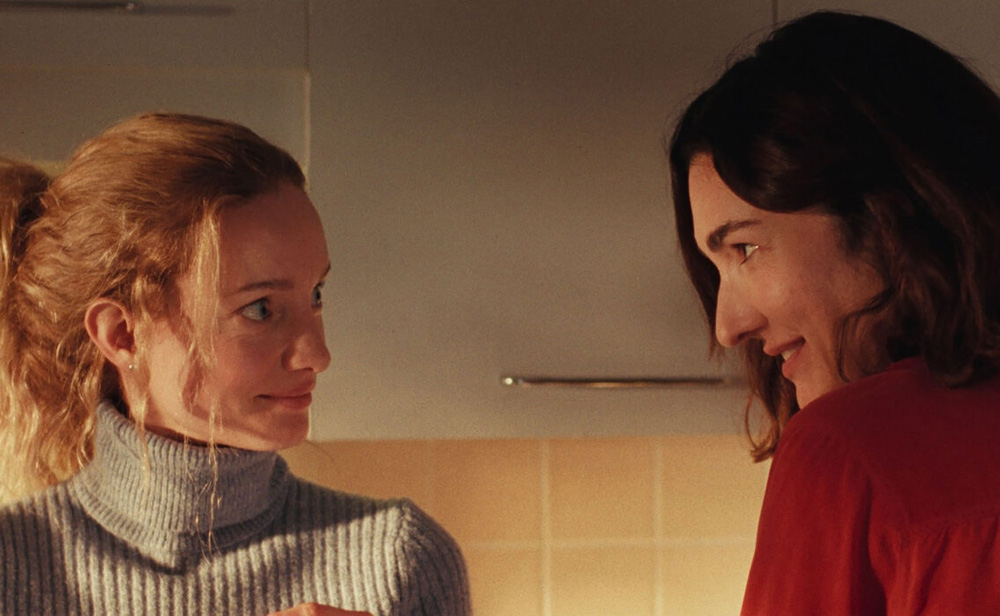

At first, “Two Women” seems like a departure from the previous films of Chloé Robichaud, who has long found creative ways to express the complexities of women who have felt uncomfortable in their own skin. The only way that it makes sense on the surface that she would tackle a remake is that it is the most unexpected thing the wildly original Quebecois director behind “Days of Happiness” and “Sarah Prefers to Run” could do at this point, and hardly a forgotten property when the bawdy 1970s sex farce “Two Women in Gold” on which it takes inspiration became a sensation in its native Montreal for how scandalous it was, imagining a pair of neglected housewives sought to satisfy their sexual cravings by inviting over a steady stream of plumbers and cable TV repairmen to tend to more than just their apartments.
However, a clue that “Two Women” wasn’t some cynical retread as well as the fact there could be something interesting to do with the premise was the fact that it was initiated by the well-respected playwright and screenwriter Catherine Léger, who previously reconsidered the traditional roles of women in stories told from the male gaze in her delightful coming-of-age comedy “Slut in a Good Way” that saw sex as a liberating act for the restless young women at its center. Ultimately, “Two Women” seems as if it might’ve unlocked something in Robichaud, who is able to go truly wild with a big, broad comedy while making the thoughtful film a seamless part of her filmography as neighbors Florence (Karine Gonthier-Hyndman) and Violette (Laurence Leboeuf) contend with the expectations society has of them, both stuck in traditional marriages and raising children that would seem to deprive them of being looked at again as sexual creatures. Yet beyond satisfying their libido, Violette and Florence seem to be chasing after something more, a craving that no matter how abstract and ever-present in Robichaud’s work the director manages to quantify as it manifests itself in the women’s behavior that can become inexplicable even to themselves.
It’s fitting that the trouble in “Two Women” starts as Violette is unsettled by the constant sound of what she thinks are crows squawking from inside her apartment, only to be more unmoored by the idea that it’s others having sex and the dividing line between humans and animals can seem particularly thin as thin as the walls when Florence is prone to acting on her impulses, somewhat to the admiration of her more timid neighbor. Both women have children to think of, but they also have to recognize that in dismissing their own needs, they are only adding to their stress and when their husbands have other preoccupations, feeling as if they need to go to more and more outrageous lengths to get some attention may make for some great comedy, but Robichaud, Léger and Gonthier-Hyndman and Leboeuf see the tragedy in it as well. Following a successful run in Canada after premiering at Sundance last year, the fierce and funny film is returning to the U.S. this week for a proper theatrical run – complete with free childcare provided for its matinee screenings Sunday at the Angelika in New York, courtesy of its distributor Joint Venture – and the director and the film’s two stars spoke about turning a story that once was a male fantasy into a subversive exploration of female desire, creating the environment to take risks and the cozy confines of the film’s evocative main location.
 Chloé, this reminded me a little bit of your series “Feminin/Feminin,” but at the same time it seems like it has a little bit more heightened comic tone to it. Was exciting to try something out that was a little bit more stylized?
Chloé Robichaud: It was just so much fun to jump in into comedy, and with “Feminin/Feminin,” there was some bit of comedy in it, but [more] dramedy. I was always a fan of Catherine Leger, the screenwriter of “Two Women.” I had seen her all her plays and to me it was just so great to be able to like render her beautiful way with dialogue. The way she writes dialogue is just so unique, so distinctive and it was a great challenge too, because as you said, it’s a bit more stylish or I would say “pop” than what we’re used to seeing in my cinema. But it was just so much fun working also with Karine and Laurence.
What got the two of you excited about this?
Laurence Lebeouf: Well, for sure just from the pages of Catherine Léger’s work already I fell in love with the the whole world of this [where] we’re touching the comedy and the drama at the same time. We laugh and we cry as we read it and I really love that — that thin line of writing that Catherine mastered. I love the story of these women and their friendship, their stories of emancipation and I haven’t done a lot of comedy, so I was happy to dip into that.
Karine Gonthier-Hyndman: I could say the same things as Laurence, but you have to understand that in Quebec, [this was based on] a very famous movie in the ’70s. So it was very exciting to work on this contemporary version, which had shaken the audience in the ’70s because it was perceived a little bit like porn, but really adapted to today with the writing of Catherine.
Laurence Lebeouf: And to work with Chloé. When we knew that it was her and going to have her signature on the film, that was also very exciting to be part of.
Chloé Robichaud: What’s crazy is that we did a big audition process to really find these two women. I knew Laurence [since] we’ve worked together before. And I knew Karine through her reputation — she’s a formidable actress in Quebec and very funny one, so I knew she would be funny, but when I saw both of them audition, I did an edit with both of their auditions like the first scene that they meet in the film. It was just so crazy the chemistry they had and they were not even in the same room and they never met.
They brought something very unique that is close to them, but I always wanted this contrast between the two characters. Karine and Laurence in real life are very different. They have a different energy, but very complimentary and that great chemistry that you cannot fake, it was there. There was a spark and you can feel it on screen.
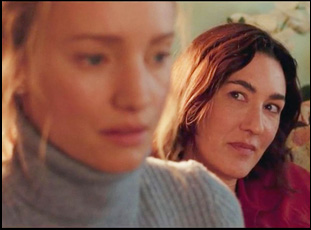 Was there anything important to you in terms of how you played this character when it could be a broad farce, but there’s real gravitas there?
Karine Gonthier-Hyndman: Although it was a comedy, I think it was important to dig into the dark side of those characters to bring out the the comedy but also the depth of what they were living. I wanted to make sure that my character had this little weird dark side, like the scenes with the hamster [her son has as a pet]. You don’t know if she’s going to kill him or not. And her whole perception of sexuality is not super sexy. She’ll just hump the guy [once she seduces him]. It was important for me for that character to be really imperfect and singular.
Laurence Lebeouf: Yeah, I think for me it was just keeping what really attracted me to my character at first — her solitude and melancholia, so you want to root for her to make a choice in the end. That arc of her awakening was important and I wanted to keep that loneliness she had throughout this, but also finding this new friendship that will make her bloom into making a decision in the end.
Karine Gonthier-Hyndman: In order to be at your best as an actor, you also really need to feel like you’re in a safe zone and having a female director, and Chloé specifically — she reunited a whole feminine team [where] the DP at the camera was a woman too — so those aspects put together really helped us to dive into those worlds without having to be conscious about what we were doing. That felt really good and Chloé is director that makes you feel very free. Chloé knows what she wants, but she also trusts you as an actor, so there’s this latitude that we have with her guidance.
Chloé, the the setting for this is so wonderful. Was it interesting to find the right apartment complex this could take place in that could say so much about the characters?
Chloé Robichaud: Yeah, it’s crazy because when I first read the first version of the script six years ago, there was this co-op and I [thought] does that really exist in Montreal? I just Googled it and this one came in first in my research and I [thought], “Oh my God, it’s exactly what I’m looking for.” It looked like a cute prison. [laughs] Everyone’s on their balcony and I really liked the rectangular windows that felt like a prison. It’s very distinctive, and a bit of Scandinavian too, so [I thought] there’s something universal also with that space. It’s not just Montreal, but there’s references from elsewhere. I just love that space and how we connected the characters all together and the metaphor of it. There’s this sense of community, but at the same time everyone was behind these windows, just judging each other. It was fun to play with those images.
Laurence Lebeouf: [That building] even brought our characters even closer because while Karine was shooting on her side of the apartment, I would come in her apartment from my apartment and wait with her while we were shooting these camera angles. She would do the same and there was something that resembled our characters in that way. We were all stuck in that little space. The whole crew also was very tiny, so it brought us much closer and I think it added totally to the [intimacy].
Karine Gonthier-Hyndman: Yeah, those spaces are reflection of how [these women] feel. They feel imprisoned, so of course if you shoot it in a tight space, you can embody that.
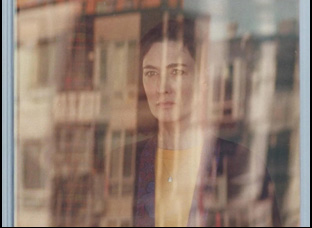 The production design was also such a great reflection of these characters – both apartment has bright colors, but they’re very different in how they’re much more solid in Florence’s spaces and more disperse in Violette’s. What was it like to work on?
Chloé Robichaud: We worked through the color palette for quite a while with the artistic director and Sara Mishara, the DP. I really wanted the the colors to be vivid because these women are exploring and there’s some liberty to it that I wanted to express through the colors. It was also an homage to the ‘70s film, which was very colorful too and because it’s shot through winter and Montreal is just so grey and so white, it would’ve been a bit boring, so it was nice to have the interior have such a different contrast.
Now that the film has played in Montreal, has it been interesting to see the reception when people likely had pretty powerful preconceived notions?
Karine Gonthier-Hyndman: Yeah, it has. That was pretty interesting because when we presented the movie in Sundance, people had no reference of that [original] movie. Then when we arrived in Quebec, we felt the attention we had was because of that movie, so people were very curious to see what we had done and even our families [were concerned], like Laurence has this story where her mother wasn’t sure it was a good idea for her to shoot that movie. There was a lot of nudity and it was pretty wild. But I think people were really pleased to see how contemporary ideas of feminism were brought up and also for the actresses back in the day, it was hard for them at that point. And for us, it was a complete different experience. There’s an expression in French, “Redonner les lettres de noblesse,” which is to give back the noble intention to the words of this movie and it felt like we tied the knot of that cycle with this.
“Two Women” opens on April 24th in New York at the Angelika Film Center and May 1st in Los Angeles at the Monica Film Center and the Encino Town Center.