



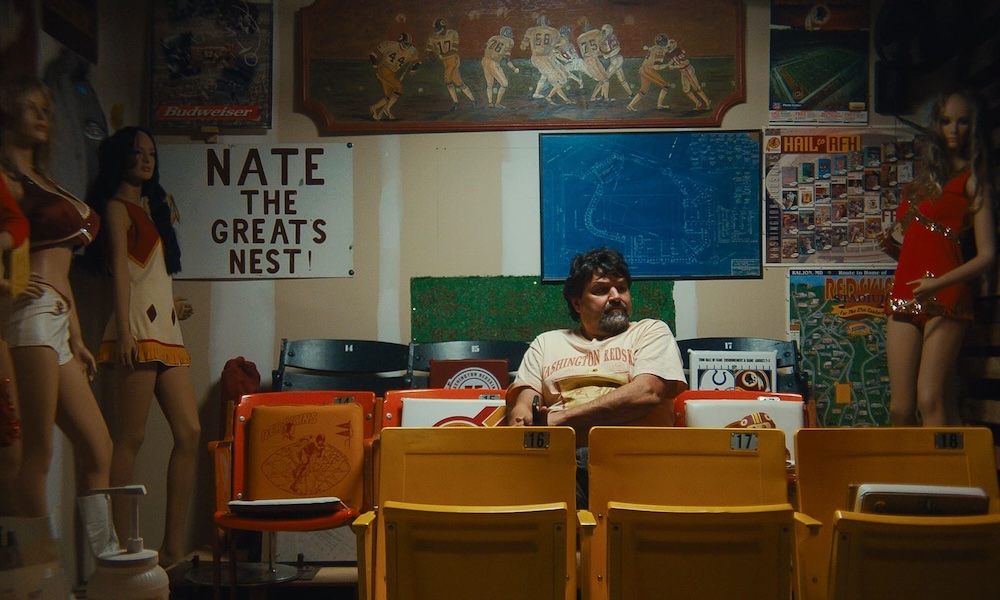

In an area known for its discretion thanks to the Pentagon and the FBI headquarters nearby, Khaula Malik finds one of the best kept secrets around the Washington D.C. area at an undisclosed location in Rockville, Maryland in “The Custodian” where Samu Qureshi has assembled a collection of memorabilia for his favorite team, the Washington Commanders. The 61-year-old constructed his own private museum in the corner of an office building spanning every decade since the team first hit the gridiron in 1932, boasting a telegram between the team’s owner George Preston Marshall and Ohio’s Lieutenant Governor from 1934 when the team was considering a move from their first home of Boston and the game was still played with leather helmets (which he has) to game worn jerseys from players ever since. But the collection has clearly come at a cost, not only when Qureshi couldn’t bring himself to join in on the fun when Washington won their last Super Bowl in 1991 and all the fans threw their complimentary seat cushions onto the field in celebration – of course, he saw the item as a cherished keepsake – but as he gets older and his wife Val wants to move back to St. Louis where she would be closer to family, the time appears to have come to relinquish his life’s work when holding onto it will cause strain.
Malik puts as much care into a portrait of Qureshi as he has put into his collection, showing the pride he takes in taking people around his carefully curated museum where the tortured history of the franchise has led to a full-fledged exhibits charting its name change from the racially inflammatory Redskins to the present-day Commanders and former players can stop by to feel like champions despite the fact that there have been plenty of dry spells in between the five titles they’ve won. Yet he fears he’s been increasingly left out of the game himself when the more time he spends doing inventory, the less he’s around family and friends and after making the collection his priority since he was four, he’s ready to part with it – ideally, by transferring it over to team officials to bolster their own historical holdings, though he finds getting in touch a challenge. As the pressure mounts between phone calls from Val back in St. Louis for him to come join her and the potential for rent hikes at his current location, “The Custodian” finds Quereshi praying to the gods – i.e. the spirits of Washington greats such as Sean Taylor and Sonny Jurgensen – for answers and illuminates the great conundrum of being a fan, investing so much time, passion and energy into that there’s no guarantee will pay off and could ultimately lead to heartbreak.
Although Malik has made something that will be felt deeply by anyone who’s ever loved a sports team, “The Custodian” is bound to be particularly well-received in Washington D.C. this week when it makes its world premiere at DC/DOX and the director generously took the time to talk ahead of the special screening about the happenstance that led to finding such a rich subject for the short film, tackling the Washington Commanders’ controversial history with sensitivity and finding the right cinematic style for the character study.
How did this come about?
It’s really funny because I was in DC filming something else and I was looking for people who had RVs and was reaching out to people on Facebook Marketplace. And Amber [Hsu], my producer [on “The Custodian”] was one of the people that got back to me and I ended up filming her RV, but when we were on the phone, she was asking me how much it costs to make a documentary. And I told her, it really depends on the project, the subject matter and scope of the film, but then I asked her why, and she said that she had a friend who she thinks should have a film made about him. And I [said], “Tell me more.” And that friend is Samu. He called me two days later and we realized we had other connections. His dad was actually my dad’s first boss at my dad’s job and then Amber [said] “I want to make this film. Let’s make it happen.”
Sounds like it was meant to be. Were you actually a fan of the Washington football team before this or football in general?
I grew up outside the D.C. area and I was a huge football fan growing up. I loved the team, so that was also why I felt called to this film because I wanted to do some kind of sports documentary, but I didn’t want to do something that was watching people play sports and when this opportunity fell out of the sky, I couldn’t say no. I also feel like throughout the years, the team was really bad, so I stopped being a sports fan, but I actually have become a fan of the NFL once more through this film.
It’s a really interesting story in part because it is this particular franchise, not only with their history on the field, but off with the controversy over the “Redskins” name before they were the Commanders. Was that actually part of the appeal? It’s handled quite sensitively.
100% because I didn’t think it was possible to make a film about his collection without addressing the controversy of the name, especially because as someone who was a fan of the team, the name issue was a huge issue for me as I got older and understood the racial undertones of what the name meant, which as a kid went over my head. So I knew I wanted to make that a part of the film, but I also felt it needed to be an organic part of the film and the best way to do that was through the context of the pieces within the museum, really bringing fans of all kinds, former players or people who are football fans into the space and just getting their honest reactions of what they were seeing.
Were those visits from former players something that would typically happen at the museum or was that arranged specifically for this film?
It was a combination. Samu loves inviting former players to the museum, so most of it with the players was Samu’s outreach, but then what’s really fun is Leroy Jackson, who’s in the very first tour, it was completely random that Samu met him because he was visiting where Leroy Jackson works as a security guard at the Catholic University Basilica, so it was a mix of people that he wanted to have come see the museum who could potentially help make some inroad inroads with the team and then us also doing outreach, thinking about who would be interesting and bouncing ideas off each other.
What was it like figuring out the right presentation for the museum? It does feel like this place of endless memorabilia, though I imagine being in an office building it can’t be that sprawling.
We filmed a lot in the museum and we tried a bunch of different things. When we would film the tours, sometimes my DP Aidan [Colt Sheldon] would be on his feet for two hours because we just filmed the whole tour with the players or whoever came in. And then we also decided, instead of just having the footage of the museum from the tour, we should also set up these dolly shots that we did through the different caverns within the museum because the space was this massive, unfinished office space and Samu had created individual exhibits through these pallets — he handmade everything. So there’s just random hallways and always another little nook of stuff here and there, so we really wanted to make sure within the film that we tried to capture the breadth of the space.
Did the idea of a ‘70s style aesthetic with slow zooms and moody lighting immediately come to mind for this?
Absolutely because I knew it was a film about a collection and wanted to approach the style with this nostalgia, and then a lot of the shots are locked off. There’s very few handheld [scenes]. And I wanted again to invoke that idea of display in a museum. My DP Aidan was paramount in helping make that happen and had some great ideas. We mostly shot the film on Prime lenses and we have a few slow zooms, which you see throughout the film, but the visual language was established from the very beginning and I feel this was a film that allowed for that to happen because it was a bit more of a controlled environment, even though the circumstances were unpredictable.
Was there anything that really changed your ideas of what this would be or take it in direction you didn’t expect?
Yeah, I didn’t know how much Samu’s siblings were going to be a part of the film. That surprised me a bit and I think their perspectives were really interesting because they’re Pakistani and German, so they grew up in a multicultural environment, but they’re also the generation-and-a-half above me, so I was curious to see how they interacted with the history of the space. I also wasn’t sure what was going to happen with the team [in terms of Samu’s attempts to reach the ownership about the collection]. I didn’t think anyone was going to actually get back to him, so we were hoping for that and that also was a nice surprise.
One thing that’s also great is that Val, Samu’s wife, is left off-camera as this looming presence when the motivation to part with the collection is the family’s move to St. Louis. Was that actually much of a decision on your part?
Initially, we were going to film in St. Louis with Samu and Val, and then as filming progressed, I actually thought it would actually make no sense to have her physical presence in the film because the museum has taken up so much of Samu’s life. It felt like she was better served in the story as the voice on the other end of the line instead of a physical person within the frame.
It’s wonderful that D.C. has a really prestigious nonfiction festival where this can premiere to a house full of Commanders’ fans. What’s it like to get to this moment with the film and share it with people?
I’m so excited. I knew that I wanted to try to premiere the film in my hometown and the hometown of the team, so I’m really grateful that we get this opportunity. Our screening has been sold out and I keep getting texts from people asking, “Are there any tickets left?” And I’m like, “Just show up early and maybe you’ll be able to get a seat.” I’m really looking forward to Friday and seeing how it all goes.
“The Custodian” will screen at DC/Dox on June 12th in the shorts program “Of This Place” at the Regal Gallery Place at 8:15 pm.