



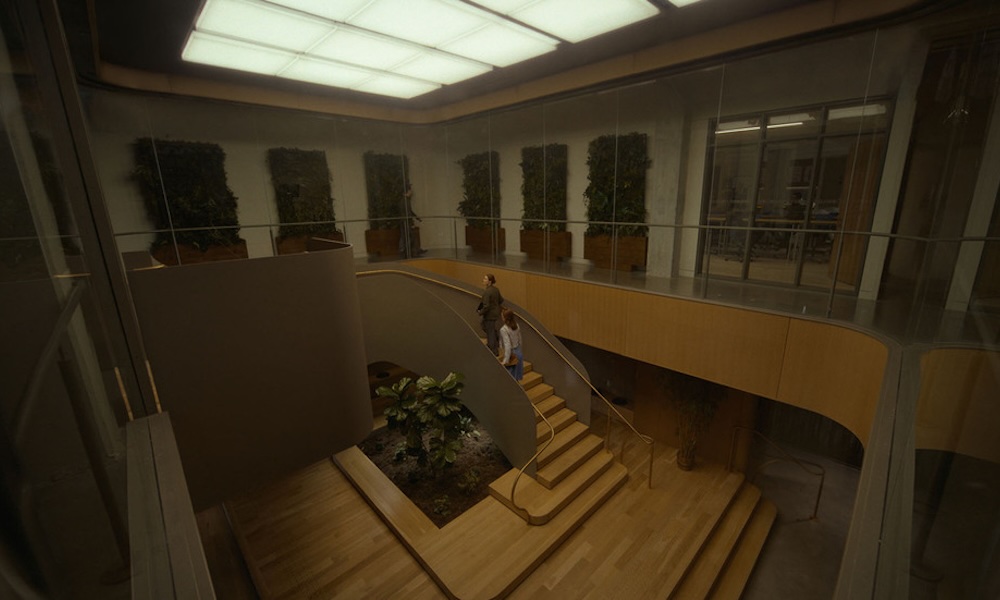

“You know the couch is more comfortable,” Jared (Shane West) tells his wife Claire (Morgan Kohan) as she walks into the room in “Holo,” though there isn’t a lot he can do to settle her nerves when he’s been dead for some time. A technological breakthrough has made it possible to speak to each other again, or at least a holographic facsimile of Jared given voice by Grey (Zelda Williams), an unseen operator elsewhere who has a wealth of information to draw on to keep up a conversation when the wealth of what’s publicly available on the internet as well as what may be privately provided by a client can ideally help clear up unresolved emotions for those who wished they had the perfect last words with a loved one.
Of course, there are plenty of ways this could go wrong, though it’s unlikely anyone could quite guess the way writer Alexander Hernandez-Maxwell and director Alexander DeSouza find in their eerie sci-fi short, presenting the strange encounter where the widow gets more than she bargained for in reviving her husband’s memory. With just three sets at his disposal, DeSouza creates a whole world in the not too distant future where the technological mediation of human experience can extend beyond the grave yet still subject to quirks of its users as Jared and Claire try to engage in a deep meaningful dialogue yet inevitably for as much as Williams’ Grey can play pretend and process the previously known information, which makes Jared more endearingly familiar to Claire, the limits are exposed by things only Claire could know. (It doesn’t help that the operator’s boss says he’s heard complaints from another client that lead him to think she should improvise less.)
When the film shouldn’t feel all that removed from a present day reality where AI is increasingly gaining traction as a solution to issues of mortality and memory that perhaps humans have no business trying to tackle in the first place, DeSouza gracefully finds ways to connect to the current moment in savvy set design and performances from the actors that acknowledge a surreal situation yet feel entirely grounded. The film gave audiences plenty to think about this week at Tribeca where it made its world premiere and DeSouza generously took the time out from the festival to talk about how his own connection to the story was made via technology, the challenge of connecting the performances of West and Williams to create a fluid version of the hologram Jared and creating a convincing dystopia on limited resources.
How did you get interested in this?
Yeah, I have been wanting to make a science fiction project for a long, long time. I’m a huge science fiction nerd and I just never found the right material. I was basically headed off for vacation one day when I was scrolling Instagram and I saw the writer, Alex Hernandez-Maxwell, post a premise [as] “Something I’m working on…” about a woman goes into a room and tries to find closure. And what really drew me in is that the premise felt very real and could happen in the next five to ten years with the way that AI and everything is going today. That scared me internally, and raised so many questions that I wanted to see if I could answer or maybe not answer in the making of the film. On top of that, I had a close family member pass away a couple months before, so I was drawing parallels from that experience to what the main character Claire in the film was feeling. So [Alex and I] started talking on Instagram, messaging each other back and forth and that led into longer phone calls.
The locations are incredible to create the atmosphere of this near-future. What was it like to find the right places to shoot?
I spent weeks looking for the right place and originally I was looking for one place, but the opening of the film is one location and then the room [the meeting takes place in] is a different location, so I split it up that way. The first part of the film actually takes place at a private high school that’s newly built here in Toronto. We found the location a week before we went to [shoot]. I just wasn’t happy with anything we were finding before that. When we first see the world, [I thought] what would it look like? It would look warm and inviting with elements of nature and it’s very cozy and friendly for the potential Holo clients. The second half of it was more of a struggle. I had looked at places you could rent and [individual] rooms, and I just didn’t find the right place. I knew we’d set five to ten years in the future, so I said, why not build the entire thing? So we built that entire set from scratch and I was fortunate to work with a concept artist. We drew multiple sketches and I pulled in references from everywhere about how the room would look and feel, so we dreamt up the room from the ground up. Everything you see after Claire goes into the holotherapy room is fictionalized.
It’s immediately striking to see a laptop from this day and age in this slightly futuristic environment. What was it like thinking about the setting for this in terms of time?
The science fiction films I like the most are the ones that are very grounded, so I tried not to make it too futuristic-looking [since] the scary part comes from making it look like it looks today and the overall feel of the world is more retrofuturistic, pulling from the back, but leaning towards the future. So the laptop was a deliberate choice, [where it] was more about the software that was running on it, and [in general] the world is is not too far from our own. There’s nothing unique about it or too far off into the the distant future.
It was also impressive how fluid everything is in the film despite the fact that I imagine you’re shooting sides with actors giving individual performances rather than opposite each other. Was it difficult to figure out how to connect those things or make them engage with one another even before you got to the edit?
Yeah, one of the things that helped me is I’m an editor by trade, so I use that technical approach, mostly in rehearsals. We had the three actors — Shane, Zelda, and Morgan — together and we broke down the script technically, so we said, “Okay, who is driving what line at what point in time?” Because when you look at the character of Jared [the hologram], Jared is a dual character, so from a a tactical standpoint, [you have to think] what actors think what line at what point [works best] and then practically we film it on set. But it unfolded to the point where we shot with one camera over three days, so the way I structured it was every day we would focus on a character — I chose to do Grey first because Grey was the foundation of it and when it’s Grey, we’re doing scenes with Zelda, but we actually had [Morgan] the actress who played Claire opposite Grey and when we shot with Claire, we flipped on the other side of the room and we shot opposite [scenes with her in the presence] of Jared, [played by] Shane and then the last day we we filmed, we flipped and we shot Shane’s scenes last. But it was always a combination of first breaking down the script and then having actors opposite from each other and [since] we actually built the room, we had a very thin plexiglass and put speakers inside both sides of the room, so [Zelda and Shane] can actually hear each other [even though they were on separate sides]. It functioned like a real Holo room in a way and that helped in terms of crafting it on that end.
And Shane and Zelda are actually good friends, and I didn’t discover that until we started talking early on in the process, so that actually helped. We had rehearsals and I had them mimic each other in the scene because they had to do the same movements in order for us to get a clean edit in post. So it was a lot of discoveries through that, but honestly, more of the discoveries came on set. One of the challenges with making a film where you had one character played by dual actors is you have to make deliberate choices. Because we shot every actor on separate days, there were times when in my script I would mark, “Okay, this line, I think Shane had a better performance as Jared,” so editor brain would click in and say, “Okay, I’m going to edit his line on this in the scene, so it goes to to Shane’s character,” and that was very fluid.
When you come from from more traditional dramas, was it interesting thinking about something that would acknowledge the genre tonally, but getting the performances that you wanted?
My approach was character first and one of the reasons why the film turned out the way it has, is because for me, I like to use the term “quiet sci-fi.” In early drafts of the script, there’s a lot of science fiction elements written into it that I had to strip away and say, “Okay, let’s just make it about two characters talking as a panel glass is between them.” But in doing that, the focus is more about the characters and focusing more on the process that Claire was putting herself through, then letting the music and the little subtle VFX glitches and the ambient lighting add up to back it up as a science fiction film. It goes back to are you know making the film feel very genuine? There’s different meanings of what genuine means, but [I thought] What is the balance we can strike in making the film look like ten years from [now]. In reality, we’re not going to be living with flying cars and huge science fiction elements. We’d be living in a world that looks like what we just saw in “Holo.”
You’ve said in earlier interviews you might’ve thought about turning this into the start of a miniseries, but I understand a feature may now be in your crosshairs…
Yeah, Alex Hernandez-Maxwell and I have been working on a concept for for a TV show from about two years ago, but throughout the process of making the short, I actually started proposing to Alex, it might work better as a feature, so we actually flipped, we restructured it to read more as a feature now. And we’re actually pitching a larger version of “Holo” as a feature film.
That’s exciting to hear and stands alone as it is. What’s it been like getting to this point with the film and getting ready to share it with audiences?
It has been a very crazy journey. I remember getting the call from Tribeca on a Friday morning saying, “Hey, let’s have a world premiere at New York City” and I was blown away. When you’re with the film, you’re shooting it, you’re editing it and you’re living inside your mind, and you start to lose that objectivity of it all. So giving it to audiences and letting them experience what I first experienced when I first read the script will be thrilling, if not more so than finding out we got into Tribeca, because as a director, it’s all about the audience reactions and the questions they ask when the last frame of the film finishes on screen. That’s where the joy for me lies.
“Holo” will screen again at Tribeca on June 13th at 9:15 pm at the AMC 19th St. East 6.