



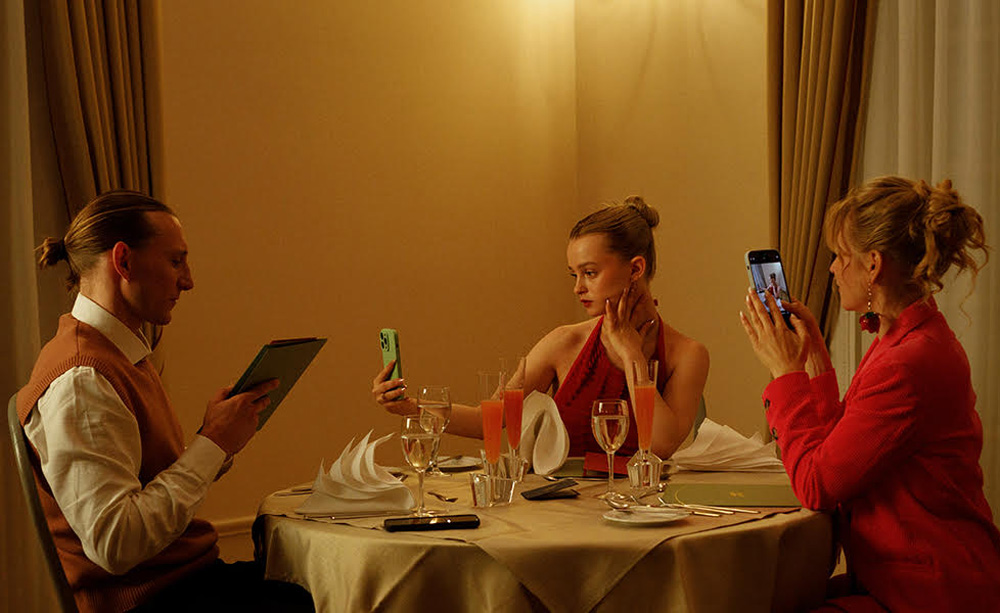

Luca (Maja Bons) doesn’t quite know what to make of seeing an AI Avatar of herself in “Babystar,” presented by a CEO who gets emotional speaking about it, clearly believing the good it will do for so many other young girls like herself to engage and have a face-to-face conversation with, conveniently overlooking the fact that if it weren’t for the technology leading up to this invention that they might still feel as if they have someone to talk to in real life. As a teen, Luca is naturally skeptical, but the experience she’s gained in that short time has led her to question the adults around her when the reason she’s in the room in the first place is the fame she’s attained online as part of a family of influencers, yet she feels as isolated as any of the young women that the CEO touts as a potential audience for the avatar and it won’t be as if she’s actually connecting with anyone herself – in fact, she tries engaging with it herself when there seems to be few others she can confide in at home when the cameras are always on.
It isn’t the first time that director Joscha Bongard has attempted to quantify the strange reality of appeasing a larger audience while feeling emptier inside in the digital age, making his narrative feature debut on the back of his 2022 documentary “Verified Couple” about a pair whose decision to put their sex life online left them wondering what relationship they had off-camera. “Babystar” is significantly more stylized as a dark satire, but Bongard impressively draws out the real concerns that the young Luca may not even be able to entirely articulate for herself just yet about the lack of barriers between her online and IRL experience, having no choice in the matter when her parents Stella (Bea Brocks) and Chris (Lilion Lewald) have raised her with a camera in hand since coming out of the womb. Similar to “The Truman Show,” Luca has only started to grow conscious that her upbringing is not the norm, living in a picture perfect house at a remove from the rest of the world and kept in line by her parents’ admonitions that their Mercedes Benz doesn’t come cheap, leaving her to think like them that the happiness of their 2.6 million Instagram followers should be put above their own.
If Luca is well aware of geographical constraints of her surroundings, Bongard adopts an influencer’s aesthetic and attitude to express how hemmed in she feels in other ways – noticeably, brands are bleeped out, lest they pay for their promotion, and the names of platforms are blurred when naming one runs the risk of upsetting a competitor – and frequently, the film is shot from the upper corner of a room where a surveillance camera would be expected to capture footage. A desire to break free stirs inside her, but it isn’t until Stella sits Luca down to tell her that she and Lars are considering having a second child – in front of the camera for a livestream, of course – that she finally has to consider the logistics of a real escape. Bongard eludes certain traps as well when it isn’t entirely the thought of having a sibling to split her parents’ attention or putting her own sanity at risk by staying that’s as distressing as the idea that the unborn child could grow up in the same way she did, leading her to act out in ways that her parents can dismiss as the emotional whims of a teenager without seeing any real reason behind them.
After a strong start, “Babystar” faces a difficult final stretch when the narrative meanders a bit in relationship to its lead who may be able to sneak away from the spotlight but finds herself completely in the dark outside of her influencer house, having the means from the wealth accumulated from her social media accounts to keep a roof over her head, but little knowledge of how to operate in the real world. Her warped behavior is left for an audience to observe rather than any forced judgment by the filmmaker adding to an experience that is queasy at best but flirts with appearing as if it has as few answers as Luca does in terms of how it’ll wrap things up. Still, Bongard has an incisive understanding of the current reality and as forward-facing as “Babystar” is, what’s most fascinating is not a progression of the narrative, but how intentionally or not, it captures the stasis of the moment – both in the timeline we all share and in a person’s life, showing how modern technology has only exacerbated the age-old restlessness of youth. The director savvily has Luca able to check in on her parents from afar any time she wants when they commit their lives online and her growing awareness of the full picture becomes paralyzing as she realizes that the adults may not have her best interests at heart but not yet old enough to be taken more seriously herself and by taking a similarly voyeuristic peek into Luca’s life, Bongard is able to achieve to share that wisened point of view.
“Babystar” will screen again at the Toronto Film Festival at the Scotiabank on September 6th at 11:45 am and September 12th at 12:30 pm.