



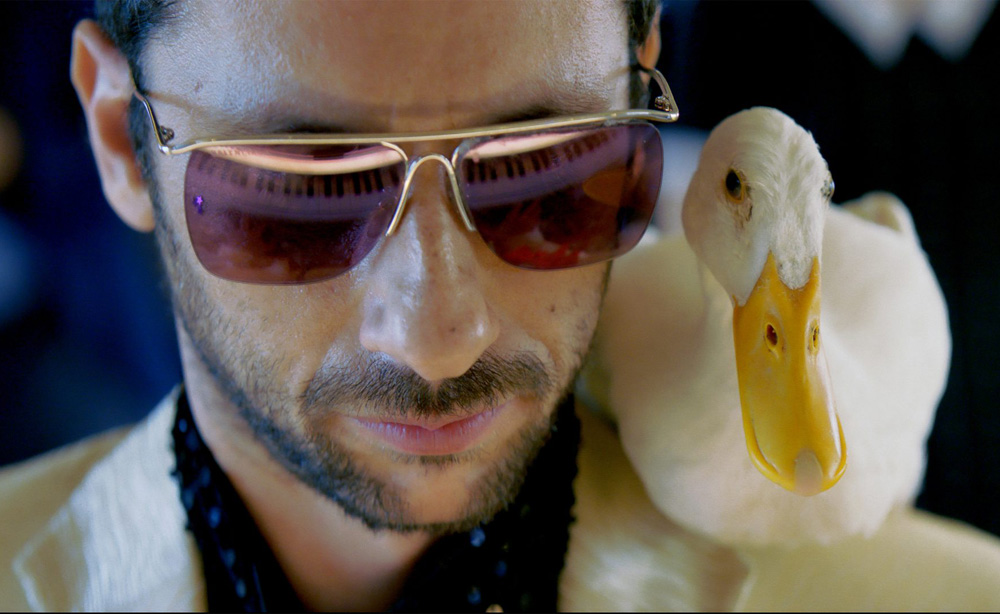

Nadav Lapid didn’t waste any time after premiering his last feature “Ahed’s Knee” at the 2021 Cannes Film Festival to begin writing his next, perhaps emboldened by the experience of seeing so many others push the envelope in the year of “Titane.” It could reasonably be expected that “Yes” would be in competition after “Ahed’s Knee” broke that barrier for the filmmaker who had steadily climbed the ladder that most internationally renowned auteurs that had become regulars at the festival have had to, building on the success of his Critics Week selection “The Kindergarten Teacher” and proving that he was truly a force to be reckoned with outside of France, his adopted home country, when his 2019 masterpiece “Synonyms” picked up a Golden Bear in Berlin, yet curiously while his fifth feature made it to the Croisette, it was a decision made by the organizers of the Directors Fortnight sidebar within 24 hours of Lapid learning it wouldn’t be in the main competition, suggesting that there might be such a thing as pushing the envelope a little too far.
Ironically, “Yes” concerns an artist named Y (Ariel Bronz) for whom the word “no” simply isn’t in his vocabulary, making one accommodation after another in his work as a performer who gets the party started with his wife Jasmine (Efrat Dor) for the wealthy that can’t be bothered to dance. The work can be debasing – he’ll quite literally lick a boot if the situation calls for it, but Y is happy to keep appeasing those in power as long as he keeps being able to do even some mortally compromised version of what he loves, ultimately led down the path of creating a new national anthem that could restore hope in his country. Of course, as all of Lapid’s films have been, “Yes” takes place in Israel, following the October 7th attacks and while the director’s tortured relationship with his homeland has been central to all of his work, grappling with his mandatory national service in the IDF that all citizens have to serve before accepting his true fate as a filmmaker born to a writer and editor, “Yes” may be the purest expression of his complicated emotions towards the country, making it both his most exuberant and incendiary work to date.
Pulsing with passion as much as anger, the film sees Y and Jasmine express the push-and-pull they feel living in a place that they increasingly feel disillusioned in through elaborately choreographed musical numbers in which it looks as if they might just jump out of their skin and the cacophony around them never stops, requiring them to keep up with a beat that inevitably will bludgeon them into submission. Incidentally, Lapid had thought at one time that this would be his first film to be set outside Israel when the chaos he summons as a result of such great wealth disparity and the social media age would be applicable most anywhere on the planet these days, but in setting it in Tel Aviv — and filming as the real war unfolded — the director made an undeniable satire, so much so that when the usual pathways to distribution such as a Cannes premiere were closed off, it managed to break through nonetheless when it is such a difficult film to shake.
Now arriving in U.S. theaters among others around the world after it looked for a time like it might not get such a wide release, “Yes” is receiving the hero’s welcome it deserved all along starting with an opening in New York and an in-person retrospective this weekend at the American Cinematheque in Los Angeles and Lapid graciously took the time this week to talk about his fervent belief that cinema hasn’t scratched the surface of its full capabilities, the impact on the production of filming in the aftermath of October 7th and being able to create a moment of reflection amidst all the conflict.
 With each film, it’s seemed like you’ve been drawn a little more towards a hyperrealism that gets at the truth in a different way. Has each film given you a little more license to go in that direction?
Yeah, it’s not like I have an official ritual with myself and I give myself the license, but I think I’m obsessed with the idea that maybe there is there’s another cinema that we haven’t yet discovered, a little bit like this moment where Columbus arrived to America, like a continent that we are not aware of. There is another cinema somewhere and I’m in permanent research to arrive to the cinema and I think of it as travel [where] even if I don’t get to this unknown continent, and even if this unknown continent doesn’t exist, it’s a journey after liberty. The moment that you become addicted to liberty, you cannot go back. And I think that the other side of liberty is danger and this danger is doing something that you never did before, so doing something that you don’t know what will it look like, these elements for me are essential.
“Yes” is quite close to being a full-blown musical, but the interest in dance seems to go back to “Synonyms” as this expression of how your relationship to Israel works its way from the inside out. Has it become a foundational part of your work?
There are many reasons, but maybe one of them is that we feel we live in the age where what we experience on a daily basis is the defeat of words, the defeat of the capacity of talking, of saying the meaningful becomes meaningless. Each and every day, words lose their meaning and manipulated until they become a bunch of syllables. And in my films, these music and dance sequences are actually an attempt of the characters to say something essential about themselves, to present themselves. There are narrative sequences of dancing and singing, but there are moments where suddenly the movie goes beyond its own barriers and try to talk – to say something essential about itself to the audience.
From what I understand, the film was originally set in the U.S., which is understandable at its core. Was it much of a decision to move it to Israel?
I wrote it originally about Israel before the 7th of October, but then there was a moment since [it’s about] these societies worshipping money and power or vulgarity and fascism, [all] walking hand in hand where there’s no more place for sensitivity, for putting things in doubt, for complexity. I think all of this can easily describe the U.S. from today, and 90 percent of societies, so we told ourselves maybe we can set it in the U.S. Why not? And we started to think about it, but the only thing was when we really started to think about it, it was the 4th of October 2023. And three days later the war began and in a way, I felt that it left me no choice but to go back to deal with the homeland.
 Is it difficult to find actors who both have the unique skill to perform all you ask of them and also to be brave enough to appear in a film that’s bound to be controversial?
It’s always complicated to find this meeting point between charisma, talent, and courage. There are many actors who are so talented, but fearful in the sense that they are able to put themselves at risk, following something that is a total adventure and the unknown. [The actors] were also very different. Efrat and Ariel were very different types of people and actors. Each one of them came to this from a different place. But the common thing between them was that I think they all felt there is something here that’s once in a lifetime in the sense that we were shooting in the middle of the war and the film is so fictionalized, but also not fictionalized. It felt like we’re shooting in the middle of tsunami and when you shoot in the middle of tsunami, the question of boundaries isn’t even relevant anymore.
Given the circumstances of filming in Tel Aviv, was there anything that changed your ideas of what this was or took it in directions you may not have expected?
It created this tension which is really primordial to the film between the political and sociological essence of this place and of these people. There is a human, existential, physical aspect. These people you [film] at this moment in time are responsible for this, this, this and this — I mean, for horrors, for terrible things — and you shoot the central city of these people and at the same time, you should you shoot people are running on running on the beach, you shoot the corner of a street, you shoot birds flying in in the central square, you shoot people on bikes. So Tel Aviv contained everything all the time that is taking place around it and the place itself.
 When I got to see the film in Los Angeles, you couldn’t make the screening yourself, but left a note for the programmer who introduced it to play it as loud as possible so the entire weight of that experience can be felt. The intensity really becomes an effective part of the experience. What was it like to do the sound mix?
Yeah, for me there’s a key moment in the film takes place more or less after 15 minutes. They sit in their in their modest living room after a night of debauchery and prostitution and Y [the performer played by Ariel Bronz] asks Jasmine [played by Efrat Dor], “Should I put the radio on?” And she says, “Let’s listen to the silence.” And there are exactly 17 seconds of silence and then again the endless noise [starts]. And I think that the endless noise is such an essential element of this reality, the fact that you never had even one second of quiet to meditate or reflect. All the time is taken by noises coming from here and there and nothing is pure. Everything is contaminated by another noise. While you talk, the characters [do] and you hear half of the sentence and you play this song but someone else is playing another song, so it’s the mixture or the combination and for me it’s a key element who has the importance to go beyond sound.
What’s it been like to see this film now go out into the world after having to overcome so much to get there?
”Yes” is a film that deals with your capacity to be an individual and to listen to yourself while in in this endless collective noise and I think that the journey that the film has had [in its release] in a way was echoed the film itself because it became a kind of detector of courage and cowardice. People might love the film or hate the film, but I think few could ignore the uniqueness and the singularity of this movie. There wasn’t any movie like this one, and yet it had to go in alternative ways [to make it to audiences]. I had the feeling the main entrance is blocked for a movie which is dealing with maybe the most explosive theme today in our world with explosive cinema. But when you go in alternative ways, you see the most surprising view.
“Yes” is now open in New York at the Angelika Film Center and opens in Los Angeles on April 2nd at the Laemmle Glendale, April 3rd at the New Plaza Cinema in New York, the Cinema Arts Centre in Huntington, NY and By Towne Cinema in Ottawa, April 10th at the SBIFF Film Center in Santa Barbara, FilmScene in Iowa City, the Cleveland Cinematheque in Cleveland and the Avon Cinema in Providence, and April 17th at the Portland Museum of Art in Portland, Maine and May 1st at the Belcourt in Nashville, Tennessee.