



In “The Man With the Big Hat,” Lyle Lovett recalls hearing the lyrics to one of Steven Fromholz’s songs and being transported to the kind of Texas town he’d pass by on the way to somewhere else, as he says the kind that “seem to atrophy and seem to dry up and blow away” in a gentle breeze being so fragile to change. The community may have come and gone from official maps, but they were preserved in Fromholz’s lyrics, describing life growing up in Kopperl with its population under a thousand people where such vivid details as biscuits cooling on a window sill can revive an entire time and place. Lovett would seem to be doing the same, eventually picking up a guitar to cover Fromholz, extending the memory of a place, but also a type of artist that seems to be an increasingly rare breed on the verge of disappearing as well.
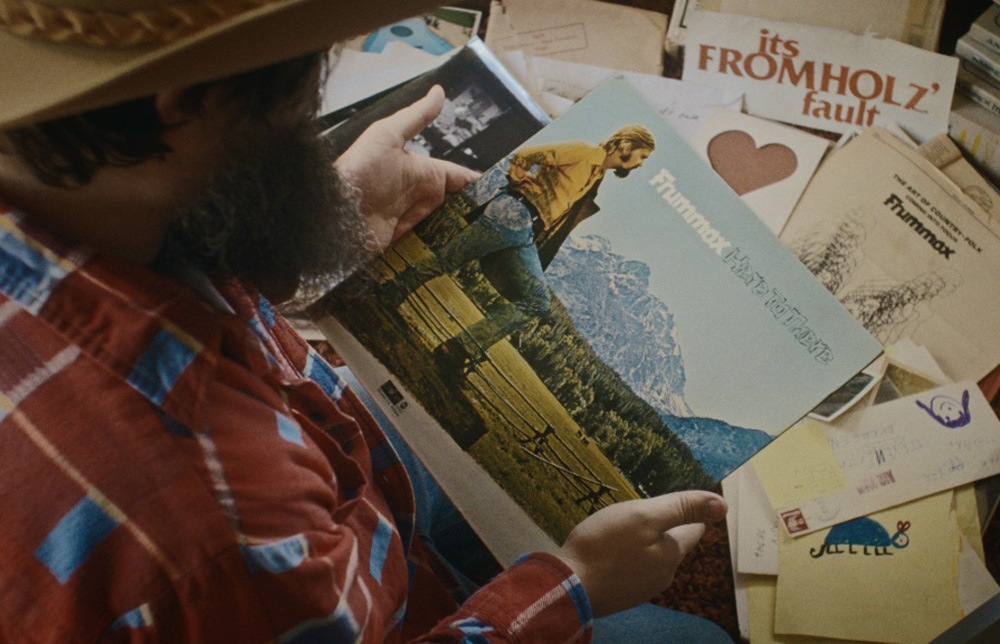
Director Austin Sayre elegantly emphasizes this point early in his tender biography of Fromholz when analog equipment is required to bring the late troubadour’s history back to life, using a slide projector to look at old negatives and a vintage Motorola tape deck to listen to recording sessions. His albums aren’t available to stream, says Sayre, and they weren’t broadly listened to when they were first released, which he can shoulder some responsibility for when a career was never top of mind. (As the artist explains, when he had the option between choosing between Joni Mitchell’s producer for his major label debut in the ‘70s who wanted to be more hands off or an unknown from the record label who promised a little more direction, he chose the latter when he didn’t know what he wanted and also in part because he thought he resembled a bear.) In tracing Fromholz’s footsteps from Kopperl to Austin with a detour through a Colorado mining town of Gold Hill, Sayre ends up telling the story of so many other singer-songwriters who have been revered by other artists but never found much more commercial success than being a regular at local clubs.
However, “The Man With the Big Hat” makes the case there might not have been a scene in Austin that came to be known as the music capitol of the world, or at least quite as vibrant, if it weren’t for Fromholz, who bridged generations of country music from Hank Williams’ style honkytonk to something more lyrical with almost freeform spoken word, drawing the likes of Lovett and Willie Nelson. The film will often let the music speak for itself, perhaps taking a cue from the “Texas Trilogy,” the three interconnected songs that Fromholz made his name and would speak extemporaneously in the sections between playing his guitar, as interviewees are more complementary than complimentary, spared having to describe what was special about it when that becomes self-evident and instead recalling where Fromholz was in his life when he wrote it. As much praise actually is lavished on Fromholz, a portrait emerges of someone who could get in his own way, leaving behind a partner in an early duo he started without notice to tour with Stephen Stills and having the talent to be a major label artist but not necessarily the drive, but also how his music was only meant to reflect his life rather than be the most important part of it, ultimately being able to stay at home as a father when he wasn’t on the road for long stretches of time as most musicians have to be.
Fromholz would eventually give tours, but not the kind that involved a guitar when he became enamored with the Rio Grande after being invited to perform a few times on river trips and “The Man With the Big Hat” will often relay his history with the same kind of casual attitude you might expect from hearing about it while observing the scenery. When Sayre, a stills photographer as well as a filmmaker, will often settle into the places the musician spent time in, taking in the view with the right mix of awe and circumspection, there’s both confirmation of Fromholz’s ability to evoke the environment with his music and the enduring inspiration of it for those willing to dig a little deeper when the likes of Butch Hancock can be seen roaming around the desert where it looks like there could be nothing and instead, you see it all. When Fromholz’s own history could scatter to the wind, the great tribute is being able to conjure the memory of the singer/songwriter so vividly and passing it along as he did.
“The Man With the Big Hat” does not yet have U.S. distribution.