



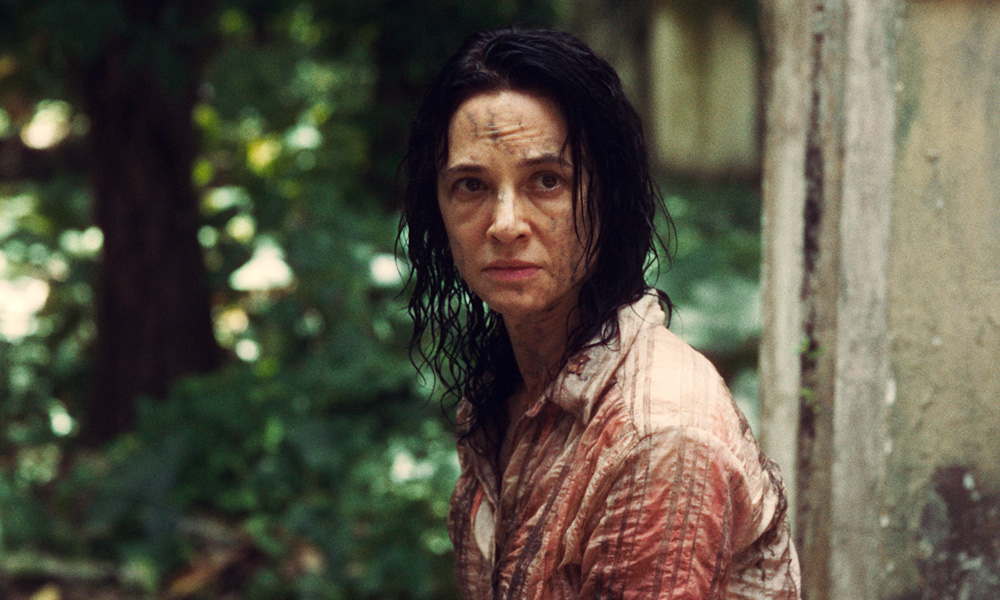

“Make yourself at home” has never sounded so ominous as it does when Sonia (Dogreika Tovar) welcomes back Caro (Asia Argento) to the Caracas mansion where she was raised in “Death Has No Master,” a site that’s seen better days at least as far as its appearance is concerned, though worse in other ways when it was once run as a cacao plantation and the subservient mentality there remains even if the owner died off. So much so that Sonia insists her young son Maiko take Caro’s bags up to her room despite the fact that any servant/boss relationship should’ve ended years ago when Caro’s father Clemente passed away and she wasn’t eager to return, leaving Sonia to tend to the property and while weeds have overtaken the 12 hectares and the house is largely crumbling, she has more of a stake in it at this point than Caro. Still, in Jorge Thielen Armand’s spooky psychological thriller, Caro insists on reclaiming ownership of the land to sell and finds that it’s more than she bargained for.
In his previous two features “La Soledad” and “Fortitude,” Armand considered how the dark history of his native Venezuela still lived in the soil, and “Death Has No Master” is almost a combination of the two when “La Soledad” involved squatters and “Fortitude” invoked the dark legacy of gold mines in the country, blending reality and fiction in a way he appears to use more as a foundation in his latest than as a practice, though the casting of a more well-known star in Asia Argento seems to be as much for what she represents as the performance she can give when the film promises a Dario-esque descent into madness. Naturally then, “Death Has No Master” opens with a recurring nightmare that Caro has had of being handed a knife to relieve a dying man of his suffering, lacking the context to fully understand what she does, but the racial disparity suggesting she’s got plenty of issues to work out. They become much clearer once she decides to head back to Caracas where she thinks she could get a million for the house, though in handing her a copy of the deed, her friend Roque (Jorge Thielen Hedderich, the director’s father who’s starred in his previous two films) assures that she’ll only get half of that if she’s lucky and that the country has changed a great deal since she last spent time there.
There’s an appropriate level of ambiguity as to who is in the right when Caro comes in demanding that Sonia and Maiko vacate the premises, getting no help from the local police who beyond citing a law that says anyone staying five years on an abandoned property can’t be forced off of cast a suspicious eye on the foreigner from Italy, and it’s clear Caro will have to resolve the matter on her own, put in the unfortunate position of being in her father’s shoes as a tyrant, looking to restore an order she may or may not believe in. Although the role may demand a little more interiority at times than Argento delivers, resulting in an awkward scene to actually work out her past traumatic relationship with her father alone in a room as anger and paranoia starts to set in, the actress is a perfect fit for the overall sensibility of the film, which never overtly tips into the horror genre, yet is filled with dread throughout, giving plenty of nods in that direction.
If this kind of thing is your bag, you know you’re in pretty good hands when Armand indulges in a long opening credits scene of Caro’s car ambling down a windy road, underlined by a free association jazz score where a variety of instruments struggle for primacy in a sea of natural sounds, as if you’re watching some reels that have been hiding in the back of a film archive for the past 50 years and waits to drop the title card until the totality of what Caro is actually asking for in reclaiming the plantation for sets in. There’s a queasiness about the disillusionment Caro experiences that feels impressively organic and while she is obliged by others such as Roque and Yoni (Artur Rodriguez), a mysterious man who lurks about the property he once worked on in a supervisory position, to succeed in evicting Sonia, there’s never a sense anyone is actually with her as she attempts to exert control over something that shouldn’t have been hers to own in the first place. “Death Has No Master” may see Caro lose her grip on reality as much as her land as it reflects a changing social order that she fears she has no place in, but in conjuring the surreality of the ground shifting beneath her feet, the film only tightens its hold on the audience.
“Death Has No Master” will screen again at Cannes in Directors Fortnight on May 20th at 9:15 pm at Théâtre Croisette and May 21st at 4:30 pm at Cinéma Le Raimu and 8:30 pm at Cinéma Olympia/Salle 8.