



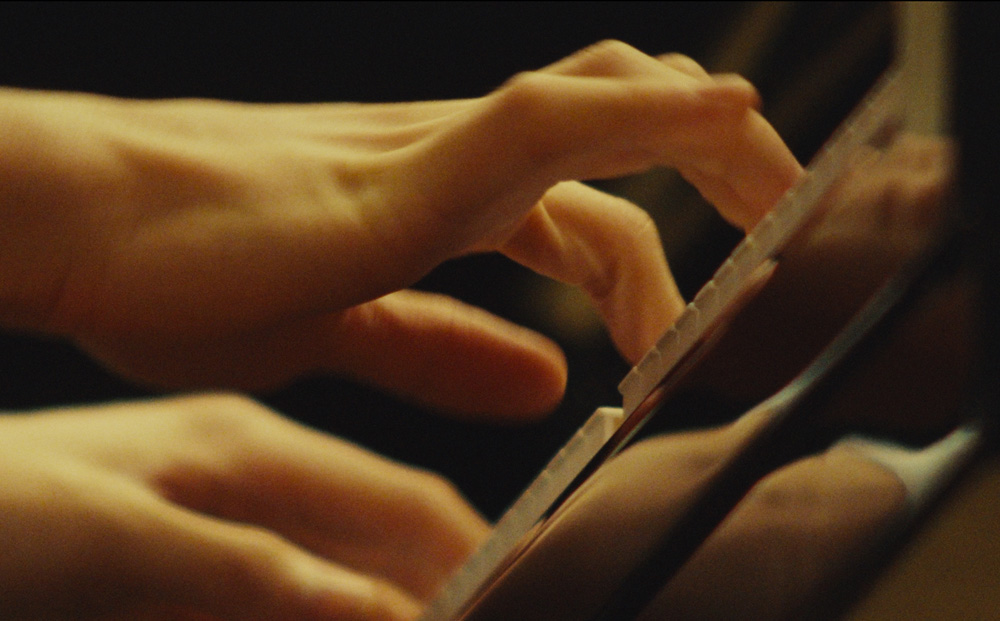

“I’d like to see sound one day,” Hidemi Okubo wonders aloud in “The Tuners,” contemplating whether its physical form might be triangular or round even though he spends his days honing their shape at least in how they hit the ear in his role fine-tuning pianos. The comments come shortly after director Pawel Chorzpa would seem to have answered his wish, exploring the guts of the instrument with the strings being pulled from keys that emerge sharply from the haze that their vibrations would create, yielding music that to the average person would register as pleasingly harmonious but any imperfection could come across as fingernails on a chalk board to someone as skilled as Okubo, who has reached the height of his profession when enlisted to work at the Chopin Competition in Warsaw, a bit like an Olympics for classical musicians when it only takes place every five years.
If Okubo has to be at the top of his game, so too does Chorzpa, who tucks into the corners of the National Philharmonic Concert Hall for the duration of the month-long competition where his eye rarely goes where most look – to the pianists, but rather the tuners that work tirelessly behind the scenes to achieve an ever-elusive perfect pitch. It’s a job that never has an entirely fulfilling answer when each environment has its own idiosyncrasies as do the pianos and all the time spent fussing over the sound is for a single performance that won’t be replicated again. The competition on stage isn’t the only place of contention when debate rages over whether tuners should be recognized as artists, with Chorzpa certainly providing evidence that they should when Okubo and fellow tuners Ortwin Moreau and Jaroslaw Bednarski show the same grace under pressure as the pianists as they ensure every note played is exactly as they’d want it to be. As Bendnarski asks at one point, it seems questionable in the first place that Chopin would even “want people to turn his work into a competition” at all, yet the tension-filled atmosphere shows just how high stakes the work is and how it takes so many to rise to the occasion to create a mellifluous experience.
“The Tuners” is now finds itself in competition itself as a contender for the Oscars in the Best Documentary Short category and with the film’s recent bow at DOC NYC and subsequent premiere online as a New York Times OpDoc, Chorzpa and his wife and producing partner Joanna spoke about how they themselves were able to hone in on a typically overlooked profession, finding the proper visual expression for sound and carving a 22-minute gem out of 360 hours of footage.
 How did this come about?
Joanna Chorzpa: Yeah, I’m a musicologist and a musician and worked for the Chopin competition for so many years, but it was surprising for me when I found one night when I was responsible for some audio recording that the piano tuners are still here. They entered the concert hall, wearing some slippers and walking through to listen. And for me, [it sounded like] nothing. They were listening to silence and I wondered “What are they doing?” But it was about the acoustics, something mystical was in it. And they started to prepare the piano for the pianist [specific to] this kind of hall — it’s really, really demanding and completely different to tune the piano for. Every hall is completely different and [there are] a lot of aspects [to consider], even from where the pianist came from, like someone who is living in a small village in Taiwan, for example, or Indonesia or Japan has a completely different way of thinking about the sound because they grew up in a different culture. They’re used to completely different melodies, like folk melodies, connected with the culture. So it’s different what they have in their head [about] what perfect pitch should be.
So it was really surprising for me that [the tuners] stayed, listening the sounds during the night and the whole day, waiting for feedback from the piano. And I came back to home to tell Pawel and he [said], “Oh my God, what are you talking about? Like they listen to the silence?” So he [said], “Let’s film this.” He found it a really interesting topic, like heroes in the shadows because working in documentaries specifically, there are so many heroes in shadows. It’s teamwork —editors, cinematographers, sound designers, but only the director and producer are in the spotlight. So he found that that was really interesting to see how creative and artistic [the tuners] are and no one knows, because even if you know about the companies, about Steinway and Yamaha, you don’t really know the names of the tuners. They’re really like a ghost.
As is noted at the end, this film coincided with a broader push to get the tuners recognized as artists. Did that have any impact on the way you wanted to tell the story?
Joanna Chorzpa: Yeah, it was a huge fight in Poland because for example, working in the Philharmonic, a tuner [was classified as] a technician, so you have the same salary as someone in wardrobe. But they had to finish school in the Academy of Music, so they really are like the artists and it was tough for them and it was a huge revolution, fighting for status of art because it’s also social security and if you are an artist, you can apply for something more. After so many years of effort, they received it and now they start to have an art school for tuning the piano so it’s more common. If we screen this film in Poland, they’re really surprised [with] people saying they deserve it since it’s totally an artistic thing.
What attracted you to the three tuners you follow?
Joanna Chorzpa: I knew them from my work. They are the main tuners for these companies and mostly they work separately, and we had a fourth also [with] Yamaha, but we included only three of them. It was really tough at the beginning because it was during the pandemic time, so there were strict rules about how many people could enter the hall. But also [we needed to limit] all the video equipment because they have to work with silence. So when mics and cameras enter into this, even when they’re not really noisy, it would interrupt them, so we filmed almost 41 days, day and night so [we didn’t interfere] and it felt like it was maybe three times more.
Pawel Chorzpa: We have 360 hours footage.
Joanna Chorzpa: Yeah, it was quite a lot. It was really difficult to catch everything, but every day we were closer and even at the end, when it was the most stressful to situation for all of the pianists and the tuners Pawel put the camera in the piano, so it was like they really trusted us.
Pawel Chorzpa: After maybe 10 days, we’d go really close with the camera, but [realized] we must be invisible in [capturing the] sound and we put the camera [inside] the piano. When I filmed this monumental finger to the piano key [for a key scene in the film], the lens I used for that [is typically used for] endoscopy. I was a couple of millimeters from the situation [with the camera]. I was really close sometimes. But they forgot about me. They were really focused on their job.
Is it true you were taking the lens off the camera at times to get that abstract look of expressing the sound?
Pawel Chorzpa: Very often, we’d take the lens off the gate to be really close and [capture] macro details. I use 500mm mirror lens, a very old Russian one and sometimes I was 20 centimeter [away], very far from a camera gate. I take this lens in the hand and sometimes change the optical line. Sometimes I move the lens to the side. We used four hands to do that because we use this camera in one hand in space and the second was a lens in the space, not in the camera gate, and we make a swing and shift and we could be very close [to the subjects] and we have some unfocused part [because] we’re focusing by our hands – we didn’t use the focal swing – but we’re changing the space between camera gate and the lens to change the focus. In the third part, we use these diopters and we don’t have one optical line in these diopters, but we take a image from out of our frame. It’s complicated and when we move this diopter, we changed the place of part of the image and we mixed two images together sometimes because we use this diopter.
Because we had lots of time — 40 days — and sometimes our protagonists sit and do some crazy stuff with the piano, so we tested new things to get really close. For example, we used a glass bowl for that you can buy at a candy shop.
Joanna Chorzpa: Just like they [do] crazy things for preparation of the piano, [we did] for preparation of camera.
When you compiled 360 hours of footage for about 22 minutes, was the core of what you wanted evident?
Pawel Chorzpa: It was really, really hard because after our first version, we were really lost.
Joanna Chorzpa: Yeah, editing took more than two years because Pawel had to watch [all the footage] three times, and watching this material once, it’s more than four months. And the editors watched twice and then you have to edit all this to have some rough cut and then we had six months to reflect.
Pawel Chorzpa: We had moment of crisis when we tried to figure out how to do that because when you have so much material, you must catch the one very important thing. My editors gave me one or two months to figure it out because we started to edit and after that, [we all] said, “Okay, I think in the footage, we have something much more,” and they left me [alone] in editing room and that was very good [to have a] break [from the] editors create a structure of the film.
What’s it been like to share with audiences?
Joanna Chorzpa: We are so excited. It’s really like a dream comes true. It’s been such a crazy time because I gave a birth to my third child and [we attended] three festivals — Krakow Film Festival, Short Shorts in [Japan] and Balinale [in Indonesia] and we like got three qualifying awards in the same week, and I had my baby in my hands. So we were surprised and so grateful that we can take a part in this beautiful journey. I have to thank the Polish Film Institute for supporting us because we couldn’t be here in the United States [now] without their support and all our co-producers and OpDocs who support us so much, and all the feedback from the audience and the interest that we’ve received, even in our Instagram, this is so crazy. Pawel also presented this film at IDFA last week and more than 10 piano tuners came for the screening [which was] so surprising and [made us] so happy. So we are really grateful for the opportunity.
“The Tuners” is now available to stream here on The New York Times.