



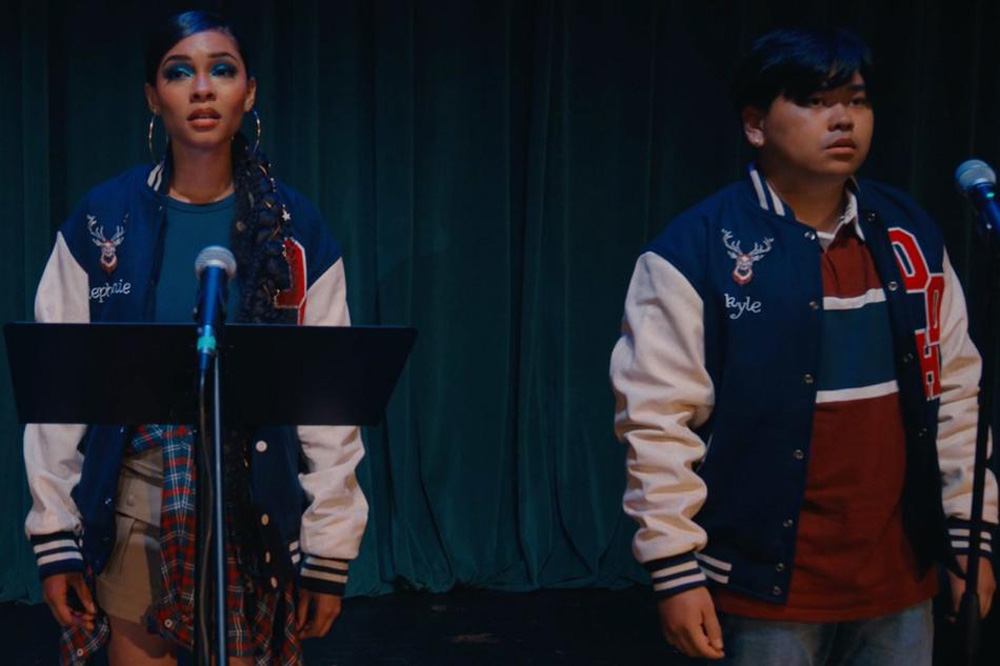

Mr. K (Zach Kozlov) has an unusual set-up for his class at Deer River High School in “Dead Deer High,” sitting outside the room he used to teach in where his students still sit. He can’t bring himself to go in himself, months after a tragic shooting at the school, but the compromise he’s made has been accepted by his class who are still processing the trauma themselves and as he stands in the open air, it has a way of wafting in when he encourages participation in an upcoming poetry slam where the teens can turn all the turbulent emotions that are roiling around inside of them into verse.
That’s why it isn’t just the Pacific Northwest setting of Jo Rochelle’s directorial debut, penned by her husband Joshua Roark, feels so rejuvenating, centering on how three students — Stephanie (Kyla Brown), Kyle (Christian Cruz) and JT (Holden Goyette) — find their way back to a sense of normal with the aid of their beloved teacher Mr. K, who may be feeling the pain even more heavily than they do as they reluctantly enter the Wordquake National Competition. It won’t matter if they succeed on stage, but merely getting their in the first place when their goal is to honor their fallen friend Vok and the obstacles to competing don’t involve travel logistics but navigating all the tricky feelings that come with expressing themselves when essentially they’ve been stunned into silence. Yet encouragement to use their voice can be found all around, from the chorus that practices next to their class to family conversations over dinner where misguided perspectives on what really happened without actually being there can lead to speaking up.
Once the words start to flow out of Stephanie, Kyle and JT, they can’t be stopped and Rochelle lets the film flow with a similar energy, making it difficult to resist as it tackles a tough subject and as the film has made an impression with its premiere this week at SXSW, the director, Roark and Kozlow graciously took the time out to talk about putting together the drama, the inspiration they took from their own experiences in the classroom as teachers and recreating a high school on screen that really felt like one.
How did this take shape?
Joshua Roark: The movie actually started as a play that I wrote in the pandemic. Jo and I met as middle school teachers in Mississippi before moving out to L.A. I teach adults now at the university and what came to me first was the young people reciting their poetry. [The line in the film] “I point this poem at you, I pull the trigger,” that was the first thing that was in my head and then after that, the [image of a] teacher stuck outside the classroom window. The story went quickly from there.
Jo, could you see the cinema in this story when it originally was a stage play?
Jo Rochelle: I mean, it was great to be married to the writer, so I was seeing him go through the process of adapting it to a screenplay. He would write 25 pages at a time. and show it to me and I would read it and give notes. We were always really aligned. We both love “Dead Poets Society.” That was a movie that we would watch together when we were dating and we love “Short Term 12,” which was another inspiration and we were both able to experience them at the same time, so when it came to directing it, we both had the same vision.
Zack, how did you get interested in this?
Zack Kozlow: I work with Josh in our non-film careers and Josh told me he’d been working on the script since maybe 2021, and he told me that he used me as a basis for the character at the time. He shared [the script] with me in 2023 and I would have said “yes” if it was not this beautiful, amazing, incredible script, but it was, and it was the kind of part that I would dream to play. I was on board from the beginning, but when he sent me the script, it was like add some exclamation points to that on board. .
Joshua Roark: Yeah, Zach and I have known each other for a long time now and I know how talented he is, so when I was [adapting] it from a play into a screenplay, it was written for Zach to play Jack, our teacher, from the beginning.
It’s interesting to hear the role was written for Zack. What was it like to play?
Zack Kozlow: Yeah, it’s a role with a lot of inner turmoil and grasping at the poetry of it, which is very rare for an actor to have this deep inner life and then this poetic way of expressing it, so it was just about finding what those things were in me that could connect to to Jack so that when we were doing our super-fast, three-week shoot, we had three takes to do the scene and I knew how to access those deep places that Jack lives in without pausing the shoot for an hour. So it was just a lot of homework and then learning the poetry and crossing my fingers.
The scene that was really striking to me that didn’t involve poetry was when Mr. K has to come home to a dinner with his extended family and sit there as a debate rages on about school safety. That had to have taken a while to pull off, given the number of characters in it.
Jo Rochelle: That was a great day. We had to wait for a while because we needed it to be nighttime, but there were so many windows in the house and we had to cover them all. I remember lighting took longer than we thought and we had a lot of coverage to get because of all the people around the dinner table. But that is one of my favorite scenes in the film.
Joshua Roark: We didn’t realize that in Seattle in the summer, the sun doesn’t set until after 9 pm, so we changed some things on set. But I remember Jo asking for that scene in the script when I was writing it, just really wanting a fun family dinner scene, really inspired by that “Office” dinner party episode because we love an awkward dinner scene.
Zack Kozlow: Yeah, and I had no room for error in that scene because I was acting right next to my wife, who was playing my girlfriend in the movie, and I was not going to mess up her takes. So I was always on. There was no there was no chance to mess that one up. That was important to me.
Jo Rochelle: Yeah, and she had a lot of lines that day. [laughs]
How’d you find your students for this?
Jo Rochelle: Our leads are from Seattle area and from Portland and we worked with Lana [Veenker] and Eryn [Goodman], who are amazing casting directors who helped us find a lot of talent who were based in the Pacific Northwest.
Joshua Roark: Yeah, and [these actors] are just so talented. When we talk about the poetry, I had it in my head as I was writing, but they just brought it to life like beyond what I could imagine. They’re so good.
Jo Rochelle: Yeah, they were awesome to work with and I feel like they brought a piece of themselves to it. I remember showing them real spoken word poetry competitions and there’s a documentary that Josh and I watched before we were dating, when we’re just friends in Teach for America, called “Louder Than a Bomb” about this Chicago slam poetry competition and I showed clips of that to the people who were playing the students. Then they just brought a lot of themselves to it, like their own rhythm to doing the poetry and I just admire them so much. They did such a great job.
What was it like to incorporate poetry into the script?
Joshua Roark: It’s such a pleasure because I’m a poet first and foremost. The play version and even the original versions of the screenplay had a lot more poetry in it and it was really interesting to find that right amount of balance, but writing from the characters’ point of view was just so much fun and what I’m most excited for is people to get to enjoy poetry in a way they don’t usually in film.
It really felt like a working school you were entering into. What it was like to set up a production where you can drift in and out of classrooms?
Jo Rochelle: It’s funny. We cobbled together a bunch of different locations to make it feel like a working high school. We worked with Olympic College and finding a classroom where there’s a window where a teacher can sit outside, but all the students can be inside and can face the window was probably the toughest location to find because it needed to be dynamic and to go along with what the movie’s asking of it, so we were looking at windows, like can Zach fit through these windows? It was hard to find the right classroom. We really worked hard.
Joshua Roark: So many times that glass around the window shook as Zach dove through it and it was scary on set when when the whole glass wall was shaking and banging around, but it turned out really well.
It was fascinating to learn that most of the behind-the-scenes crew actually had teaching experience. Did it actually feel like it had an effect on the final product?
Jo Rochelle: Tangier Clarke, our editor is in the classroom right now, teaching his high school students and I think it did affect how we looked at the movie in post because he came to it with fresh eyes. He wasn’t on set with us. So he saw the whole film, assembled it. and put his touch of well, this is what a classroom feels like for him so maybe we’re talking to the sound team and we’re going to get a little bit more noise because it’s never quite silent in a classroom – Things like that that are really realistic. I think that it adds that touch to it.
Joshua Roark: Also, when we were putting the cast together, we really wanted [actual] young people filling these roles and that comes through with the edit and the production, just an adoration for what young people are and what they’re capable of.
The score is a really wonderful part of this throughout and you have a lot of a cappella or choral music that creates this idea of voices breaking through. Was that in mind from the start?
Jo Rochelle: I don’t think it was immediate, but then when we knew I was going to direct it, I’m in a choir, the Santa Monica Chorus and I love choir music. Because we knew we were going to Seattle, I was looking up [choirs there and found the] Seattle Girls Choir and they were singing this song Its Motion Keeps by Caroline Shaw, which is in our film [now]. It’s just so moving and it felt like the movie.
Joshua Roark: Right. Then quickly it was like how do we get this threaded so that we see young people singing in the film too, so there were some edits to the script, but it made sense and it’s entirely Jo’s vision for the project of the young people’s voices present throughout in that choral music.
Jo Rochelle: Yeah, when we landed in Bremerton, Washington, I think the very first thing we did was go to the high school and watch a choir performance and then I went up to the choir teacher and said, “Could we maybe collaborate and have your students in the film?” Eighteen or 19 students signed up to do it and then came back to be background in different scenes, so all of a sudden, Mr. K’s class has all these students in it. Most of those are choir girls and I love them so much. It was just really fun to work with them and to have their voices in the movie.
It came together so beautifully. Even though the premiere is still to come, what’s it like getting to this point with the film and getting ready to share it with audiences?
Zack Kozlow: It feels like something that we’ve been dreaming about with this movie since before we ever even thought we could make it.
Jo Rochelle: Yeah, dreams come true.
Joshua Roark: There’s just so much joy. And that’s what we really want people to take away from the film is just love and joy and discovering poetry. We’re so excited.
“Dead Deer High” will screen at SXSW on March 18th at 11:30 am at the Alamo Lamar 3.