




There’s something strangely appropriate about the fact that the title of “Mineshaft: The Cruising Murders” is vaguely misleading, conjuring ideas of a lurid true crime documentary when that’s hardly what director Jeffrey Schwarz is interested in. It is, as advertised about the murder of Addison Verrill, the film critic for Variety whose death at the hands of Paul Bateson, a day player on William Friedkin’s “The Exorcist,” led the director to explore New York’s underground gay scene where the two met each other and was beset by a series of homicides in the late 1970s for the 1980 film “Cruising.” Yet anyone familiar with Schwarz, who has long pulled back the curtain on a hidden history of Hollywood with its many gay icons in biodocs of Divine, Tab Hunter and “Grease” producer Allan Carr, could suspect that “Mineshaft” might have more on its mind than your average “Dateline” episode and while the film gives ample space to consider the factors that led to Verrill’s tragic death, it is as much if not more about how a further injustice was done to his memory as Friedkin proceeded to make the Al Pacino thriller against the wishes of the gay community that feared misrepresentation and that equating violence with homosexuality would only add to the retaliation against them as they led already precarious lives.
As Bob Geary, Verrill’s former partner before his death, tells Schwarz, it’s actually the first time in the 42 years since the murder that he’s been approached by anyone wanted to tell Verrill’s story “on a sympathetic level,” and although it’s perhaps been for the best that much written about “Cruising,” a box office bomb, often omitted its origin story entirely, “Mineshaft” immediately makes up for the mistake it appears Friedkin made when seeing the gay scene as an interesting backdrop for his follow-up to “Sorcerer,” instead putting the community first. Geary, a member of the entertainment industry as well working in the law, is afforded ample time upfront to describe his romance with Verrill, which could feel glamorous as the two attended movie premieres because his partner’s job as well as entirely different than anything he’d experienced before in other ways when the thought of meeting someone who could be smart and funny in addition to any physical attraction was unthinkable when so few were out at the time.
Schwarz does a good job of outlining the climate of fear that led to anonymous sexual hookups and East Village clubs where fantasies could be indulged without concern about later identification, building a habit for a generation of gay men that might not be given up even if the world was becoming incrementally more accepting of them as couples and as Geary describes how it became an issue in his relationship with Verrill, who would sneak off in the middle of the night, the nuanced depiction of men seeking satisfaction for their pent-up desires stands in stark contrast to the brutal world depicted by Friedkin, who plied a set full of male pornstars with alcohol and coke to grind away behind Pacino. If anything, Richard Goldstein, a writer with the Village Voice at the time, says the underground scene “was like a Fellini movie, interesting and dramatic” as he remembers the surreal sight of anonymous sex that was happening in the back of big rigs left open by the docks outside the clubs for that explicit purpose and Schwarz is able to actively rebut the reductive narrative that Friedkin chose with a reality that’s more compelling in its details.
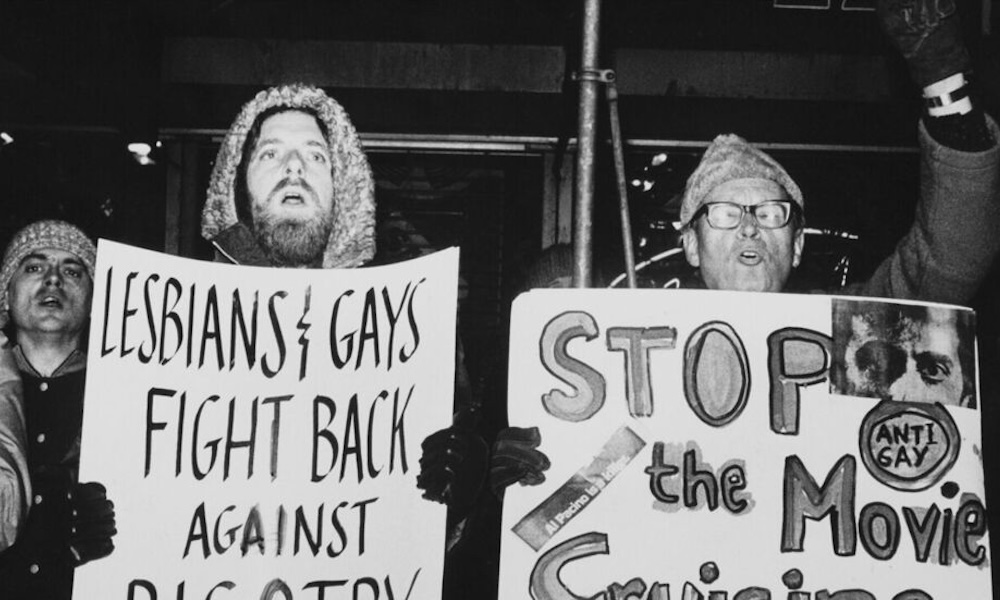
That would be enough to make “Mineshaft” worthwhile, but then there’s a rollicking recounting of the tumultuous making of “Cruising,” which some say could’ve been doomed from a script stage when it didn’t involve anyone from the gay community, but definitely done for when that script was leaked to interested journalists and local officials that encouraged a public spectacle with protests at all the shooting locations. Called “the most exciting thing happening the summer of 1979 in New York” by one activist, footage of the preemptive revolt in the streets against the film is bolstered with amusing sequences about its ridiculous dialogue and broad characterizations. However, Schwarz doesn’t dismiss those that have become fans of the film as its reputation has grown in the decades since its disastrous release (in addition to bad buzz, Pacino refused to do publicity for the film after it was recut late in the game), finding beyond those that have enjoyed it as camp, it remains a rare piece of evidence of that era even happening when few gay stories made it onto the screen, no matter how problematic it was. While making the point that with more and more films around it, the burden of being the only widely seen reference for gay life at that time “Cruising” could be better appreciated as simply one piece of a larger puzzle, context really is everything in “Mineshaft,” which gives a fuller picture of a time, a place and the people.
“Mineshaft: The Cruising Murders” will screen again at Tribeca on June 7th at 8:45 pm at the AMC 19th St. East 6 and June 9th at 9 pm at the Village East.