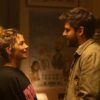


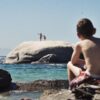
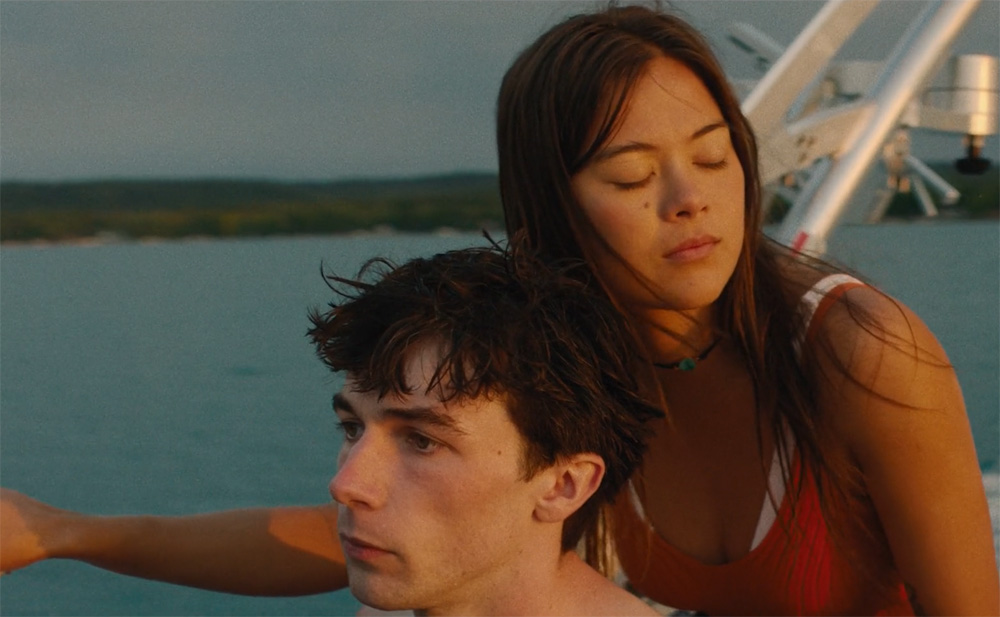

“This place doesn’t even exist you’re here,” someone says of the lakeside retreat in “An Autumn Summer” where a group of teenagers have retired to spend their final few months together before going off their separate ways. The sunset that can be counted on every night to cast a glow over the water on Michigan’s Macinac Island becomes a beautiful reflection in another way in Jared Isaac’s bittersweet drama in which Cody (Lukita Maxwell), Kevin (Mark McKenna), Jared (Jun Yu) and Martin (Julian Bass) ride bikes around the winding roads of the remote getaway and go for a swim when the moment seems right, not concerning themselves with time when other than Kevin’s aunt Marylou (Louise Barnes) and uncle Steve (Tony Horton), they have no other adults to answer to and even the ones around are quite permissive. Still, there’s a frustrating awareness that the clock is running out as Cody and Kevin face potentially the last days of their high school-spanning romance and all four consider spend some of their idle time what life will look like when they’ve always had one another within a stone’s throw.
The crisis is as old as time, but it feels as crisply conveyed as the sea air in Isaac’s feature debut, which as filmed by “Come See Me in the Good Light” cinematographer Brandon Somerhalder in a rare foray into fiction feels as relaxed as a weekend in late August. Casting a foursome that has an effortless ease about them as lifelong friends, the director suggests that the end of a relationship may not have to be all that dramatic to be really affecting when it appears the beginning of a slow unwinding that all the characters may look back on with some sadness is potentially afoot and as the teens wonder if all they have to look forward to is a farmer’s market on the weekend with a few extra vendors showing up unexpected as Steve and Marylou do, their restlessness with the familiar is also kicking up. Yet for all the anxiety running just beneath the surface, “An Autumn Summer” has turned every stop on its festival run from its premiere at Heartland to Miami and Woods Hole into a warm excursion and ahead of the director’s hometown premiere at Chicago’s Music Box Theater tonight with a Q & A moderated by fellow Windy City native Joe Swanberg – in advance of further theatrical travels around the country before a VOD release in June, he kindly took a few questions from us about the personal inspiration behind the film, working with such cinematic natural surroundings and feeding off the energy of his young ensemble of actors.
 You come from an acting background. Did you always have the directing bug or did it grow over the years?
I don’t know, but now the bug has definitely bitten because every artist is different, but something I’ve always loved is getting people together, so doing it for an artistic endeavor just [seemed] like a natural progression. And we had so much fun. We were on location living together for a month, so getting to make that happen, it felt like being back on the black box acting stages in Chicago and being a part of just like an ensemble making a piece of making a piece of art and just throwing it all out there.
What was the spark for “An Autumn Summer”?
It’s a true story based on summers that I spent in northern Michigan with my best friend Kevin and his family. They’ve been going up there for almost 40 years now and I was invited first to go up at the age of 12 and then Kevin brought his girlfriend Cody and he brought our other best friend Martin. And that summer spent up there became one the most sacred little traditions of my life. I’ve always felt that feeling up there and that tradition, being with those people, is a time of healing and renewal and overwhelming goodness and I’ve always wanted to take that feeling with me and bottle it up in some way. I always took it with me wherever I was just living my life and it’s beautiful to reflect on.
I actually started with the idea that anytime I wanted this feeling, it was right here in this script. You didn’t have to live a tradition for 20-plus years. It was right here in these pages and the first person I sent the script too was our incredible cinematographer, my close friend Brandon Somerhalder. When he felt that there was something there, that really validated the accessibility of something so specific to me, which I think is something that we can all relate to as storytellers. Oftentimes, the more specific anything can be about someone else’s experience, I find myself more easily able to access that story, so it was really great to see that a friend who didn’t know any of these people who are very important to me could relate because I didn’t know if anyone else would care. But when it reminded him of his life, I really felt like, “Okay, these pages at least provide that feeling. Now if we could put it on screen, we’ve got something here.” The first draft was written in COVID summer, and I didn’t know we were going to get to go up there that summer, so it was all derived out of that.
Was this actually shot in the house where you had this experience yourself or just the area?
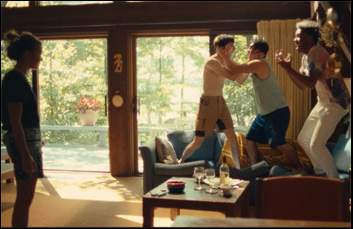
I’m from the city of Chicago, so honoring the landscape up there and making it feel mystical was a core feature of the film. When we go up our tradition, we rent cabins that are very close to that A-frame house [in the film], which is such a beautiful place. That fell into our laps. I was up there a couple summers before doing a location scout for a month, and my mom came up and was like, “Oh, there’s this little house down the road that’s available for rent. You should rent it out next year for when you film.” And frankly, this was such a gem of moviemaking because the cabins we stay in are lovely, but aesthetically that A-frame house is so much more representative visually of the feeling we have that it felt like another thing that really was just like God blessing us and elevated the film with its production value.
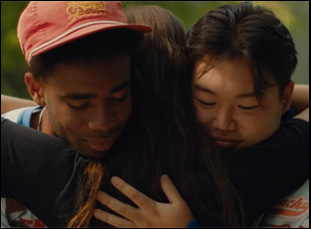 The way light enters the house and is used in general, could you design the shoot around the natural ambiance?
All credit goes to our cinematographer Brandon Somerhalder, a future Academy Award winner for a reason. We had discussed how we wanted the light to feel from the outset and then we did just work with what nature gave us. We had beautiful weather and we made sure to shoot once the sun was past its peak and really capture those gentle tones. The interiors, I wanted it to feel like opening up the old pages of a French book [where you could] soak in those tungstens. And then outside, we worked with the majestic landscape that we’ve got, and she did not disappoint.
What was it like to find the right cast for this?
It was an absolute delight and a magic trick to get to watch them do what they did every single day. We had a pretty solid script that provided all the backbone necessary for them to build the deep, rich inner life of these characters, but again, I felt like I was like back in Chicago being a part of these theater troupes with this ensemble cast and watching them be electric with each other every single day. We wanted it to be a living, breathing organism where we were really listening to what’s happening on the day and letting that inform the script. There were definitely rewrites every single day and I would say like Jun Yu, who plays the 18-year-old me [Jared] is just comedy gold. We just kept feeding him lines and I actually noticed Jun Yu and Tony Horton, the P90X fitness icon who went out on a limb to to act in this movie and did such beautiful work, I loved watching them do their improvs every day.
Really the essence of who our actors are melded with the roles and vice versa and it was a seamless, really beautiful thing to watch. There were all these beautiful little gems along the way that absolutely found their way into the film. My most favorite little micro scene was completely improved between Mark McKenna and Tony Horton. And there was so much improv made it into the film, all of which was better than anything I could have ever come up. It was a joy to get to watch them do what they did every single day. I can’t speak for any anybody else, but I’ve never slept better than the month that we were up there filming.
You’re the only filmmaker to ever tell me that.
I didn’t sleep well before and I haven’t slept great since, but while we were up there doing the thing, I felt complete peace. Everybody was so talented — Lukita, Mark, June, Julian, Brandon, our whole crew. Everybody just brought their A-game every single day, and we were so excited to be having this this summer camp together.
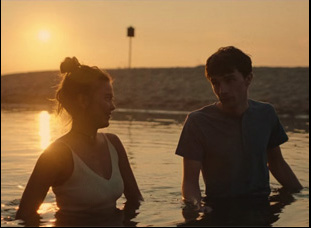 A scene I had to ask about because I imagine it had to be pretty precise was there’s a scene at dawn where the sun is rising and Kevin and Cody, played by Mark McKenna and Lukita Maxwell respectively, are wading into deeper waters quite literally as they talk about their relationship and the sea level starts rising on them. What was it like working with the conditions?
That was day four of our shoot and I think we did seven takes of that. We used the fourth and it was always designed to be in a oner. We’ve been on this whirlwind summer for a while and now it’s like, “Let’s take a deep breath. We’ve gotten past the summer rush. Let’s take a second.” And wading into those waters as the sun’s behind them and they’re in Lake Michigan with an ocean behind them, it was such a beautiful celebration after each one of those takes. The whole cast and crew was clapping for our cast, just really reveling in how talented they are and Brandon’s work that day, he really wanted to be floating on top of the water, so we had the camera strapped to an outer tube and Brandon was in the water with them for that five-and-a- half-minute one take shot, which we were all super proud of.
From what I understand, you might’ve brought the environment into this in a way that might be less obvious, working on the film’s score. What was it like to incorporate the sounds of the environment into this?
Mehrnaz Mohabati and Armin Karbaf are sound designers. They worked on “F1” this year and they do big budget things and small indie films, so I was very grateful to our our editor, Daniela Ovi for connecting us with them and then our composer Hayes Bradley also just knocked it out of the park. We really got into the weeds and I wanted those cicadas to be singing through through even the house. And our sound designers were like, “Cicadas in the house?” And I’m like, “Trust me on this, if you’ve been to the Midwest in summer, you feel all that. Every single air particle is permeated with nature and I wanted like I wanted that all to be flowing throughout the film as the landscape was a massive part of things. I wanted everybody to feel that. And Hayes really swirls around the ethereal and the magical with a dark undertone to it. There’s both a magic and a mystery in it, so I really felt that if we were able to combine that feeling with the golden element of youth and love that is an autumn summer, those two elements would come together and form something ethereal and a bit haunting, but also healing.
I listen to the score now just to enjoy it outside of the film. And as a first-time director, everybody else was so talented and experienced and gracious in allowing me to stumble through parts of the process and didn’t judge me for saying stupid things and really willing to to go to the deep end with me. And I think we came away with a really beautifully crafted film, very much including the sound design and the score.
 What’s it been like for you getting this out into the world so far?
I’m really excited to get it out there in a in a bigger way. It’s been a really, really lovely festival run where we’ve gotten to make new friends and memories. We’ve won awards along the way from acting, cinematography, sound design, production design, audience awards and directing, which has been lovely validation of all the hard work that everybody put forth and signifies the strength of of all the different artists that came on board. I’m also really excited for people to get a little bit of a sliver of of light. Millennials are making our coming-of-age movies now, so it’s that window of time where I think a lot of us are reflecting on that time in our lives. In 2010, there’s a sense of innocence and optimism that I’m hoping that people will enjoy and get a little bit of a little bit of healing would be nice — and a little bit of lighthearted love.
“An Autumn Summer” will have a special screening in Chicago at the Music Box Theatre on April 23rd at 7 pm.