



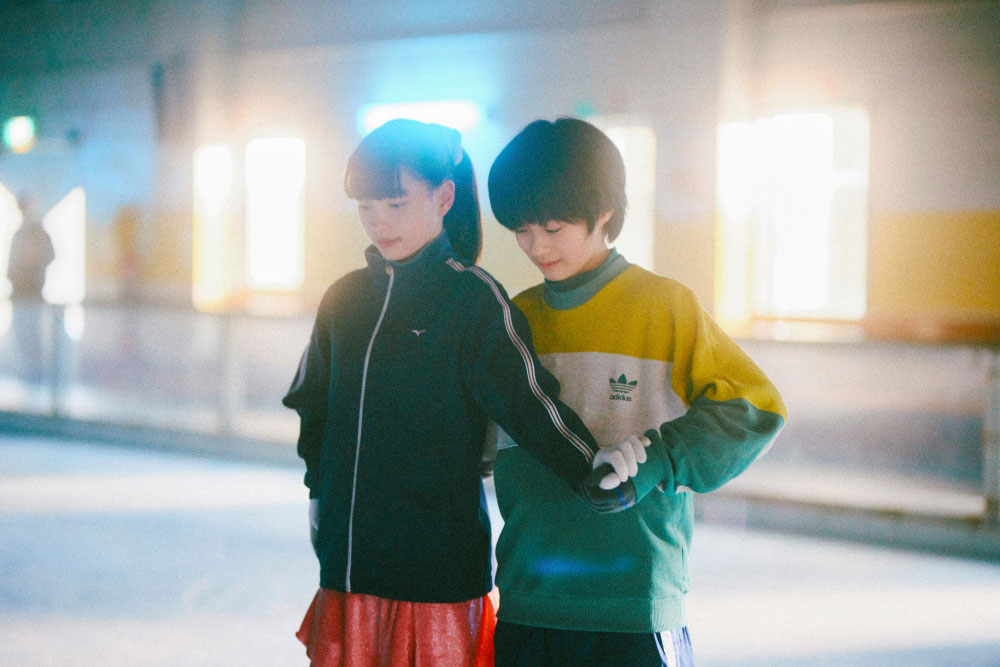

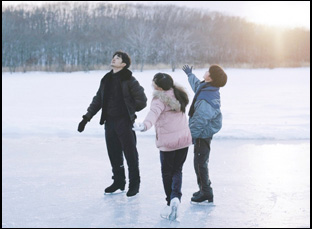
When the winter snow blankets the small Japanese town at the center of “My Sunshine,” the local ice rink can seem quite warm by comparison. It is where Takuya (Keitatsu Koshiyama), a young boy who has suffered through a number of different sports trying to find a right fit, learns to put his best foot forward after lacing up some skates after Arakawa (Sôsuke Ikematsu), a former professional skater-turned-coach, sees him struggling to gain his balance on the ice and thinks to pair him with another skater, the disciplined Sakura (Kiara Takanashi), who has remarkable technique from diligent training, but seems to be missing some passion. Elegance for the skaters arrives naturally after graceful way they come together as a trio, making up for one another’s shortcomings in a place where everyone knows each other so well, it’s hard to confide a feeling that something isn’t right personally and as Arakawa oversees a pair of skaters that are stronger as a duo, writer/director Hiroshi Okuyama shows he is one to watch as a filmmaker with the disarming drama.
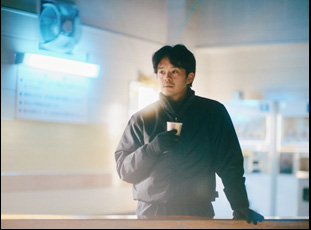
Starting out as a cinematographer before making his directorial debut “Jesus” in 2018, Okuyama proves he has as gentle a touch with performances as he does behind the camera, watching the young actors in front of lens flourish as if they’re experiencing the same growth as they’re expressing as part of their characters and his sensitive lens picks up the small moments of personal revelation you know they will take with them for the rest of their lives. Okuyama himself was inspired to write “My Sunshine” after hearing the song of the same name by the band Humbert Humbert, coupled with the charisma he knew Ikematsu could bring as the coach who becomes a matchmaker for Takuya and Sakura, and injects a little rock ’n’ roll both literally and figuratively into the compassionate coming-of-age tale where Arakawa himself has to find his footing in a new town where he has to have some concern about whether he’ll be accepted as he is and put his professional past behind him to start a new chapter.
Ever since “My Sunshine” debuted at Cannes last year, it’s brought joy to audiences around the world at stops in Sydney, Toronto, Busan and Stockholm, amongst other festivals, and now arriving on U.S. shores, Okuyama with the help of a translator, graciously spoke about expanding horizons with his latest film, how he leaves room in a production to find the character dynamics and the casting process that led him into every skating rink in Japan.
 You’ve said in other interviews that you were surprised how far your stories could reach with the experience of your first film. I wondered whether that contributed to wanting to set “My Sunshine” in a rural community.
As far as the rural setting for this film goes, perhaps I was thinking about that idea that films can reach very far and wide. But certainly with my first film, I hadn’t anticipated at all that it would show at so many film festivals and so many countries abroad. I was hoping that with this film as well, it would be something that would reach outside of Japan, but I certainly didn’t want to then think so hard about it that I was trying to depict a Japan that would appeal specifically to foreigners because I know that that can lead to mistakes. I knew that if I wanted to make a film that has broad appeal, you run the risk of having a much shallower film. I wanted to make sure that it is going to be a very domestic or local story and that it go as deep as possible. That’s how I landed on this memory. I also wanted to think about how to depict a story not through words, but through image. And I think that helps to create something that can be seen very widely.
How did you land on figure skating as a connective tissue?
I learned figure skating for seven years when I was a kid and I always had in mind that I wanted to make a film based on that experience. But the time I spent learning figure skating was very peaceful, and it wasn’t at all cinematic, so when I thought about how can I make a film that’s not just a recreation or restaging of my memories, I had to really think deeply for a year or two about how that can be translated into something that’s more interesting.
 It seems like you got there, particularly in how as you mentioned the image really is so expressive in its tenderness and warmth. What was it like getting that feeling visually?
When my [first] film was being screened at the Busan International Film Festival, I brought my project proposal [for “My Sunshine”] and I was pitching it to the film. And the company ARRI became very interested in the project and sponsored it, so being able to use their cameras, which are used for most of the films that are screened at Cannes or nominated for Academy Awards, I think that was a huge aspect of how I was able to achieve almost a film-like quality, even though we shot on digital.
We [also] lit the scenes in a way that’s unconventional in Japanese films. With the skating rink itself, there are 12 large windows on either side of the skating rink and out of all of them, I put in a big light bulb. And on the other side of the same 12 windows, I completely covered it in black, and the contrast is very clear. That allowed us to create a really interesting contrast because for the human eye, if it’s just bright, we don’t really register the light as a presence. But when we create that contrast, there needs to be a darkness for the light to come in. Then we’re finally able to really register the presence of that light. So I worked together with the lighting technician to make that quality of light.
It was incredible. Was it difficult to find young actors that not only could pull off the performance, but also be able to skate?
I thought it was going to be very difficult to find child actors who are able to do both and for Keisatsu Koshiyama, who plays Takuya, he is someone who is able to skate and can act. We met Keisatsu just on the second audition that we held, so it ended up being a very smooth process. But for Kiara Nakanishi, who plays Sakura, it took a very long time to find an actor like her and I felt very lucky to be able to cast her. That’s because with the child actors that are already part of a talent agency, there are very, very few that can skate, so we decided to try to go to figure skating rinks all over Japan and put up flyers saying that we’re filming a movie and we’re looking for the heroine for the film. About 100 children found the project through that. We auditioned them, but still couldn’t find the right actor. So I actually ended up having to go to these skating rinks and scout for the actor myself. And that’s how I was able to find Kiara.
 It’s interesting because I’ve heard that Sôsuke Ikematsu, who plays the coach, actually visited various skating rinks himself to learn how to skate and picked up things for the character. Did your own travels actually lead to anything that contributed to the story beyond finding your cast?
It was helpful, but I also realized the skating landscape has really changed since the time when I was a child when I was learning how to figure skate. When I was skating, boys were in the complete minority as far as people that were learning how to skate. But now, as you know, with the appearance of star skaters like Yuzuru Hanyu, it’s becoming a very cool sport for boys, so boys and girls are half and half in the rink. So I learned that I couldn’t skate figure skating in the current stage. That’s what made me realize that I wouldn’t be able to make a film that was set in a present-day skating rink environment because I didn’t feel like I knew enough about it, so it was a useful practice to make that decision to set the film in a period of the past.
When you put the actors together for the first time and start seeing their relationship dynamics, does it change your ideas about how they’ll interact on screen?
Yeah, there’s discoveries that happen with every scene that we shot, and part of that has to do with the fact that my scripts are not very detailed. There were producers, and even Ikematsu-san had commented on the fact that my scripts are a third of what a typical feature-length script should actually be and that is to create room for these discoveries as we’re on set trying to fill these scenes, seeing what the dynamic between the actors will be, so there were many, many discoveries.
 What it’s been like to share the film with audiences?
The reaction to the film has been different depending on where I’ve shown it, but also who I’ve shown it to, and I think that people have different interpretations of what is a good film, depending on what their values are, or what age they are even. But I think that a good film is one where 100 people watch it, and 100 people have different interpretations on it, so I feel like maybe I’m finally getting to a place where I’m able to make good films and it’s given me a lot of courage and hope.
“My Sunshine” opens on September 19th in New York at the Quad Cinema and September 26th in Los Angeles at the Laemmle NoHo 7 with additional cities and dates listed here.