

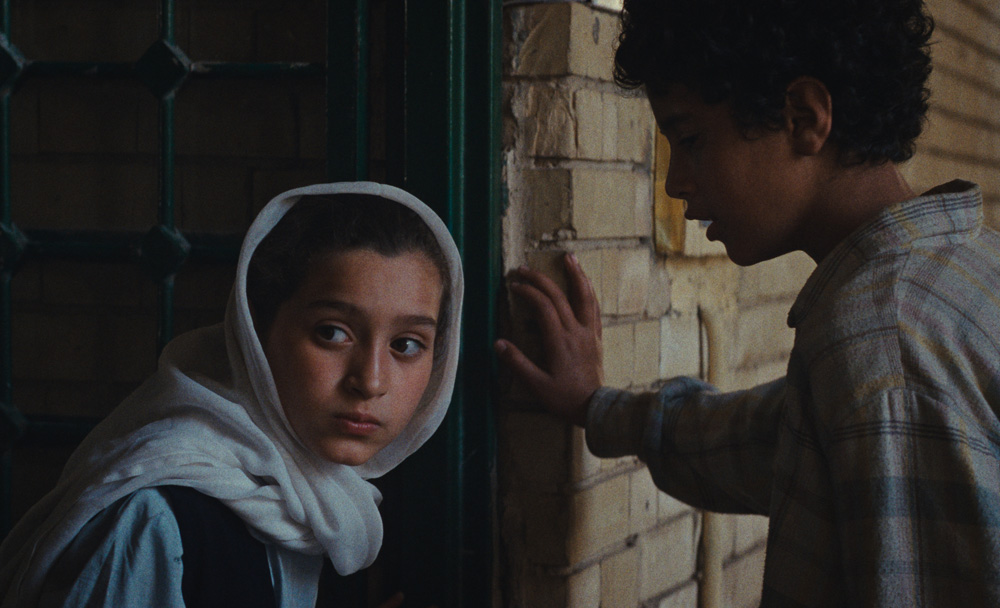

There are a few different ways to look at the daunting task ahead of Lamia (Baneen Ahmad Nayyef) in “The President’s Cake,” for whom a request from her teacher to bring a dessert to class might as well be asking her to fly to the moon and back. In 1990s Iraq where people live under the iron fist of Saddam Hussein, it could actually seem that way to those outside the country when Lamia is just as hard-pressed to find the flour and sugar required for such a task when the crippling sanctions that have been imposed by other nations have made the price of basic goods scarce and unaffordable, but while director Hasan Hadi, who was raised there himself during the time of great turbulence, doesn’t deny how cruel it is of Lamia’s teacher to make such a demand, he also sees in the nine-year-old girl both the innocence and fierce determination to make an rollicking adventure out of it, illuminating the perseverance of those that find a way to endure under an oppressive regime.
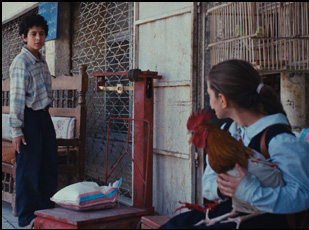
In following Lamia from the Red Sea where she resides with her grandmother (Waheed Thabet Khreibat) to the city in which she scours street markets and barren store shelves for ingredients, accompanied by her classmate Saeed (Sajad Mohamad Qasem) who faces the equally improbable chore of bringing fresh fruit to class in honor of Hussein’s birthday, the film shows a lively community where there may be danger lurking around the corner for the young girl without adult protection but also no shortage of people willing to come to her aid when for as much fear there is in the air, there’s also a collective resolve. Even without the rooster that also joins Lamia on her journey, the film tracks a wild day in which Lamia is just one person trying their best to survive in the face of limited options, but represents the future of a country that could easily fall into despair.
As for Hadi, he felt he had no other choice but to shoot “The President’s Cake” where it was set in Iraq despite knowing it would’ve been easier to mount as a production elsewhere, turning down offers to film in other countries that could’ve more easily raised the film’s budget and took casting calls to the streets to find nonprofessional actors to fill the key roles. The authenticity pays off with a local flavor that can’t be faked, finding tremendous beauty and vitality in a place often reduced to dust in other big screen treatments from abroad and drawing out touching performances from his young stars Nayyef and Qasem who can still see a world of possibilities in the face of the hopelessness around them. A bright light when it premiered at Cannes last year where Hadi won the Camera d’Or for his feature debut, the film now arrives in U.S. theaters and the director graciously took the time to talk about how he crafted a process as much as a final film that could be true to where he grew up and people he knew, finding out where less was more dramatically and his hopes that he won’t be the only one for long to tell stories about this particular time and place.
 Notably, this film chronicles a time in Iraqi history that has never been put on screen before from an Iraqi perspective, filmed in Iraq. How did you even know something like this could be possible?
If you’re not crazy enough when you start making a film to believe that it’s possible and it will be the most important film in history, then there is no point of jumping on the road and making this journey, so it’s a bit of delusional. You feel like this is such an important story and you actually hope that [feeling is] still true, and that’s why you take upon such a big challenge to make it a feature.
How did the actual story come about?
It’s a story inspired by childhood memories [where] every year our teacher would make this draw and pick the students responsible to bring different birthday items. One of those years, I was one of those students, but I was lucky enough because this teacher was not interested in [a gift] that was edible, so I was picked for flowers. But some of my friends were not that lucky, especially one that who was picked for the president’s birthday cake and wasn’t able to deliver that cake. Somehow he got expelled from the school and his [confidence] completely changed, so in a mix of the childhood memories [I had] with the questions or reflections you start to have looking back at your earlier years as an adult.
Did the geography of the region actually give shape to the story? You show off quite a bit of the country.
It was the tone that inspired the locations. When I say that, the film has a lot of fable-ism or magical realism, and what better place to convey that visually than marshes, or houses [that sit] on the water, people using boats as their transportation, almost like a Disney [film]. It’s also an image that I grew up with. When I was a child, I used to have these images of things from my country that were never transmitted to people [outside of Iraq]. I think people have a very specific idea about Iraq that is mostly shaped by news reports and headlines, but for me, it was important to show you an Iraq that I grew up in, that never made its way to the news and was reported on big news agencies, and to break that stereotype.
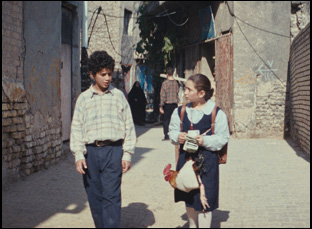 It feels like you do that with the very first frame of the film, shooting in such wide scope where there’s a real elegance to how you pan over to the harsh realities of the environment to capture how wondrous it can be as well. What was it like finding the right visual expression as a general style?
When I was discussing with my [director of photography] about the shooting style, we were talking about how we can enhance the tone through camera work, and also how can we minimize the editing because we wanted the authentic raw performances to unfold on screen with minimum editing, but at the same time how not to make it boring for the audience. You’re dealing with non-professional actors, so the idea of coverage [and creating a familiar camera language of having] a medium close-up, now close-up, now wide shot, was really something that requires a lot of training and they don’t have that, so we really try to create that through our cinematography style. It also gives the audience the feeling that they are becoming part of the journey, like they are eavesdropping on our characters and that style of cinematography we felt could convey all of these ideas.
From what I understand, you had workshops with the actors, but they weren’t exactly rehearsals. Are there ways the characters or the relationships change from seeing them interact with the material?
You start to change everything. It’s way more customized when you’re working with people who are not professional delivering the lines, so you need to start developing an ear to their musicality. Every dialogue has some musicality and you need to understand how they speak, what kind of language, what kind of accent, and the way they speak, so you revisit the dialogue and whole scenes with the hope to make life vivid on the screen. When you’re trying to make films, especially your first feature, you’re like, “Okay, there is this script that I have and I’m going to follow that.” but then suddenly at some point you have to know that real life is different. Locations are different, the actors that you’re getting are not exactly the same actor or the same character that you have on the paper, so then you understand that you need at some point to allow for the life to breathe into it and suddenly much more interesting things start to show up.
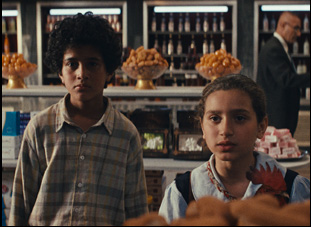 Because Benin is so wonderful in the film as Lamia, what sold you on her to carry this?
The first thing is just her presence and her eyes. Sometimes her look could have spoken more than what dialogue could have conveyed and she was very, very similar to the character I had on the paper. I received this 30-second video of her saying her name and some information about her school and I immediately felt that she is the person to carry this. We got in touch with the parents, but the parents were not y sold on the idea so much. It took a bit of convincing and conversation because they didn’t know what exactly we’re trying to do. But after we involved them in the process and made them part of the journey, eventually they were very supportive of the whole thing.
It blew my mind that the scene in the flea market where it’s quite chaotic with a lot of people involved was the first scene you shot. Did it feel like a trial by fire?
Honestly, it was one of the most fun days. It was so energetic because suddenly when you come to the set, I felt like “Okay, I’m really transported to my childhood now. I can see myself walking on the same street [I did when I was younger] and the images are so vivid. Everything is great.” So somehow even though it was very scary for me because it was the first day, and you want to really take on so little, so you just don’t jump in one time, somehow it worked out perfectly. We were very happy with the way that everything was starting and it told us that this film is going to be special. This film is being more than just a film, it’s being like a historical document of a certain period.
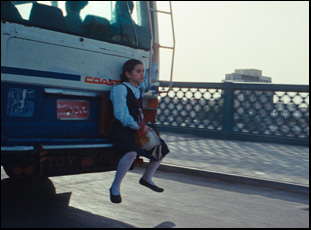 It’s so difficult to shoot a film in the sequence the story is told, but you’ve said you tried as much as possible. Did watching that unfold actually change anything in your mind as you moved forward?
It changed ideas within [certain] scenes because I had this liberty to improvise in the scene. I used it on some scenes and didn’t practice it on others because a scene plays out and then you feel either the characters are not real and you need to listen to your inner voice and trust it to fix the problem. There’s always going to be an issue to talk about and there’s always going to be a mistake that the director will commit, but the secret is to understand and trust your instincts and change that and correct the path, so that’s what I tried to achieve in this film.
During the shoot, there was one scene [where] I had lots of dialogue with Saeed and Lamia, like two or three pages, and it was for me emotionally important and the scene was supposed to be shot at night. But when I walked in, suddenly I found Saeed sleeping and Lamia just about to fall asleep, and I exchanged looks with my editor and with my DP and it was like, “Maybe the scene is that. There is no dialogue. You see them in silence.” And we shot it that way and I honestly was like, wow, three pages of dialogue, throw it away.
It’s quite accomplished for any film, but particularly a debut feature. What’s it been like to have this under you belt and share it with the world so far?
It’s such a thrilling journey and blessing. It’s very humbling to this almost universal [positive] reaction to the film and it’s very fulfilling because for a very local story [based on] very personal memories, to see that embraced by the audience around the world is surreal. It’s almost spiritual to feel like, “Okay, [this story] is important,” and it has encouraged lots of artists from Iraq to also come forward and start to share their own stories, their own memories, and raise their own voices. I think and I hope that within the next few months, it will be even more Iraqi stories that make it to the world stage of cinema.
“The President’s Cake” opens on February 6th in Los Angeles at the Laemmle Royal and New York at the Angelika Film Center and the AMC Empire 25.