


It is very easy to make a deal with the devil, as a shadowy figure known as The Ogre (Diego Doria) explains in “The Tree of Knowledge,” informing his assistant Leitao (Joao Arrais) that selling his soul wasn’t difficult when he considered it worthless to begin with. In exchange, he was granted broad powers by Satan to turn humans into animals, an ability he directs towards the tourists that seem to be ruining his ancestral home of Portugal where historic landmarks are being overcrowded and trampled by looky-lous that can appear to have the manners of feral creatures before the Ogre can even cast his spell. There is a question of who actually is doing the devil’s bidding in Eugène Green’s witty present-day fantasy when The Ogre has a point about those encroaching on his turf and driving up the cost of living for all around, yet it takes a young man named Gaspar (Rui Pedro Silva) to reconnect with his own Portuguese roots to gain clarity on what could possibly calm down tensions in a turbulent time.
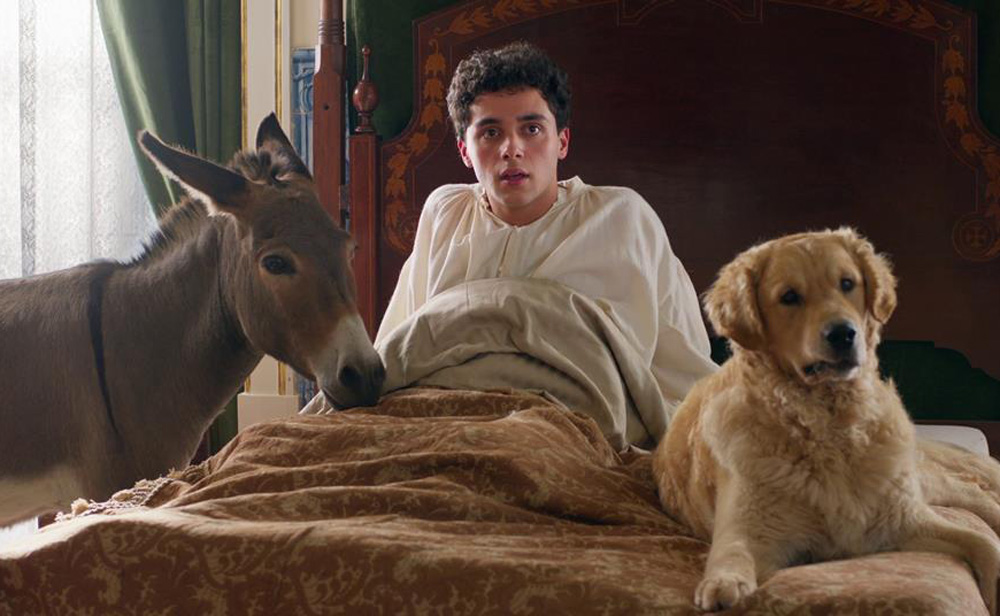
Green, who has built a signature style in films such as “La Spaienza” and “The Son of Joseph” that marries a droll sense of humor with a deceptively intense style of performance in which actors are often obliged to speak directly to camera, finds plenty to run with in the devil’s playground he envisions where Gaspar is nudged out of apathy by his mother who wants him to find a summer job and he is led to Lisbon where he nearly falls under the Ogre’s spell. He retains his humanity, but he’s befriended by a donkey and a dog that weren’t so lucky and the trio end up finding their way to a dilapidated palace still inhabited by the spirit of Queen Maria I (Ana Moreira) where he can hide out from the Ogre and catch up on some history of the place as it starts to come alive in front of his eyes. When Gaspar is chased by one mythical creature and led to consort with another in a friendly witch he turns to for help, the film clearly isn’t operating in reality, yet Green reminds of the magic to be found in our surroundings that one can easily lose sight of as it’s muddied by gentrification and other issues raised by a modern economy.
The endearingly off-beat film offers a definite change of pace for audiences at Fantastic Fest where it made its premiere this week, but locals will find its plot eerily similar to what’s occurring in Austin in the moment as is happening in urban centers around the world that have had to worry about its homegrown charm being commodified to the point of no longer being recognizable to residents and as Green was on his way to town, the director spoke about how the disappearance of the place he knew so well from his youth became the foundation to create his latest film, working with actors of both the human and animal varieties and how he achieves visual effects that are truly special.
How did this come about?
The story came to me in 2017 when I was on a shoot in Lisbon for the short film “How Fernando Pessoa Salvou Saved Portugal.” I was very shocked by the changes in Lisbon because of mass tourism because I knew the city before the great wave. One evening I was alone and I was in the little garden that you see in the film where Gaspar sees the Tevez River for the first time and where he’s kidnapped [by the Ogre] and the idea came to me of an adolescent boy who runs away from home and who is kidnapped by an ogre who has the capacity to change people into animals. The rest of it just came writing. Writing scripts is rather easy for me. What is difficult afterwards is finding the funding to be able to shoot them.
I’m glad that you did. Were there certain locations that you had in mind that you could build the story around?
Yes. In Lisbon, for example, there are certain places like that little garden or the Miradouro Da Senhora Do Monte with the young people you see at the end with the great view of Lisbon behind them. That’s a place where I, when I first came to Lisbon, I always stayed in a hotel, which is just next to that Mirador and it used to be very calm and there was no one there. It’s the most magnificent view of Lisbon from there. It’s as if you’re looking at a map. You see the whole city before you. And now you see how it is when it’s filmed at the end with the tuk-tuks and the masses of tourists and the souvenirs and all those horrors. So those two places were in my mind.
Also, while I was writing the script, I took a holiday in a national park in the north of Portugal, where the village of Soaju is, where there were those espiguieiros, those green [buildings] made of granite, and we shot them like tombs with a cross on them. I was very impressed by that, so I wrote that scene while I was there and we were able to shoot the [entire] film [within] Lisbon, because the palace was just 45 minutes from Lisbon, so at first [someone on the] production said, “Can’t you find espiguieros near Lisbon?” But those are unique. They’re just in that village and another village near it, and they’re less spectacular [elsewhere] because they’re less high. So that was the only time that we left Lisbon for one night to be able to film that place. But the places are very important. They have a spiritual charge.
What sold you on Rui to play Gaspar?
I did a lot of hunting to find a young actor for that role. The other actors I chose because I knew their work, but I found him and I always look for some interiority, and he has a gaze where the entire interiority passes through the gaze. He’s very young, so he hasn’t read a lot of books, but he’s very fine and intelligent and as soon as I said something to him, even something deep and profound, he understood immediately. I also like [what he brought] physically and his voice. The first time I saw him in a video, I was almost sure that it would be him, and we still continued to do a lot of auditions, and at the end, I was sure that it was him.
There’s a very specific acting style that you’ve employed on all your films where there’s a lot of direct address to camera and it has the same intensity as you might see on the stage, which I know was a big part of your early career. Does that take some adjustment for the actors?
On my first film, it was a little more complicated because no one had ever seen that before. But I always have to work with actors who are very intelligent, and they understand what I’m looking for. Even if it’s something that they’ve never done, they understand the reason and what that style can bring about, so they enter into it very easily. It’s more difficult for older actors than for young actors because it’s normal. The older actors have so much technique and they’ve done so many things, but in another style, it’s more difficult. But everyone in the cast managed to act in the way that I wanted them to, and I’m very happy with the result.
You also got some marvelous animal performances in this. What was it like having them on set?
That’s a little more difficult. But I’m used to shooting animals — not hunting them, shooting them on film or over the camera. [laughs] But in almost all my films, animals have an important part, even if it’s just in passing. But the two most important animals [in this film], the donkey and the dog, are both professionals cinema animals. They’re trained. The donkey was very good, and the dog was cute, but he always did systematically opposite of what we asked him to do. We had to do a lot of takes, and his [trainer] was tearing his hair out. But he managed to make him do what he had to do.
The other animals [that are all seen in the streets of Lisbon at one point], well, it was with a special effect, of course, when the tourists had changed. But they’re all real animals. We filmed them in the studio on a greenscreen, and then the special effect specialist took them out and put them into the image of the [town] square. There weren’t too many problems with the other animals. There was one day that was rather difficult with the wolf, because the wolf and the dog weren’t supposed to meet, but there was a moment when they met, and the dog was on a leash, but the wolf wasn’t, so it was almost a dramatic incident. But the trainers are very professional, and they kept the two animals apart.
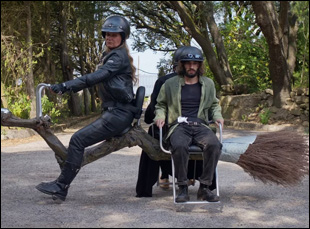 As you mention with the scene with all the animals, you seem to blend special effects with practical ones in a really effective way. What went into creating the broomstick effect for the witch in the film?
That was more complicated, because the art designer designed the broomstick, so we shot it really as you see it, except that there were cables which made it go up and down that were taken out in post-production. But it was very amusing. Everyone had a good time doing that. We had big cranes to make the cables go up and down and actually, the place where the broom goes up and where it comes down [elsewhere] was the same place, but we just changed the angle around so that it looks different because that was necessary. We had no means of moving the broomstick to the domain where the castle is, so it’s a false thing, but it’s part of the magic of cinema.
“The Tree of Knowledge” will screen again at Fantastic Fest on September 23rd at 6 pm at the Alamo South Lamar.