

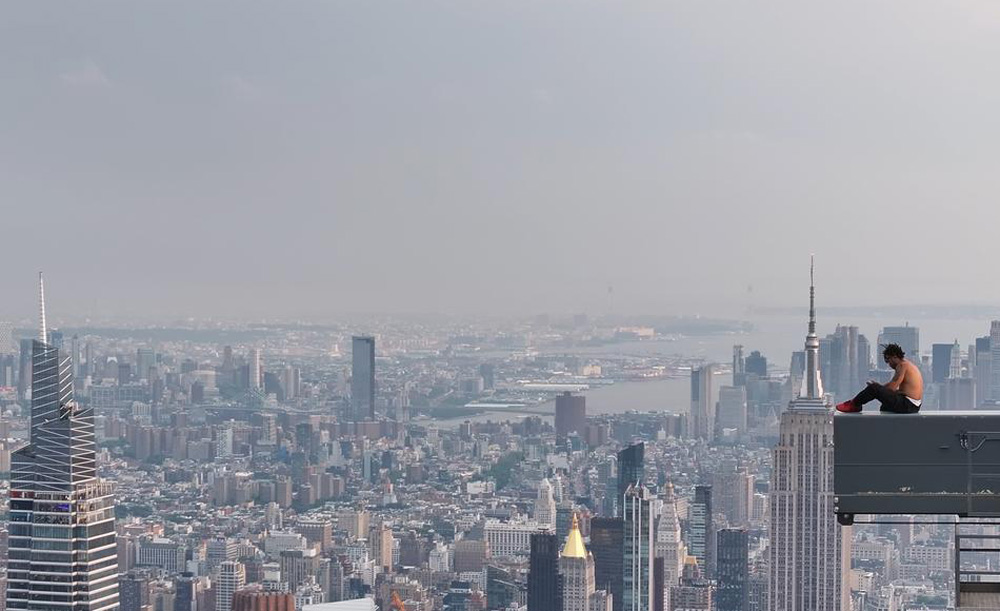

It isn’t often in a nonfiction film to have angles from every angle of a police chase, but “Drift” generally takes a view of the world you don’t normally see. Making novel use of dash cam footage from cop cars that are a part of the public record, director Deon Taylor also can draw on the GoPro that Isaac Wright wears as part of his artistic practice, documenting his climbs up some of the tallest buildings in the world on Instagram without seeking permission to do so. The fact that Wright volunteers his own footage so freely when it could later be used in court as evidence against him for criminal trespassing reflects his own feelings about the legality of it and the exhilaration of putting something within public view that should be off limits makes a strong case that he’s working towards a greater good, despite the danger he poses to himself. In “Drift,” it becomes compelling to see Isaac not only challenging gravity in a physical sense to get to heights out of the reach of most, but also that of laws that forbid him from reaching his full potential.
A genuinely fascinating subject outside of the end result of his death-defying exploits, Wright is physically suited to scale large buildings from his time in the military, but was happy to take the honorable discharge after a chronic condition in his right leg cropped up and put him on a path to becoming an artist, taking pictures from the top of the world. However, upon running afoul of the authorities, his military service actually becomes a liability when it’s used by prosecutors to justify stiffer charges against him when he is said to pose a violent threat. Taylor conspicuously leaves out what increasingly seems like a decent amount of information about Wright’s history, presumably for the purposes of a tight narrative — he introduces just one of his brothers, Micah, from a family of five, and his lawyer Laurence Haas, a pugnacious presence on camera, is revealed to stand in for a host of others that he’s had over the years — but it’s clear nonetheless that he was unfairly targeted by an overzealous prosecutor from Cincinnati that took an interest in his case, going so far as to stop traffic in Arizona where Wright was ultimately apprehended by officers with AR-15s after taking pictures from the roof of Great American Ball Park and even if a crime was committed, the punishment of placing him in a cell for 23 hours a day with just one hour out in the yard as part of his sentence hardly seems fitting.
Making his documentary debut, after directing a number of crime-themed dramas such as “Black and Blue” and “Fatale,” Taylor doesn’t allow for a dull moment and although it can seem like narrative expediency is prioritized over an entirely faithful recounting of events at times, the film relates a riveting only-in-America tale where Wright is likely vilified because of his race and at the same time can seize opportunity to become a millionaire when his photos only become more valuable from his reputation as an outlaw. Admonitions that “No AI was used in the making of the film” and “Don’t try this at home” are less necessary as warnings than part of a certain showmanship on display, which end up feeling true to Wright, who clearly enjoys bringing everyone along with him via camera climbing up spires and clutching onto the sides of buildings, sending out drones for jaw dropping 360° shots of himself at various pinnacles. A goal of Wright making it up to the top of the Empire State Building is set up at the beginning, as is being handcuffed and led out of a gallery show of his work when he’s constantly a wanted man, but previewing these things can’t spoil them as climactic events when Taylor circles back later, knowing that they’ll only be appreciated more for what the photographer has had to experience. As Wright says, “The journey to take the photo is as important as the photo itself” and for as stunning as the pictures in “Drift” can be, the journey actually is more so.
“Drift” does not yet have U.S. distribution.