



Cole Webley has spent a lot of time at post-screening Q & As for “Omaha” explaining how the end of his debut feature is based on reality, a question that wouldn’t even come up if the rest of it didn’t feel so true. He personally had been so shaken by it that after planning to merely read the script to get a better sense of the spare writing style of Robert Machoian (“The Killing of Two Lovers”), with whom he planned to collaborate on something else, he couldn’t get out of his mind what Machoian found as a disturbing trend in American life and the two set aside what they initially were working on to get the story of a father taking his two kids on a cross-country road trip on its feet. Machoian had known for years it was powerful, but what made it so affecting also was what prevented most from even considering taking it on.
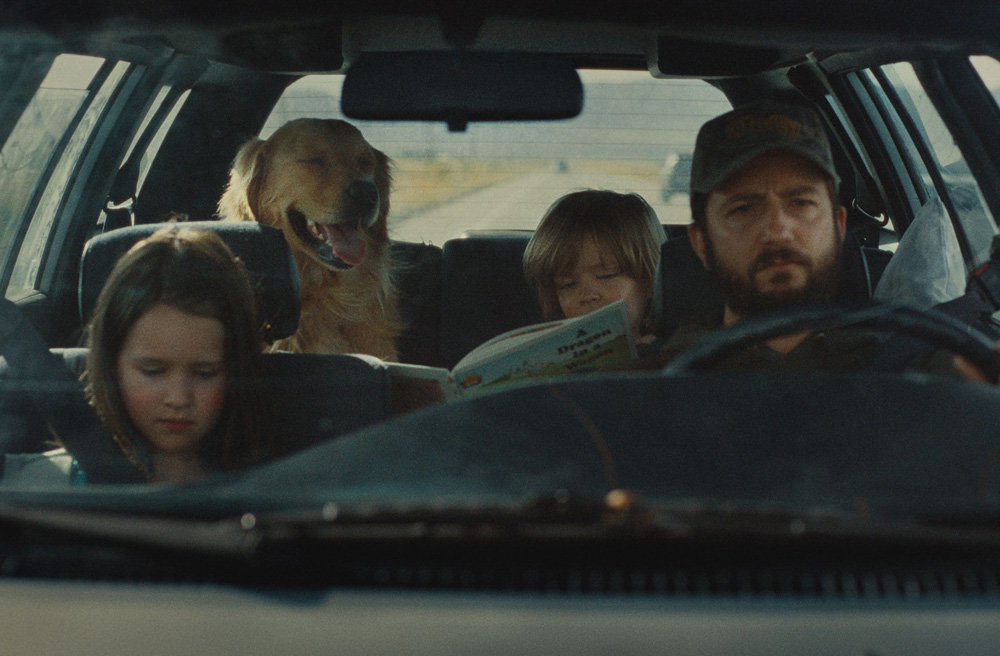
Webley had no such qualms and such fearlessness runs throughout “Omaha” before reaching its devastating conclusion, packing into a station wagon with both young children (Molly Belle Wright and Wyatt Solis) and a wily dog to manage as a dad (John Magaro) desperate to find a safe landing spot for all of them drives with only a vague idea of where he’s ultimately headed. Although Machoian wrote the script nearly a decade ago, the film feels particularly attuned to this moment of rising costs and economic anxieties as the family barely escapes the authorities after taking up residence in a foreclosed home and goes in search of another, with the unnamed father trying to shield the kids from having too detailed an idea of what’s going on. He keeps them entertained with trips to Utah’s famed Salt Flats and the Omaha Zoo, attractions that won’t take too much out of his pocket, but has to endure the stress of worrying if they’ll want ice cream when it would potentially put a paying for a place to stay for the night out of reach.
However, the wrenching decisions that the father is forced to make become an expression of how much he loves the young Ella and Charlie and “Omaha” gradually reveals from their interactions alone how their precarious existence now was the result of a series of small, seemingly imperceptible setbacks that they couldn’t have had much control over, exposing just how thin the line is between staying afloat and drowning as a working class family. The film is anchored by riveting performances from Magaro and Wright, in particular, who may not be able to speak directly about the problems they’re facing to one another, yet their expressions say it all, and the striking cinematography from Paul Meyers and a gentle score from Christopher Bear add to the purr of the engine that keeps running in spite of everything, all arriving somewhere you could hear a pin drop. After taking audiences’ breath away from its premiere at Sundance last year on, “Omaha” is now opening in theaters across the country and Webley graciously took the time to talk about having a light touch with such potentially heavy subject matter, charting out the twists and turns in a road movie and creating such a strong family on screen.
 From what I understand, you were actually working with Robert Machoian on something else when this one came to the fore. What got you interested?
Yes. Robert and I were working together as he was doing some rewrites on a screenplay and I had discovered him via “The Killing of Two Lovers,” his film at Sundance, but shocked to realize he had this whole body of work that I hadn’t seen and that he also lived an hour away from me. So we quickly became friends, and I harassed him into doing a rewrite with the movie and then I said, “Robert, surely anything that you’ve written — anything — I want to read it.” And he gave me this script, “Omaha.” And I read it purely as an audience, and I remember finishing it and [thinking], “That’s going to make a great movie. Cut to four months later and there I was on the first day of the shoot.
What happened in between that and directing it was I really, really went back and read the script as a filmmaker instead of just an audience member. It was so apparent why this movie needed to be made, and especially the potency of emotion on the page and the idea of the family dynamics, the story about fatherhood and the struggle of this singular man in a time in his life, there was no one answer for why it had to be me, but I just loved the story and I love the simplicity and I love a road trip movie. And we ventured deep into that.
Was the simplicity intimidating? Stripping things back the way Robert generally would seems like it could be as tricky as building something.
If anybody knows Robert’s work, I definitely see how he would have made this movie and I would have loved that movie too. And the script was very raw, it was very stripped back. And I think I’m a little more of a romantic than Robert, in so much that I really wanted to create a soft landing place for our audience. I wanted them to know they were in good hands and that I wasn’t going to beat them down for an hour-and-a-half and the script didn’t do that, but I know that there was a way to make that movie that would have. I really wanted there to be music, so I set out very early to create a theme through music with Christopher Bear that established a sense of tone. And I set out to have this element with Wyatt [Solis] and Molly [Belle Wright, the two kids] and this silliness of Wyatt sitting in the back seat — things that are easy to write on the page, but then when you get an actor, what is he doing in the back seat that feels so whimsical, that feels so charming, that feels so inviting to this world, we worked really hard to bring these things into the movie and I’m proud that we did.
There’s a real gentle rhythm as well with visual language. What was it like figuring out how to film this?
It was easy. We first focused on photographers and photo books on the American road trip and we started pouring over those pages. What I was mesmerized by was this simple composition and recognizing beauty in the mundane, meaning not a lot of camera movement. That’s what these road trips felt like for me as a kid, just looking out the window and having the landscape framed by a door window or standing by your car going pee and looking at the sun, how it breaks through the clouds over the Wyoming plains. So there was like an approach to it that we said, I want this to feel effortlessly beautiful and when we started working with Wyatt, we realized the camera was not going to be able to move a lot. We were gonna have to just be observational with him because we didn’t know what he was going to do in between every take, so that really manifests some of the language.
That may be it, but was there anything once you saw the dynamic between the actors that changed in your mind about this?
Yeah, one is that originally, the script was very much from the perspective of the Ella character, and when John [Magaro] got on set and I started to see some of the things that he was doing, it became clear to me that I just had to give his character more screen time. I really wanted to feel more of him. Originally, I thought I’m never going to see the dad unless we’re from the perspective of the kids and they’re in the room with him. But I broke that rule on day one of the shoot. I just saw John doing work that gave me more details of who he was and I loved it. The rest was pretty much as scripted. It was just being there to catch lightning in a bottle with them.
John has said there was an ongoing conversation about doing more with less. What was it like to navigate that on set?
Yeah, there was some dialogue that we cut, but not a lot because the dialogue and the script was very thin [already], so we allowed John to say so much by just me sticking the camera on him and Paul and I just working to find those angles that were revealing. But cutting this movie, it was my goal [to think] how can I slim it as much as possible? The movie is only 84 minutes, and part of that was just eliminating anything that anybody said that was overly descriptive and then ultimately cutting anything that the kids did that felt like it was like they were acting — which wasn’t a lot, but it was enough that felt like, “Oh, there’s an adult there telling them want to do.” So less is always more. And when you have performers like John and Molly and Wyatt, it was like, “This is going to be incredible.”
From what I understand, Molly had a dog back home that she missed and could draw on for her performance. How much did you allow the actors to find their characters in that way?
Any great actor knows how to dial into some of those things. And Molly won the part by auditioning for that role because of that experience with her dog [because that scene] was the end of the first act that propels us into the heart of the movie and lets us know, “Now we’re in dangerous territory.” Molly’s first tape, it was like, “Holy cow, she’s the girl. She could do it effortlessly and she could do it over and over again. It was really powerful stuff.” [But I learned the inspiration for the performance was] that when they moved to L.A, right before booking the movie, they had to leave the dog with another family in Australia and obviously that was hard for her, so she channeled in some of those feelings. We all love our dogs. I’m definitely a dog person and I tried to stay out of it a little bit and just guide the performance, but I know poor Molly shot that scene out so many times, by the time the movie was over, we were really happy to let her stop thinking about her dog.
Did you actually know most of the locations from the script phase or did you go out and do a version of the road trip yourself to figure out the stops?
A little of both. We definitely went on a road trip. Robert, myself, and Paul, the cinematographer, jumped in my truck and we drove the path. We stopped at gas stations, we stopped at hotels and really figured out [where] they would have journeyed. Being on those interstates [brought] so much of the conversation of what the movie was into light. We were surprised by some of the things we found and others like, Robert [saying] “That’s the gas station I wrote the ice cream scene in,” we drove off and we went up and we scouted it and we shot there. The streets of Omaha was more of us walking around and imagining what would work for that car to roll down the hill and not be able to get going again. That was all part of the magic of going [there] and that’s invaluable to be able to get in a car with your three closest collaborators and go find and imagine these sets.
What was it like taking everybody to the Salt Flats?
I’ve been in Utah for 20 years and you’re not a Utahn filmmaker if you haven’t shot or got sunburned on the Salt Flats something fierce.That was the first thing, everybody wear lots of sunscreen and stay hydrated because it’s like shooting on the moon a little bit. Everything gets dirty. It’s got salt that erodes all the metals, so you gotta be super careful with your gear. Thankfully, it’s not zero gravity there, but it was tough. And we shot that scene with them and them arriving in the car all within four hours because that’s what we had with Wyatt that day. I look at the movie now and think, “How did we do that in four hours?” Because it was a lot of pressure and it was very hot that day. It was on a Friday and the kids had done all the pool work earlier that week. I believe that was on a Friday and they had done all that swimming before and Molly’s eyes were tired because she’d been swimming with her eyes open for the character in the chlorine, so bless their hearts.
Was there anything that you may not have anticipated that made it into the film and you now really like about it?
Yeah, there was stuff running around that zoo and what Wyatt was saying that was a little bit of ad libs. We always had great fodder and started him with some of the dialogue and he would just continue to take it and take it and take it. There was some dialogue at the zoo that I always loved. Something like “You’re going to take the polar bear to the show and tell.” I remember when they’re eating there at the zoo, [the father] says this thing about, “Hey guys, don’t fight,” and [Wyatt’s] like, “We have to fight. We’re siblings.” And that was so true to life.
The thing that really, I wasn’t sure if I was going to get, but I did was just the brilliance of John, Molly and Wyatt’s performance at that hospital. I was really nervous. and I approached that day with a lot of uncertainty. You can’t really rehearse that, and I knew John was going to deliver and I assumed Molly would bcause she’s always so good, but when Wyatt and Molly delivered those takes on that hospital day — that was also on a Friday, and I spent the weekend cutting the picture together at my home office — I’m realized I have the scene and that was such a relief to know that I had that because I knew the movie could hinge on that scene and that it was in the can. Also, all shot on one day.
Unbelievable. Even though you had a wealth of experience before this, what was it like ultimately getting a feature under your belt?
It’s weird. It’s like raising a child — and I have four of them — and you look back and you’re like, how did we even survive those few years where things were so chaotic and exciting and new? You were learning and now you look and this kid’s like 17 or 20 or 15 or 11, that’s just my kid’s ages. You think “How did it happen so fast? And how do I look back at those times so fondly?” Once you have time away from the project, you’re able to look back at it and just be grateful and you’re a little less to judge it. And I’m not ready to watch “Omaha” much anymore. I saw it a few times [around the premiere], and I think I’ll give it another five years or so, but it was such a beautiful process. I am a filmmaker through my bones and I’ve always wanted to just make features. I was lucky enough to stumble onto a career that I worked very hard for in commercials and now having both where I can go do the short projects and then anchor in on these longform [films] where my heart truly is, it’s just a really, really great place to be.
“Omaha” opens on April 23rd at the IFC Center in New York, May 1st in Los Angeles at the Nuart and Omaha at Film Streams’ Dundee Theatre and expands nationally on May 8th. A full list of theaters and dates is here.