

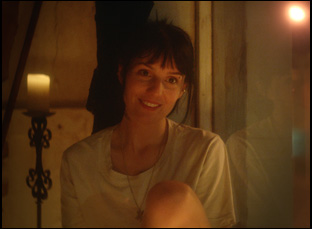
“I don’t know if you’re a jinx or a lucky charm,” Buzz (Scott Major), the owner of a record store tells Anna (Alexandra McVicker) after she asks for a job in “The Serpent’s Skin,” with the applicant suddenly thrust into the position of evaluating her potential boss in the immediate aftermath of an armed robbery as she tenders an application. In all his years of running the place, he hasn’t had a break-in before, but he can’t seem to be too shaken up about it when she stands her ground against the masked man and she’s got the gig if she wants it as a result, but her arrival will always be tied to the incident.
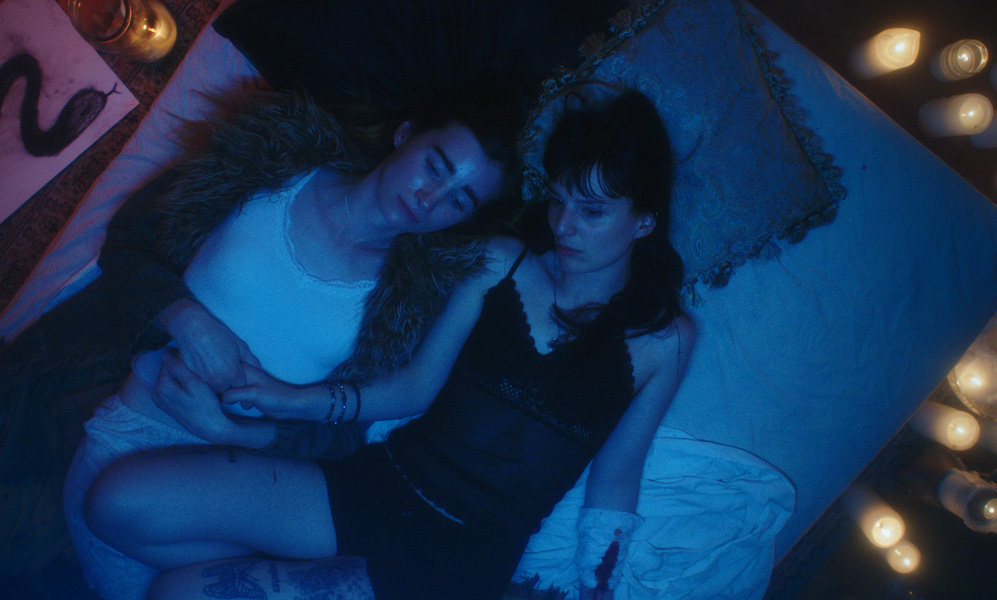
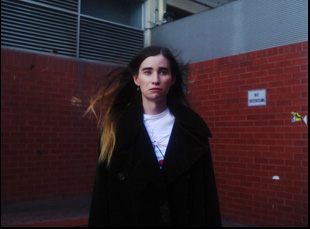
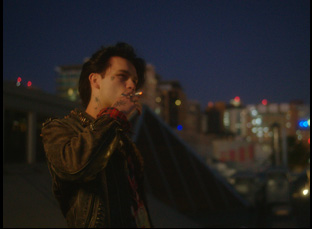
The idea that danger can bring people together as much as tear them apart runs throughout Alice Maio Mackay’s supernatural romance when Anna is brought to the big city in the first place by the terror she experienced in her hometown where she felt she’d forever feel out of place. Not only does she end up being welcomed with open arms by Barry, but also Gen (Avalon Fast), an occasional browser at the shop that immediately locks eyes with Anna and can’t be bothered to look back down at the vinyl, yet Anna has seen her before, quite literally in her dreams and can’t help but wonder why. Although it’s evident upon their first meeting the two have a transcendent connection, Mackay suggests it’s a little more than the passion that exists between them as their bond seems to bring out the best in one another, it appears to have let loose the worst in Anna’s neighbor Danny (Jordan Dulieu).
At 21, Mackay has already put together a formidable run as a filmmaker with five scrappy features under her belt prior to “The Serpent’s Skin,” breaking out with her 2023 film “T Blockers” in which a group of trans women were the only defense against an parasitic outbreak in a rural corner of Australia where the men were being eaten away at almost literally by their determination to maintain dominance as it clashed with practicality and despite spartan budgets, the filmmaker boasts big ideas, unleashing a corker in her latest in which having superpowers becomes a reflection of how repressed people typically are in a world that insists on conformity. It’s only fitting that when Mackay finds there’s so much going on under the surface with her characters, the same is true of the film itself where a candy coated veneer and a goth metal pop soundtrack seemingly unearthed from the early 2000s become an expression of just how irresistible Gen and Anna find each other when it holds the same magnetic pull over an audience and leads to a frisky and thorough interrogation of desire.
After a summertime premiere at Frameline and Fantasia Fest where it only contributed to the seasonal heat, “The Serpent’s Skin” is now available everywhere on VOD while it continues to play in theaters and Mackay graciously took the time during a recent stop in Los Angeles to talk about assembling a creative team that doubles as a who’s who at the vanguard of Queer cinema at the moment with “The People’s Joker” director Vera Drew moonlighting as an editor, “Camp” director Fast in the lead and “Castration Movie” director Louise Weard onboard as a producer, a yearning for more sincerity in cinema and getting the right vibes on set.
 How did this come about?
I’d made a few movies and I wanted to do something that was a bit different in tone. I grew up with “Twilight” and The Mortal Instruments,” when all these like supernatural romances were big. I also grew up on things like “Buffy” and I really appreciate the earnestness and sincerity they approach topics. Sometimes they talk about trickier things, they do it in a way that is still campy and fun and has a lot of heart. I feel like we’re almost in this irony epidemic where everyone’s trying to not to be sincere and it was really important to me to make something that was really from the heart and even though it has campy ‘90s VFX and really silly characters or humor intertwined, I just wanted to make something like just like sincere.
What was it like connecting with Alexandra for this?
It was through a friend of a friend. The producer on this movie, Louise Weard, was at Sundance and saw “I Saw the TV Glow” and one of the leads, Jack Haven, lived with Alex and they’re old friends, so Louise was like, “You should meet Alex,” and I’d seen her on an HBO show separately. I had a screening of “T Blockers” in New York and we met and we became friends and then I asked her to do that movie. It was her first movie post-transition, so it was really special creating this role. It was beautiful and obviously, the experience would have been memorable regardless, but I think it added an extra honor and was special for her as well.
It really does seem like a dream team you’ve assembled. Did it come together organically or did you think having a group of filmmakers who direct their own films as well could be interesting as collaborators?
That was really special, having them collaborate on making my vision come to life. It was naturally who I surround myself with. Louise is a great filmmaker, and a really close friend and I wanted her producing help and then I’d seen Jessica Dunn Rovinelli’s feature but she’s a great colorist as well. Vera Drew is obviously an amazing filmmaker too, so it was just like having all these friends and people whose work I’d admire and look up to.
 Vera has said that on your previous collaboration “Carnage for Christmas,” you really handed over the film and gave her a lot of trust in the edit to do what she would. When you clearly have a singular vision, does that kind of trust in someone else come naturally?
Trust is really important and it’s like really special working with [Vera] because like I feel she really understands my references and my viewpoint really, really well. Not many other filmmakers understand me to the level that she does and also just knowing her as a friend these last few years and becoming really close, we’re on the same wavelength. So having her come in as an editor is really cool because she reworks the footage through what she knows is my vision but is able to reshape it into something a little bit different and go further rather than just receiving like a stock edit or the film, [thinking] “This is in chronological order and there’s no whiz bang effects.” She’s like, “I know what you want, I know your inspirations and this is what you’ve shot and how far we can take it.”
Vera said specifically on “Carnage” that you asked her to “Rob Zombie it up,” which was interesting because on this, there’s a lot of exciting post-production elements but I wondered how much may be premeditated for the edit?
We were lucky on this one because Louise was doing an assembly cut while we were shooting, so the time zone [difference] was really helpful because we’d be in Australia, we’d shoot and the proxies would upload and then by the time I woke up, Louise would have the footage [cut], so we could see what we were shooting as we went along. To an extent, everything’s a bit premeditated, like the montages are written in and the [descriptions of the] dream sequences are intercut in the script. But sometimes they’re not exactly written how they appear visually. It’s just like “dream sequences intercut” and then it’s Vera’s brains and skills and imagination to bring those aspects to life.
Was it interesting to have this real international array of collaborators from outside Australia?
Yeah, I love it. Some people would take issue with the accents or whatever, but I want to work with the best people to tell the story, and especially with this film, I’m always looking at it from an almost otherworldly, fairy tale-like alternative reality so I want it to feel grounded in some formal reality but at the same time I still want it to be removed from the everyday world. So creating this weird dichotomy of different accents where you’re not sure where the setting is just adds to this supernatural sub world that I’m creating.
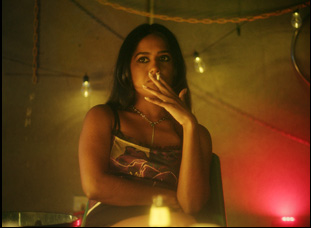 You really upend some expectations in an interesting way – one of my favorite moments in the film is where it seems like you’re leading up to a sex scene and you cut to a concert that is shot in a way that’s just as seductive.
It’s weird because I feel like the film is very sensual and the romance and sex is very important and integral to the plot and the character’s motivation, but I don’t think it’s necessarily an explicit film, so conveying sensuality in its different forms was really important, especially at that point in the film [because] Danny has the neck tattoo and we’ve seen him as a sexual being, but it’s like his sexuality is ramping up because it’s right before he takes his first victim, so it’s different ways of conveying those experiences.
What was it like bringing Avalon into the mix?
Yeah, it was really cool. They’re such an amazing filmmaker. They’ve got “Camp” and “Drinking and Driving,” which premieres next week as well. We met also in New York when I had a “T Blockers” screening and we hung out as filmmakers, which was really cool. We just became friends and then I wanted them to come on set in some aspect more behind the scenes at that stage, and [Avalon said] “I’m interested in acting. I’d love to audition for a small part,” and then I just thought of them for this role. They recorded a self-tape and it was really exactly like what I wanted and they were wearing an Evanescence T-shirt and that nailed the aesthetic and tone as well. And there’s something so beautiful about working with another filmmaker and also with Alex, being her first role after transitioning, and Avalon in a lead role as an actor, not a filmmaker, that’s really special [bringing them together from] both of these worlds.
Their characters have such a beautiful rapport with one another from that very first scene after their meet cute in the record store where they’re talking in the alley, it’s such a great meditation on sensitivity. What was the evolution of that, from the writing to seeing it in the actors’ hands?
I think [we shot that] was maybe a few days into the shoot and it was a really important thing to nail, especially shooting the close-ups so tight. It was a stylistic choice, but also it feels so intimate to them, I really wanted to use the close-up as close as we could get to convey this sense of intimacy and trust because that’s how it’s coming across to the audience as well. The way we shoot the film, we typically rehearse almost like a play, especially with those long dialogue scenes, and then just watch them unfold and then bring the cameras in.
We didn’t have the budget for [the actors] to meet in person beforehand, so Alex arrived the day before we started shooting and [Avalon] a few days [later] and then we had done a few Zooms with the intimacy coordinator and a little bit of that kind of stuff, but the trust that they really put into me as a filmmaker and into each other as actors and that vulnerability and really opening themselves up, I was in awe of how moving and beautiful it was to watch them do their thing.
 I wouldn’t describe it as a gothic romance, but their connection is accentuated by genre elements. Was that an interesting tone to get right without leaning too heavily in any one direction?
The tone is very set in stone from the beginning. Certain things are accentuated by the edit but it’s important everyone’s on the same page and for some, it’s a hard film to categorize – it’s played at a lot of genre festivals, but I feel it sits in this other space outside of the horror genre because the things that I was interested in growing up, like I watched “Buffy,” but I watched it for the character development and the soapy, romance aspects and I was interested in how supernatural elements propelled the story forward, Even with films like “T Blockers,” I focus on making them hang out and character films about queer or trans life and then the supernatural elements are secondary, allowing me to push the films further stylistically where I’m able to do things I wouldn’t be able to do otherwise.
The needle drops are also really great. Did you have a sense of the music from early on?
I’m big with temp music, especially with Jordan playing Danny, I got him to listen to all the Emo 2000s music like Sleeping with Sirens to get into character. But I didn’t really know exactly the songs that we were going to use, so the Adams family, who are a cool group of filmmakers who I love so much, they contributed a lot of music through their band H3llb3nd3r and I didn’t really think about their music before [filming]. We just happened to both be fans of each other and they let us use that music and it worked really well. They explore a lot of poetry and witchiness in their music. And then the score was Alexander Taylor and Eduardo Daniel Victoria collaborating and the juxtaposition between the smooth flowing score with the lesbian lovemaking and then the staccato, angry music with Danny and his victims, that was really fun to explore as well.
What was it like to create the lighting scheme with your cinematographer on this to set the right mood?
We’ve been working together since the first feature film, so it’s really nice to grow and work [together] as a hive mind. We’ve tackled different visual inspirations, like “So Vam” was inspired by “Party Monster” and “Carnage,” we wanted a grungy Rob Zombie, handheld aesthetic and this one is like a middle ground between Gregg Araki’s “Kaboom” and his digital aesthetics, but also a little bit of “Twixt” by Francis Ford Coppola and then like a little bit of CW like “Buffy” and “Riverdale.” I just really love creating these visual worlds, especially when you’re dealing with characters who have magical abilities and their love is so otherworldly, almost like this special entity, it’s really important to use color and accentuate it as a character rather than have it be so boring.
Has it been interesting to have the same crew behind the camera as you’ve been working towards a larger scale?
Yeah, I feel like really lucky. I did work experience when I was in high school at this company where he shot their content and he and his team really just trusted me because on “So Vam,” I was 16, we shot [the film] in seven days in summer and he really just helped me make the film the best I could from the beginning. I feel like even the costume designer and makeup people I’ve worked with are a lot of the same people. They really trusted like the vision and the story. They wouldn’t have been there if they didn’t believe in it because they’re micro budget productions, so it’s really special having someone trust you so much as an artist and coming with me on this journey from there to now.
The films have been steadily been growing in scale, but have been wildly different from one another. When you’ve been making these at a pretty rapid clip, have you actively wanted to change things up as far as the types of stories you’re telling with each film?
I don’t really like think about things in those ways. Previously I’ve just explored different subgenres and elements of stories that I’m looking to tell and going forward, I’ve got one more micro budget feature coming out or then I think I want to try and get a bigger budget. But it’s always just making the things that I want to see and not making what I think people want to see from me. I’m not looking at audience reactions and [thinking], this is going to steer what I take with me to the next one. I love filmmaking and doing whatever I think will service the story the best possible way rather than taking what other people think about those aspects.
What’s it been like to take this film on the road? I know you couldn’t end up traveling with “T Blockers” as much as you would’ve liked.
It’s been really, really special. For “T Blockers,” I was at the world premiere in Salem, which was really special — that festival kinda changed my life — and then I did a MoMA screening last year in New York, which was also crazy to like have my film playing in a museum. But for this one, I was able to do Fantasia last year and then to go from Canada to London to all these different cities has been really special. It’s really surreal because even when I started making films, I didn’t think people would necessarily show up. I just made them because I felt like such a strong desire to tell stories and it means the world to me that the film is even resonating with one person. I don’t think it’s quite hit me yet. The new Fangoria coming out, we’ve got a feature on the cover, which is really exciting as well. That’s so crazy to me. I never would have imagined it, so just the fact that people even see the film is really special.
“The Serpent’s Skin” is now available on demand everywhere.