




It was clear from Pete Ohs’ very first narrative feature “Everything Beautiful is Far Away” (co-directed with Andrea Sisson) that all the director needed for a compelling film was a camera and an interesting person in front of it, having two in Julia Garner and Joseph Cross as they wandered around a desert together, parched from the experience of trying to find a lake that quenched a thirst elsewhere when it announced such an original voice. As spare a production as it was, however, it still might’ve been a little too cumbersome for Ohs’ tastes, with all the planning required to pull it off and prescribed ideas about story and character that the filmmaker had hoped to loosen up for his next film “Youngstown,” in which he decided there would be no script at all and not a lot of prep in the traditional sense when he would be handling most of the responsibilities from the film’s cinematography to the ultimate editing of it, shaping it as he went along based on what felt natural to the actors.
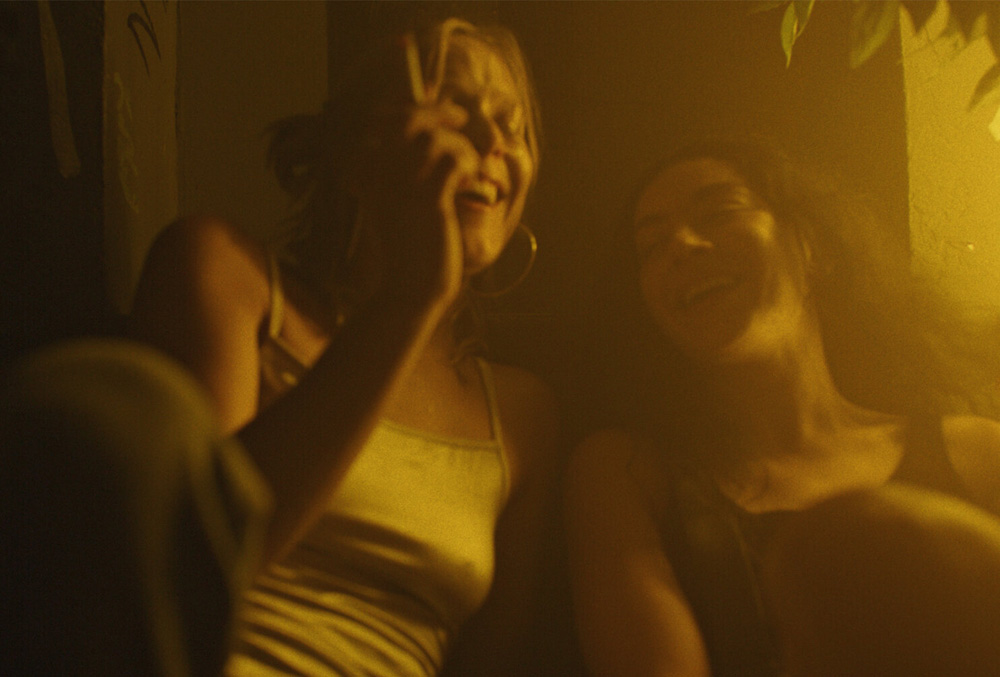
While Ohs’ films are singular because of him, he’d be the first to dismiss the auteur theory, seeking out collaborations wherever he can as the rare director who regularly works on other people’s films in various capacities on such films as Albert Birney’s “OBEX,” and as the production footprint has gotten smaller with each film, the films have drawn higher and higher profile casts from his 2022 brain twister “Jethica” with “Alien: Covenant” star Callie Hernandez to last year’s “The True Beauty of Being Bitten By a Tick” in which Hernandez opened up a rural cabin she had bought for the express purpose of making films for the director to bring together “Slave Play” playwright Jeremy O. Harris and Zoe Chao and James Cusati-Moyer to use as their playground for a taut thriller. By that score, his latest “Erupcja” is a bit of a blockbuster, providing Charli XCX with her first leading role opposite Lena Góra for an adventure set in Warsaw as the former weighs a potential marriage proposal from her boyfriend Rob (Will Madden). The lack of surprise before he can pop the question is surely part of the reason XCX’s Bethany staves off commitment, but also the fact that she’s always had some chemistry with Góra’s Nel that hasn’t gone entirely unreciprocated and in the home of Mount Vesuvius, something is bound to erupt.
Although actors are regularly credited as co-writers on Ohs’ films when they all come up with the story together as the shoot unfolds, “Erupcja” takes full advantage of an ensemble where everyone has experience from a variety of creative pursuits as well as the cultural history of its setting, delighting with the playfully colorful ‘60s style interstitials of Vesuvius that lingers over the proceedings, as does a gruff omniscient narrator all too conscious of the follies of youth that the film’s protagonists fall prey to. The spontaneous energy that was behind the film spills off the screen as “Erupcja” comes to feel like one of the parties that Bethany and Nel end up at during Bethany’s trip and when surrounded by centuries old architecture and the consciousness of tectonic plates slowly shifting, the characters aren’t the only reflection of attempting to make a break from the old to the new, but the film itself to exhilarating effect. With “Erupcja” now hitting theaters after taking the fall festival circuit by storm last fall, Ohs generously took the time to talk about refining his approach over the decade that followed his debut feature, how he ended up finding a creative soulmate in Harris and how getting creative has extended to keeping collaborations going when there are only so many crew positions to fill.
 I saw your intro to New Directors/New Films and in all the times we’ve talked, this is the first time I’ve heard you describe your work as “a table of bubbles.” Was this something you were consciously working towards as an approach or something you grew to see?
That’s wild because that metaphor has been around for me from before I made “Youngstown,” like from five movies ago, and that was the first film that I made with this process. I had this desire to make a movie the way I made things when I was 15 years old and it was all about returning to fun and having low stakes. It was a rejection of all things I had been experiencing in Los Angeles. I [thought], “I don’t need a script, I don’t need producers, I don’t need a budget. All I need is a camera and a couple friends.” And [for “Youngstown”] I was going to go to Ohio with two friends for two weeks to make a movie. About a month before we were going to go there, I was feeling very anxious. And I have this journal entry where I’m working through my feelings and saying, “Why am I doing this? This movie is so stupid. It’s going to be bad.” And thankfully I therapized myself [writing, “This movie is a table made of bubbles. Do not put anything on it. That is not what it’s for. If you put a plate on it, it’s just going to fall through. Don’t put your budget on this thing or your hopes, your dreams, your expectations. Just appreciate it for the the strange magical object that it is.” And that’s what making a movie is with this with this approach.
So with each of the movies, this is the metaphor I bring up to all these actor collaborators that I bring in, just as a way to lower the stakes and to remove pressure because I do not believe pressure is helpful for the creative process. It allows us to let go, feel free to take risks and to be vulnerable with the belief that environment will create an enjoyable experience for us and then probably also will result in some interesting art getting made as well.
How did you end up collaborating with Jeremy O. Harris? I was excited to see that you edited his film about the making of “Slave Play,” but wondered if the relationship actually predated that.
Ten years ago, we met via South by Southwest. Jeremy used to write reviews of films. This is before he had started writing plays and before he went to Yale, and he then came to a feedback screening of my first narrative feature that I had directed. He gave really good notes and we became friendly, and then over the years we just stayed friendly. We would see each other sometimes at festivals or if either of us were in what cities we were living. And in the spirit of “Erupcja” and coincidences and synchronicities, I went to see “Slave Play” off-Broadway in 2018 and then this producer/director, (Chris Caribel) wrote me a message after I had worked with him on a Quibi series he was directing, and he said, “I’m producing this documentary about ‘Slave Play’ with Jeremy O. Harris directing, and we need an editor.” I texted him back the Playbill and the ticket to “Slave Play” that I had still kept and I said, “I think I’m the right editor for this job.” That became the first time we got to work together. We really had a great time working on that film and that just became the beginning of our creative collaboration that’s been really rewarding and life-changing.
How did the idea for “Erupcja” come about?
These films I make, I always start with a location that I find narratively inspiring in some way and I was living in Warsaw and I was falling in love with Warsaw. So I started talking to some Polish friends I had and just said, “Let’s make a movie in Warsaw later this year and then I came to New York to visit for a film festival and while I was in town, I was hanging out with Jeremy. We were at a bar in his neighborhood. at 3 a. m. in the morning and then Charli walked into that bar and and Jeremy and Charli knew each other enough for Jeremy to bring her over to our table and we started talking about movies. At the end of that hour-long conversation, we were like, “Let’s make a movie in Warsaw in three months.” So these magical collaborators come together and then through conversations with them we arrive at the eventual story that we’re going to tell.
It actually resembles a Polish new wave film. Was that in mind from the start or did the style seem right for it later?
I’m always just trying to be really present and aware and and in conversation with what is happening around me. A big part of Warsaw that I’m drawn to is the communist-era architecture from the ‘70s. That just naturally informed the aesthetics of the movie of how it should feel, like some 1970s arthouse film and just not fighting it. It’s like that’s what this has. Just use it, lean into it. Then the other aspect was this was my first city movie, so we were still a really small crew, but we were going to be walking up and downstairs, shooting in small apartments and metros, so [I thought] do I want to carry a bunch of tripods around and extra equipment? The practical sense of just having the small camera and being able to easily jump off and off of trams just made my life easier. So you’re finding a merging of problem solving things that satisfy both the creative elements and the logistical challenges as well.
The city setting struck me – you’ve only shot off the grid in highly controllable locations. Was this much different on that front?
I loved it. The first narrative feature I did, “Everything Beautiful is Far Away,” was shot entirely in a desert. And that location is incredible, but it’s all the same. Each day you didn’t get some new thing to be inspired by and respond to. Filming in a city, I would enter an apartment or an art studio and get to discover these cool balconies and [think], “Wow, this apartment has amazing balconies. I’m going to use those.” And then you build entire scenes around it. You build an entire visual language in the movie because you start to realize, “Oh, I’m always looking out windows, looking up and down from different points of view. So it almost makes it easier because there’s constantly these things that are inspiring, these opportunities that you’re not having to seek for, you just have to be ready to receive them.
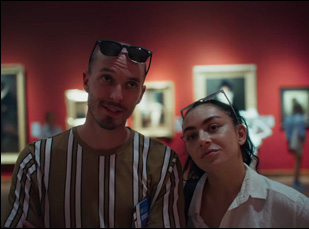 The tension between the old and new that actually seems to exist in Warsaw becomes quite thematically appropriate for these characters that seem stuck in the present, neither ready to move forward or live in the past exactly. And besides the scenery, you’ve got scenes like Charli’s character Bethany reciting “Darkness,” a Lord Byron poem. How much of this might’ve grown organically versus anything you might’ve had planned.
The reality is nothing is planned for. We are just always trying to be ready for anything and everything with a faith and trust in the process. That poem was something that had just entered into Charli’s life coincidentally. She entered a hotel room and it was playing over the radio and when she heard it, it reminded her of some of the things we had been talking about [in terms of] the themes and the volcanoes and the emotions of for this movie that we had started to brainstorm. So we put that poem in our back pocket, not knowing when we would pull it out, what it would be for, or what it would even mean if we were to bring it out. And it wasn’t until the last day of Charli’s shoot. She was gonna leave the next day, and we know we’re about to film the last scene with Bethany, and it was going to be at Nell’s apartment, [so the scene was] going to be between Bethany and Nell. And we weren’t sure what [the scene] was going to be, but I’m having a conversation with Jeremy about what it should be and because we’re filming in order, we know we’ve been doing a few scenes in a row of these characters talking, so we both [thought], it shouldn’t just be another dialogue scene. It needs to be something special. And then I remembered that poem and I said to Charli, “What if the scene is that poem? Do you think you could memorize it?” And she was like, “How long do I have?” I was like, “Two hours.” And she said, “I’ll do my best and then she did.”
Once you see the dynamic between her and Lena, was there anything you were particularly excited by?
The movie that we made is because of who these people are. If it was a different set of actors, it would be a completely different movie. Also because we are just being so present during the making, we are ready for it to change, so when the actors first got to Warsaw, this is the first time that Charli and Lena are meeting and we’re shooting the movie in order, so we’re going to start to shoot things, but their characters haven’t met yet. But what that also means is each night while we’re having dinner, while we’re drinking wine, while people are on the balconies smoking cigarettes getting to know each other, we’re getting to like learn what each other’s energies are. We’re finding out if they have any sort of chemistry, so by the time they get to meet, we have confidence now that we know how these characters can be and we can lean into it. If they had zero chemistry, we would have needed to change and tell a different story, but instead we saw what we had and we kept using it.
The score also brings quite a wonderful energy to this. What was it like to work on the music?
I’m always looking to do experiments to try things I haven’t tried before. If I have an idea and I feel like I’ve never seen that, I move towards it fully and I’ve been making all these movies and the sad thing about movies is you only have so many seats on this spaceship. You have so many collaborators [over the years], and there’s only room for this number of actors and this number of of collaborators at the different stages. And I had made and I had worked with Isabella Summers on the “Slave Play” doc and on “Tick.” And prior to that I had worked with Charles Watson on “Love and Work” and “Youngstown,” but I had a desire to work with both of these composers again and they were both messaging, [saying] “I’d love to work together again.” So I thought, what if this movie has two composers — and they don’t work together? What if they just compose things separately?” The excitement was this story also has these dual storylines and these two languages, so again, it fits the thesis of what this movie is.
They were both down for that experiment and then what the music actually became was I with with these composer friends who I always asking to send me scraps, like demos and who knows in what movie it’s going to show up? Maybe it becomes the score, maybe it just becomes something that’s playing [in the background]. Maybe it becomes some character’s ringtone. But [I say to them] “If you have stuff, just like give it to me and let me put it into the stew.” So I had these two different music cues this one dance track from Isa that she had just made, not having seen the movie and then this weird flute organ thing that Charles had made unrelated to the film, but I put those in and they had these textures that again felt somehow connected to this 1970s thing, this dreamy quality of the fairy tale that these characters are [describing], as well as the explosive nature of what happens when the women get together and they go out partying. Then when those two things felt right, I showed that to the composers and I said, “Okay, now make more, because clearly this is working.” Then they just got to go play and make even more stuff.
“Erupcja” opens on April 17th in Los Angeles at the Nuart Theater and New York at the Angelika Film Center before expanding in the weeks to come. A full list of theaters and dates is here.