

Most filmmakers will tell you that the Audience Award is the one they prize above all others at a film festival, but for the team behind “Steal This Story, Please,” the meaning of people voting has additional value.
“That is such an enormous compliment because it’s the audience themselves saying, ‘This is our favorite, this moves us,’” says Amy Goodman, who can often only assume that someone out there is listening as she broadcasts daily for “Democracy Now!”, the wholly independent media organization she founded 30 years ago, informing the public in ways that the major broadcasters have shied away from with corporate concerns to be mindful of and not always able to see the results.
Adds Tia Lessin, who co-directed the film with her partner Carl Deal, “As a filmmaker, it’s so gratifying when people just show up to the film, much less like clap and enjoy it. And the best thing possible when they actually give you an audience award because that is proof positive that people are interested in the story that you have to tell.”
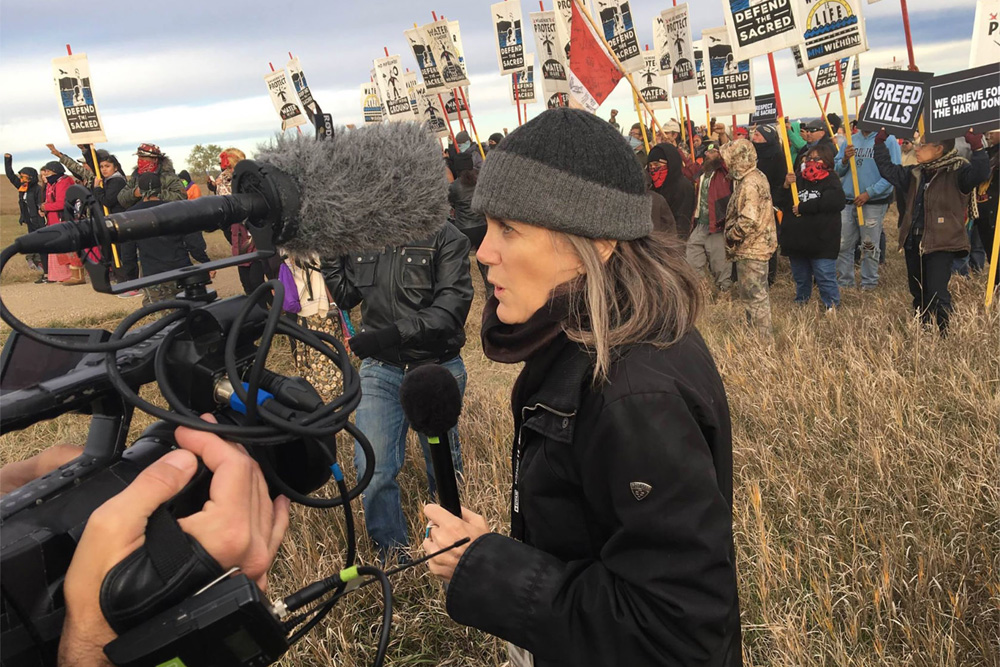
Goodman will frequently refer to that great unknown that she transmits to as “the silenced majority” rather than the silent majority, and the awards that “Steal This Story, Please” has racked up at festivals ranging from Woodstock to Mill Valley and St. Louis to Santa Barbara have reflected not only the quality of the film, but the fact that for all the stories that Goodman has doggedly pursued and brought to the surface in the U.S. — reporting on the American-backed coup in Haiti that pushed Jean-Bertrand Aristide into exile, airing the prison journals of Mumia Abu-Jamal when NPR was pressured into shelving their own broadcast to being on the ground in South Dakota for the protests against the Keystone Pipeline – perhaps one of the most compelling has been her own.
“Steal This Story, Please,” which takes its title from Goodman’s belief that news shouldn’t be exclusive, making her own information gathering available to all to be redistributed, illustrates the journalist’s dedication to building a network of her own amidst other media organizations that ultimately see it as a way to turn a profit or peddle influence. Working her way from covering international conflicts for listener-supported WBAI radio in New York to eventually establishing her own multimedia platform with “Democracy Now!” where she regularly welcomes correspondents from across the globe, she hasn’t only informed the public of injustices occurring around the world and exposed connections between leaders of industrial giants and governments, but inspired many to ask more questions about the world around them, something she credits herself to her Jewish upbringing and is shown even in high school taking her principal to task with an op-ed in the student newspaper. Although her dog Zazu threatens to steal the spotlight at times, the film offers an warm portrait of someone constantly looking into darker corners to bring enlightenment and has created community when the public can depend on her for hard truths as well as hope and good humor.
After premiering at Telluride last fall, the film is opening theatrically across the country with Goodman, Deal and Lessin making many in-person appearances along the way in the months to come and they graciously spared some time to talk about teaming up on the cinematic biography, trying to capture a career that has been so adventurous and releasing the film in a way that exemplifies the power of independent distribution.
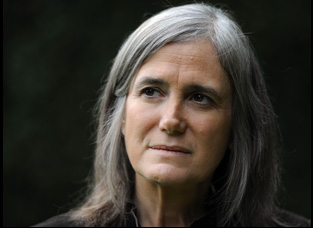 From what I understand, the footage of Amy at the Republican National Convention was shot 25 years ago and Tia was behind the camera. Did this all feel fated?
Tia Lessin: Yes, the shots in the film of Newt Gingrich and George Bush Sr. was footage I shot. In fact, we got the tapes back from the “Democracy Now!” archive, and they’re 26 years old now and I saw my little illegible handwriting on the tapes, and that was fun. I’d met Amy a year earlier [after] I had first come across her reporting the field at the WTO protests in 1999. I was with Michael Moore. She had her own team and I don’t know who was a bigger celebrity, frankly. She was a rock star back then, and it was just at the very onset of the indie media movement. So I was certainly a listener and we admired her coverage, and then I worked with her for a couple days that next year [at the Republican National Convention] and I got to see up close what unstoppable force she was. Did I think back then that I was going to be doing this now? Definitely not, but it totally makes sense. I got a glimpse of everything that we got to learn about her in the making of this film — that she’s inexhaustible, She’s committed and she covers journalism like an athletic event, so we had to cover her like we were on our own athletic event. And it’s always nice when your life comes full circle.
Carl Deal: Amy’s reporting over the last 30 years coincidentally coincides with our conscious political life, so it was like a walk down memory lane of the greatest hits of all the stuff that we’ve been organizing against and trying to counter in our work. We had to figure out how to wade through [the archive] and decide which pieces fit for this film because everything is important. But we didn’t want to make a documentary that was just important. We wanted to make a film that told a story that people could relate to, so basically we followed the stories that we saw that were speaking to us in this moment, which as it turns out, meant that they were relevant to what was happening in the world today, Our other mantra is also always, don’t ever cut out a laugh. And Amy’s full of laughs.
Tia Lessin: Amy entrusted us with her personal archive, her “Democracy Now!” archive, her dog Zazu…
Amy Goodman: [appearing on Zoom, with Zazu in tow] They didn’t tell you it’s a dogumentary, did they? [laughs]
Carl Deal: Amy, just when I think that you’ve gotten all those Zazu puns out, you come up with a new one.
Tia Lessin: [laughs] But there was extraordinary footage of her covering seminal events over 30 years and eyewitness footage of massacres, of protests, of the ravages that oil has taken on Nigeria. So it was a lot of material and it was also epic spanning so many years, so we definitely had our work cut out for us. With our editor, Mona Davis, together with her, we got it down to a sizable 90 minutes.
It’s such an amazing work in that way. And Amy, what made this the right time for you to reflect on all this?
Amy Goodman: Well, it’s 30 years of “Democracy Now!”, although Tia and Carl started a few years ago. and it’s just an amazing moment in time with President Trump in office calling the media “the enemy of the people,” when there’s nothing that could be further from the truth. It’s just so important to talk about the importance of independent media. International journalists from other countries had come to do documentaries on “Democracy Now!” and they wanted to understand what is this? We know state media, we know private media, but what is this? And in the tradition of Pacifica Radio, which started when 77 years ago in Berkeley, California, the idea of an audience supporting these authentic voices so that when we’re covering war, we’re not brought to you by the weapons manufacturers. When we’re covering climate change, the fate of the planet, we’re not brought to you by the oil, gas, and coal companies. And when cover inequality, we’re not brought to you by the financial institutions or the banks. It’s critical that we have a different kind of media. What’s so interesting now is that I think many in the corporate media world would agree at this point. They are seeing their newsrooms sliced and diced and that’s why media should occupy a totally different place, since it’s essential to the functioning of a democratic society. It should be non-profit. It should be a place where people try to attain the highest in goals of discussions and debates about the critical issues of the day.
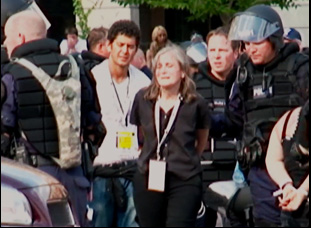 This isn’t intended to sound flip, but an inspiring part of the film to me as someone that works for an independent outlet myself is how easy you make all this look, even though I’m well-aware even for a small site like mine it’s quite difficult, but that maybe it isn’t as intimidating to take action as you’d think. Was that an important part of this for you?
Amy Goodman: I work with an amazing brain trust. It is a group of dedicated journalists and videographers, graphic designers, artists, people are deeply committed to independent journalism. And so I certainly don’t do this alone. And you see a lot of those people in “Steal This Story, Please” — Jeremy Scahill, who got a start at “Democracy Now!” You see Sharif Abdel-Qadous got a start at “Democracy Now!” Nermeen Shaikh, who’s still with “Democracy Now. These amazing folks who, we all share the same ideals as with Tia and Carl. And I think that is really what we were trying to convey is that these kinds of organizations are critical as President Trump targets the media.
Carl Deal: Yeah, and we wanted to tell a story that challenged these attacks on the media. We’ve been following the consolidation stories since Amy started covering it, and there’s so much said about it and so much documentation, but it feels like the rest of the world has finally caught up. Even the folks who work in those very institutions that are compromised now are there with us now because there’s no denying what’s happening. We never would have imagined 30 years ago the extent to which the transparency with which we would have a president who was out to manipulate, control, and bully the media by any means necessary. But it’s not a surprise that it’s happening.
Was there any dimension to this story that did come as a surprise in terms of an angle you should explore more that you might not have thought at the beginning?
Tia Lessin: We were surprised all along the way. Though we knew about Amy’s reporting over the years, there were many stories we hadn’t heard and what was the most surprising was, as Carl said, these assaults kept coming from on high against press freedoms as we were making the film. That informed so much of our filmmaking because it became clear that this was an institution that was really under attack like never before. Then in the last months as as we were finishing the film, the consolidation of the media was on steroids, so to see that the alarm bells that Amy had been ringing for 30 years were really being now noticed by everyone and there was no way to ignore this anymore and the grave impact it had, we were equally surprised by the story we were telling, but also the events that were happening around and how they were all converging.
I know the ending changed from the time the film premiered in the fall to what you see now in theaters. What was it like to engage with the present moment?
Carl Deal: Yeah, in very, very small ways, we live in the digital age where you can do things very quickly and relatively affordably. We’re independent, so we don’t have endless budget to do what we do, but we didn’t feel like we could put this film out and end it with a call to action and ignore what was happening in the last three months here in the States, because what we saw happening in city after city through the last couple of years, but really coming to the fore in Minneapolis was not just the brutality of the federal government and its willingness to cast the Constitution aside, but the way that community came together to support their neighbors and to put their foot down. That’s exactly an underlying tenet of what’s so important about independent media and what Amy does is you’re basically working in lockstep with your audience. You’re not giving them what they tell you to, you’re just giving them the truth and you’re accountable only to them. And they’re very appreciative is what we’ve seen when you do that.
Tia Lessin: One of the changes we had to make in the end was, because we were finishing the film before Telluride, Skydance Media and Paramount had merged as we were getting it ready for the theaters. They’re now circling Warner Brothers and probably by the time this film sees streaming, if it ever does, that deal will be done. So we couldn’t keep up fast enough with the current events, frankly.
Amy, this film ends up being so timely in a variety of ways — I know there was an amazing “Democracy Now!” 30th anniversary celebration recently as well, and of course, you’ve got to celebrate the wins, but at the same time, all this is going on. What’s this moment like for you?
Amy Goodman: Well, [the anniversary] was incredible because we did that at the historic Riverside Church where Reverend Dr. Martin Luther King, April 4th, 1967, a year to the day before he was assassinated in Memphis, gave his speech against the war in Vietnam where he said he realized that his country was the most powerful purveyor of violence on earth. He was slammed by the corporate media. Life Magazine attacked him saying he had done a disservice to his cause, his country, and his people and he sounded like he was reading a script from Radio Hanoi because he opposed the war. But he stood his ground, and you often have this where the corporate media represents the status quo and very much those in power. And then you have these movements and people like Dr. King, but it’s not people. It is like one individual, buoyed by an entire movement and though the president’s the most powerful person on earth, the movements are more powerful.
There is a force more powerful, and that is the movements of this country and around the world. That’s what he was tapping into, and here we were 30 years later just honored to be in this space. We had Hurray for the Riff Raff singing “Pa’lante (Forward)” after Juan González, one of the founders of the Young Lords, talked about his experiences, saying this group had one of the most positive portrayals of themselves of any group he knew because they understood the importance of controlling the narrative. And Tia and Carl put together a segment on Juan’s history that just by itself was so strong, it’s a little mini documentary. That idea of controlling the media, telling your own story, is fundamental to “Democracy Now!” We believe you have to go to where the silence is, where the corporate media for some reason dares not tread, where so many people are and it’s not quiet. It’s rowdy, it’s raucous, people are organizing. It just doesn’t hit the corporate media radar screen. And that is really the majority of the pulse of humanity. And I think that’s why “Democracy Now!” is so authentic. It’s not your typical pundits who know so little about so much explaining the world to us and getting it so wrong.
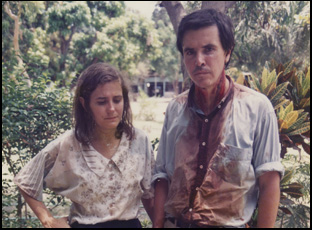 I know how difficult it is out there to get any movie but particularly a documentary into theaters these days, but has it been inspiring to find the networks that you can actually get this film out without engaging with the corporate structures involved?
Carl Deal: We’ve been down this path before, Tia and I knew a while ago that we were going to have to do this on our own. and much in the spirit of what Amy does with her team at “Democracy Now!”, we’ve identified that there is an audience. We’ve had a really successful festival run, and we’ve been able to gauge the audience response and obviously there’s a lot of love in this world for Amy and a lot of interest in learning more about her. So we’ve assembled a wonderful team and we’re already booked in nearly a hundred theaters at a time when the conventional wisdom coming out of the industry is there’s no appetite or audience for political documentaries. We’re hoping to prove them wrong. and so far so good.
We’re not doing it alone though, of course, because we’ve tapped into audiences that are paying this forward. Because of the moment we live in with all the attacks on independent media, with all the removal of public funding for so many arts organizations — a lot of these art houses are nonprofits as well, and they’re suffering —we are partnering with independent media groups, community radio and TV in all the major markets and bringing out their people and giving them access to the film for fundraisers. So we’re really conscious of that audience and trying to raise awareness and help plug their funding gaps right now as well.
Tia Lessin: Right, the same consolidation that has been so damaging to the practice of journalism has also been damaging to the practice of both fiction and nonfiction storytelling on screen. There are fewer distributors and those that are out there are limiting content. They’re limiting who makes the content. they’re limiting the kind of creative control the creatives have over the content, so this is liberating. We made this film independently, we’re distributing it independently. We have very few constraints except integrity. We want to be generous of spirit and we want to get this film out as widely as possible, so it’s exhilarating, actually to have this freedom and we hope that the audiences show up for this film.
Amy Goodman: I also want to encourage people to come out to the movie theaters because this is a communal experience. The pandemic really made me appreciate how incredible it is. As we build community media around the world, we want to ensure that it always comes back to that. Public media was there for us during the pandemic, providing a huge kitchen table that stretched across the globe that we all sat around and debate and discuss the most critical issues of the day, each one of us alone in our places. But now we can come together and keep these art houses alive, keeping your own mind and heart alive, and it is wonderful to watch a film like this together.
“Steal This Story, Please” is now playing at the IFC Center in New York and opens in Los Angeles on April 15th with a special one-night screening at the Laemmle NoHo 7 with Goodman and Deal in attendance before opening on April 16th at the Laemmle Glendale and Laemmle Royal, and on April 17th across California at the Roxie Theatre in San Francisco, the Smith Rafael Film Center in San Rafael, the Alamo Mountain View, the Rialto Cinemas Sebastopol, the Ojai Playhouse and the SBIFF Riviera Theater in Santa Barbara. A full list of theaters and dates is here.