



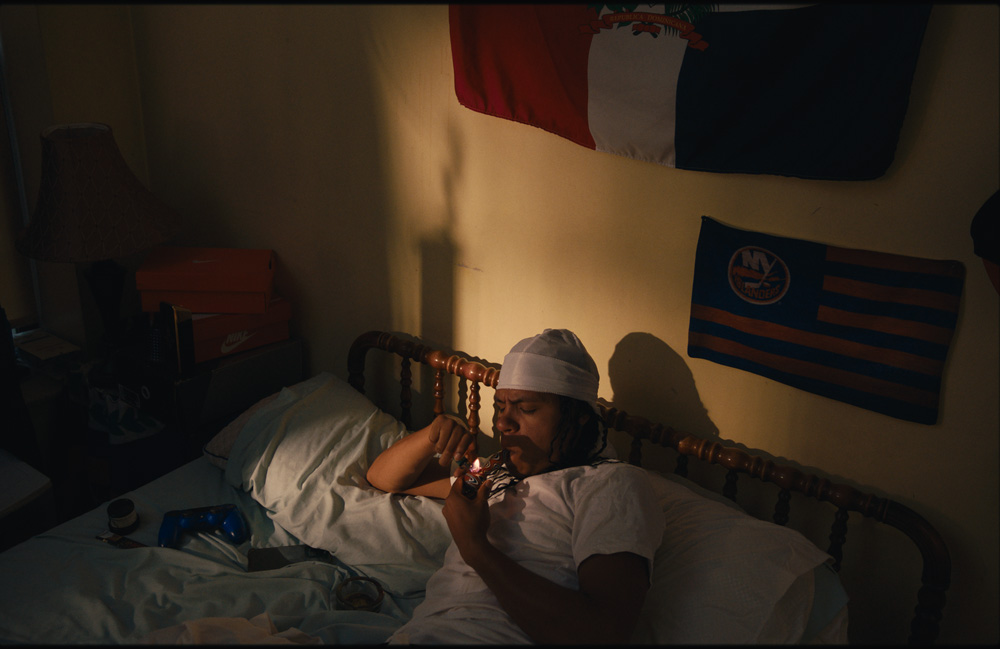

Joel Alfonso Vargas wrote about the Bronx he grew up in for his luminous feature debut “Mad Bills to Pay (or Destiny, dile que no soy malo),” but the film only started coming together as he lived abroad in England where he was finishing up film school and for as vivid as the memories were, there was still room upon his return to actually start production for the city to become a little crisper.
“It was really interesting, and even now when I’m back because I’m living there at the moment, obviously the things that you take for granted you start to see a new light,” recalls Vargas. “For me, everything was just beautiful all of a sudden. I could almost see it through the lens of a foreigner, so every time I come back, I watched the elevator train pass by and I’m just like, ‘Oh my god, this is so wonderful.’”
That feeling continually wafts off of Vargas’ disarming comedy even if it finds its lead Rico (Juan Collado) in dire straits, blissfully ignorant of the world of trouble he’s gotten himself into upon getting his girlfriend Destiny (Destiny Checho) pregnant when the two haven’t yet finished high school. Rico is industrious yet misguided, already trying to sell colorful drink concoctions called nutcrackers on the beach that only the most intrepid with iron stomachs might try when he’s first introduced and that’s simply to have some pocket change when he lives with his mother Andrea (Yohanna Florentino) and sister Sally (Nathaly Navarro) in a cramped apartment and cash is always tight. Both the space and the wallet are about to shrink a little more when Rico learns he’s about to be a new father and knows after Destiny’s own parents have kicked her out that taking her in is the right thing to do, though while he can pat himself on the back for being raised right without ever having the presence of his own father, he has no clue of how to handle the situation.
Filmed in long static takes where chaos is bound to break out inside of every scene, the film naturally extends the idea that despite being stuck, there’s plenty going on for Rico, who will have to learn the hard way how he’ll become a responsible adult, though Vargas suggests he may not be entirely conscious of how much he already knows from being raised in a house of full of women and while the path looks long and arduous for the young man, “Mad Bills to Pay” is short and sweet, full of crackling humor occasionally at his expense but also from observing the no nonsense world he’s grown up in when he just wants to be laid back. Vargas would seem to have it both ways himself when the film never feels forced and yet the punchlines couldn’t be sharper, owing the filmmaker’s canny approach to letting life into the frame. After charming audiences upon its back-to-back premieres at Sundance and Berlinale last year, the film is set to take over the world as it begins to roll out into theaters this week for its proper theatrical run and Vargas spoke about not only how he kept a loose atmosphere on set to get the best from his cast, but shrewdly designed a short that could be pulled from a mostly finished feature to generate excitement around his debut, which ultimately might not have needed it when announcing such a clearly special filmmaker.
 How did this all start out?
The idea came to me around the COVID pandemic. I was just doing a lot of reflecting on my childhood and where I grew up and like everyone, I was just trying to figure out what’s coming. Prior to the lockdown, I feel like for many people in the world, we lived these very busy lives where there’s very little space to really think about things. So I had all this space and for whatever reason, this character just kept popping up in my head who is based on a lot of guys I grew up around. I started listening to that and some imagery started to pop up in my head and I would log that all down in a notebook to the point where I got a really solid outline. Then I just parked it because around that time I was also going back to film school — in my twenties, I went and never really graduated, so I decided it’s lockdown, I might as well just go back and and finish, so I ended up in the UK at the National Film and Television School and I started to develop this idea even more. By the end of that, with people I’ve met there, we traveled back to New York and shot the film.
From what I understand, you did what so many filmmakers think about doing when they’ve already convened a cast and crew, but hesitate to pull the trigger on, which is stretch a shorts budget out to a feature. How did you make that decision?
We were at this film school who basically funded a short, so we took that money for the thesis project and put that towards the feature, basically. Usually when people approach making a feature coming from a short, a short is like a standalone thing [where] you use that as a calling card and it will take you maybe two or three years to then make that feature, but we inverted that process and made the feature first and from that feature, we cut a short. So the short was basically the first act of the feature and we submitted to the Locarno Film Festival via the school and that played very well there. We we won an award. Then organically the conversation while we were there was like, “Oh, so what’s coming next? Do you have a feature?” And [we could say] “Actually we do. It’s literally in post-production.” So it was great and between Locarno and Sundance, it was maybe a five-month period and having that short out for that time was a great way to build awareness and start building those relationships so that when we could release the feature, we already knew the people that we needed to contact.
There was some other money that needed to be raised, basically personal funds and [we] took out a business loan. It’s very entrepreneurial and higher risk because it’s a film and we made the film for peanuts. Only around the time when we got into Sundance did more money come in for music licensing and things like that, but we were just calling in a lot of favors most of the time. It wasn’t really calculated. It just happened that way.
What was it like to get the right mix for this wonderful ensemble you got?
We were very rigorous about our casting. We looked everywhere. My whole logic to it was to leave no stone unturned. I usually have a preference to work with people I meet on the street, so the initial approach was just to go to parks and beaches and we ended up seeing a lot of people through that avenue. But in the end, the casting process ended up being more multifaceted. Destiny Checo, who plays Destiny, we found on TikTok. Juan Collado [who plays Rico] was on Backstage and has acting experience. Yohanna [Florentino, who plays Rico’s mother] is someone I’ve worked with before, and Nathaly [who plays Rico’s Sister Sally] came via an agent, and that was it but to get there it took a lot of chemistry testing and different pairings. We saw close to a hundred people and the search was rigorous. Yohanna was the first person to fall in place in terms of who was cast because I knew I wanted to work with her as the mother, but then it became a job of [casting around her] and who looks like her, so the criteria just kept growing.
 Did the varying level of experience actually add to the energy on set? The final product feels very spontaneous.
Yeah, it did. It was challenging at points, but I think it was mostly pretty straightforward. When we ran into issues. on things with the improvisation, I could always rely on Yohanna, who’s probably the most experienced actor in the cast and I could almost direct by proxy through her so she would bring it back in if she needed to and we rehearsed a bit before principal photography and we did have little bits before scenes, so that helped us answer questions or iron out whatever kinks (they’re wearing them.)
[The film] almost always changes, not just on “Mad Bills,” but on every film that I’ve made so far and I welcome that. My writing is usually just a guide and I don’t really have a top-down perspective on it. I’m looking to make the film that’s in front of me, not the film that I’ve written, so I’m really relying on my cast and this is why the casting is so rigorous and we test so much because I’m looking at my cast to bring shades in the gray, the nuance and the experience and all that. That happens on anything if you’re open to it and they elevate whatever is there in the writing.With the character of Rico, a big part of the character is not having a father around to be a model for him. How did you talk to Juan about expressing that kind of absence?
With Juan, it was interesting because obviously he’s playing a character and it’s fiction, but I think his lived experience is adjacent is to this character’s lived experience. He grew up in a similar household like I did, without a dad and that was the ground on which we could connect with the story and talk about things. But in all honesty, we had him look at the outline and I think he glanced at it, and I don’t know if that was out of arrogance or because he just knew the story, so we didn’t really talk much around the text. He immediately understood what the character and what the scenario was about and he was able to play all these all these things with a lot of nuance and a lot of humor. I gave him full license to do that and the success of the film is a credit to everybody involved, but Juan did bring so much to to it.
 Was there anything that happened that you may not have expected but made it into the film and you now really like about it?
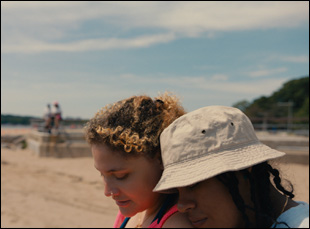
There’s a lot. It’s New York City and it’s a place where a lot of random things happen on a day-to-day basis. That’s a spontaneity that I wanted everybody to be sensitive to, so that if something interesting was happening, we’d just be ready with the camera to capture it and that’s what we did. For example, the couple that Rico meets on the beach and goes out to party with – he has that whole moment where he’s just fist pumping in the nightclub – we met those people literally quite randomly as we were shooting on the beach. I had someone basically go up to them and befriend them and they took a liking to him. Then they were just like, “Oh, what are you guys doing after [the beach]? We’re going over to City Island, just to hang out and party a bit.” Obviously this wasn’t on the schedule, but I was just like, “No, we have to take that opportunity just to see what comes of it.”So we had that flexibility despite the scheduling being quite tight, so it was just a balance.
Weirdly, that seems to correlate with the picture itself where you’ve got these static frames, but so much happening inside of them that’s unpredictable and something that really stood out as a result was the production design with how lived in these places felt. What was it like putting that together?
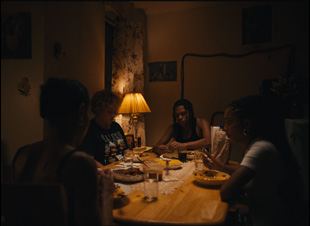
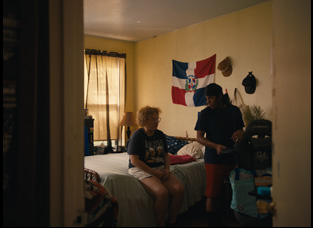
I wanted the the spaces to be as prominent in the film as the characters because I feel like those places tell a story, especially in a city where life is so transient. People are always passing through spaces, and photography was a big reference. I had this idea that although it feels so urgent and right now and immediate, on the other hand, life is passing through and this is one New York experience in a tapestry of a million experiences. We’re here for a limited window and then we go, to get kind of spiritual about it.
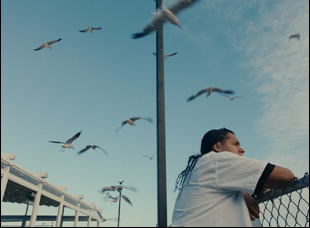 Was sound design a fun part of the process, it only bringing the environments to life, but placing the emphasis in an argument?
A lot of it is a credit to our sound recordist Mark [Brin], who was very good at finding these textures. He did some stereo recordings throughout the Bronx, on the beach and [elsewhere]. Then the other credit really goes to the sound designer Alina Ushakova, who without having spent much time in the Bronx, really went above and beyond to bring out those textures and add her own. There’s so many details that seem quite incidental or almost like part of the production sound that aren’t, like the ice cream trucks passing or the cars going by and get that sort of stereo pad. We spent a lot of time on sound because with one [camera position], sound becomes even more important.
What’s it been like to see the film start to get out into the world?
It’s been great. The film has exceeded every expectation that we had for it because we didn’t make it with a general audience in mind. We made it with a lot of specificity, so it’s beautiful to see that specificity really resonating with people around the world. We’re coming out through Oscilloscope now so more people get to see the film and honestly I just feel like I’ve got to pinch myself. It’s really cool.
“Mad Bills to Pay” opens on April 17th in New York at Film Forum and the Regal Concourse and on May 1st in Los Angeles at the Los Feliz 3 and Santa Barbara at the SBIFF Film Center.