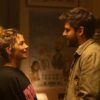
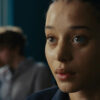



What always made “Psycho Beach Party” so potent, even in its original stage production, was the feeling of danger that surrounded it when actor and playwright Charles Busch skewered the sensibilities of ‘60s summertime classics such as “Beach Blanket Bingo” and “Where the Boys Are” by suggesting that there were much more lurid things going on under the sand, giving his Gidget-esque heroine Chicklet multiple personalities. However, when it came time to do a film version, Busch found himself pushing even closer to the edge, quite literally scaling a ladder to reach a movie screen high above the ground at a drive-in theater for the film’s climax.
“It was some silly thing because these crews are all straight guys, and it’s so out of character for me, but somehow I felt being in drag that I had to prove that I’m just as much a guy as all of you,” Busch recalls, ultimately giving into the wishes of director Robert Lee King who wanted to use a stunt double for the scene, but insisting he make at least part of the climb himself. “Maybe it would be different today – certainly I would be, but I felt I have to do the action thing, even though it’s really dangerous and in heels.”
Busch’s daring in all kinds of ways has paid off in time as the wicked satire has continued to be a crowdpleaser at midnight screenings since its initial release in 2000 and could seem as if it was made yesterday when it gave juicy parts to Lauren Ambrose, who would star as Chicklet, and Amy Adams, who played her rival Marvel Ann, and pushed the envelope with its queer sensibilities when a fair share of the muscle men on the beach are more interested in one another than the young women in bikinis or the movie star Bettina Barnes (Kimberley Davies) that has come to the coast to lay low.
If it felt like Busch was going for broke, it was because he never imagined the play becoming a film in the first place, employing a set that was primarily comprising of pages of teeny bopper magazines of the ‘60s and playing Chicklet himself, reveling in the joke of a 30-year-old man playing a 16-year-old surfer girl. However, when the idea of a screen adaptation was bandied about a decade after the show’s successful off-Broadway run, Busch and King reimagined the story as a murder mystery where not only Chicklet, but her various personalities including the particularly demanding dame Ann Bowman, might be a suspect and Busch could slide into an entirely new role of Captain Monica Stark, the sassy detective on the case of all the bodies starting to pile up on shore. Produced at a budget that might not have been too much more than the Frankie and Annette films of thirty years earlier, the film lovingly recreates all of the genre’s kitschy charms compete with rear-projection surfer scenes and an exquisitely furnished Tiki Hut for Kanaka (Thomas Gibson), the king kahuna of the beach, all of which adds up to the cinematic escapade that its characters desire and only the audience gets with all the pesky homicides going on.
“Psycho Beach Party” is having another high tide moment this week when it will celebrating its 25th anniversary with screenings at the IFC Center in New York where Busch will be joined by Ambrose on July 30th and director Robert Lee King on July 31st and Busch generously took the time to talk about how the radical reconception of his play to become a film, giving a glamorous performance on screen all the while he was actively developing a stage and screen follow-up in the equally cutting comedy “Die, Mommy, Die!” for which he would take home an acting prize at Sundance for the delicious spin on 1950s melodramas.
 I’m so glad this is getting its due now. Did you think this would be something you’d be talking about 25 years later?
It’s a strange thing about that movie because when it came out, I don’t think it really quite got the cult success that maybe we’d hoped for, but I found in some people from the cast that we’ve talked about or when it started showing on TV on cable in the late or mid-2000s, a lot of kids growing up saw it on TV and have a real affection for it, which is wonderful.
From what I understand, you weren’t initially sure it would make a good movie, but Robert convinced you to make a screen adaptation. How did it come about?
Yeah, the play which did quite well and ran about a year off-Broadway, but it was so uncinematic. Some plays, you clearly see how anybody could turn that into a movie script, but there really was very little plot in the play and it was just very campy and little narrative. I blame myself for a lack of imagination, but I just really couldn’t see it. But I had the most marvelous manager, Jeff Melnick, who was just this outrageous character and he just adored me. He passed away a few years ago, but I think it’s very few people who could say that they had a representative who thought more of their talents than they do and he just saw all sorts of possibilities in me. He really kept thinking that it was a movie and kept pursuing it for years and I just rolled my eyes. Periodically he would report back, and say, “Oh, so-and-so passed,” and I didn’t even know they were looking at it.
But then [Jeff] became the manager of this young director/screenwriter Bob King and Bob had made a very, very well-received short film that Marcus Hu’s company Strand released, along with two other short gay films, and Strand was very interested in Bob doing a feature. So [Jeff] got the idea to put us all together. Again, I just didn’t quite picture it, but Bob, even as a young man, had a wonderful story sense and he contributed enormously. My play was strictly a pastiche of early ’60s beach party movies, “Gidget” in particular, but Bob thought that it would also be fun to make it also a pastiche of ’70s slasher films, which was a genre I wasn’t even familiar with. In the [initial] script, there was no killer, so Bob came up with the idea that there is someone who’s killing these surfers.
That solved another big problem because in the original play, I played Chicklet, and lo, these many years later when [it was going to be adapted for the screen], I was way too old, but also we didn’t want it to be that stylized a movie with an older man in drag playing a teenage girl, so there was gonna be a biological girl playing the part, but they all wanted me to be in the movie. So who was I going to be in? I didn’t want to play the mother. That really wasn’t for me. So then I thought, if there’s a killer, then there needs to be a detective, and wouldn’t that be fun if I was a Susan Hayward-kind of a hard-boiled, rather glamorous lady detective. That was really, really fun.
On the DVD commentary for the film, you mentioned how you were concerned about how being in drag might translate to the screen, both in your performance that you had perfected on stage, but also visually. What was it like to pull it off?
I had little parts in a couple of big mainstream movies — actually, I shot three weeks on “Addams Family Values,” as their glamorous actress cousin, the Countess Aphasia Adams-Dubarry, and then I was totally cut out of the movie. But it was fascinating experience being on this big, huge fantasy film and being photographed so carefully by Don Peterman, an Oscar-winning cinematographer, so with this little film, I was concerned. What I do on stage is that I like to think that I’m rather realistically presented as a woman. I’ve never been that stylized a drag performer and I’ve always had rather realistic makeup, so I was concerned how I would look. Almost my entire role is played out in exteriors too, but I think I look pretty good in the movie and [was working with] very talented people — and so many young people working on this film and in every department.
 You clearly had Bob directing this, but when the tone is so attached to the cadences of the dialogue and it was in tune with those beach party movies of the ‘60s, were you working through those kinds of things with the cast that may have been less familiar with those films?
Bob was very concerned that someone in my position, having done the play and [being] the writer and the actor being there all the time, could take over and be giving notes, which I understood. And there really does have to be one person in charge. But I’ve never really wanted to be a director and I think I’ve got excellent manners, so I stayed away, and I was very pleased with the tone because so often young people who haven’t done their homework or just don’t have a feel for period dialogue, it can sound kind of like an audio thumb in your soup.
We were very fortunate with Lauren Ambrose, who, considering her youth, was a highly skilled actress and verbally very sharp and nuanced and she had really such a difficult assignment there. I wasn’t all that involved in the casting, but I think that it was between Lauren and one other actress and Bob showed me their test. Both were very good, and it’s so funny how people’s minds work. I think Bob had Sandra Dee in his head [since] Gidget is blonde, and Lauren has naturally red hair. But I said, “Well, there’s kind of a history of redheaded funny ladies? Ever hear of a lady called Lucy?” So it wasn’t an issue, and we were just very fortunate to have her.
Is it true you told Robert he should be looking more for someone in that role to play Ann Bowman than Chicklet?
Yes, that would seem to be the most difficult thing to find. It’s one thing finding a cute young girl to play a cute young girl [as Chicklet], but so much of it, she has to be this kind of Tallulah Bankhead/Cruella DeVil kind of lady and [Lauren] was able to do that. I wonder if it’s because she studied opera and maybe gave her more exposure to the grand manner.
Something that’s really different from the play was the whole addition of Kanaka, played by Thomas Gibson who has this great rhyming dialogue on top of everything else. Were there opportunities like that you were excited about with a screen translation?
It is hard to revisit something and try to get your enthusiasm back, and the screenplay really doesn’t bear that much resemblance to the original play, other than some of the Bettina Barnes [patter], some of that stuff is verbatim. But when Bob came up with this whole slasher plot, that’s something completely brand new that we laid into it. All that stuff with my character [Captain Monica Stark] and Kanaka, that’s all brand new, and I rather enjoyed it because it really was a challenge. I learned so much and I really have to thank Bob for teaching me a lot about screenwriting. Shortly after that, I had the chance to do “Die Mommy Die” as a film, which had also been a play at first, so I was able to apply, you know, all that I had learned from Bob King on “Psycho Beach Party” and “Die Mommy Die,” was easier, also because the play was a melodrama pastiche of Bette Davis and Joan Crawford ’60s suspense films, so it had a real plot. And they came right after each other.
 They actually overlapped, from what I understand, at least in terms of actually doing the play version of “Die Mommy Die” as the film production of “Psycho Beach Party” was going on.
Yeah, it was nuts. I knew I was gonna be in L.A. making the movie. On paper, it was a very short shoot, 21 days and I wasn’t playing Chicklet, I was playing a much smaller role, so it would seem that I would maybe work 8 to 10 days on [“Psycho Beach Party”]. And I got this call from my dear friend Ken Elliott, who had directed all my early plays and was living in L.A. to find work in television as director, and he said, “Well, you’re gonna be in L.A. What do you think we did a play at the same time?” And I said, “Ah, sure, that’s a great idea.” So I had to come up with some sort of play for us to do.
I can write really quickly on assignment, and I thought I have to write something that’s one set with not too many characters, so I came up with “Die Mommy Die.” I wrote it very quickly and somehow Ken got ahold of the Coast Playhouse on Santa Monica Boulevard in West Hollywood. The theater owner promised to raise all the money for us to do this play, but it turned out that the theater owner hadn’t raised any money, so Ken and I were going around to all these different parties of rich gay people, and I would be in my black dress and red wig, and my friend Carl, who came with me to be in the play, he and I would just sit at these parties, get up and do little scenes from “Die Mommy Die,” trying to raise money. And we were panicking because we’d promised these [set and costume] designers that they were going to get paid and [there was a question] are we doing it or not? It really was down to the wire.
And at this point I’d started filming [“Psycho Beach Party”], and I was in a conversation with Victor Syrmis, one of the producers of the movie and I don’t know why I didn’t think of this before. but I was just telling him our tale of woe. And he said, “How much do you need?” It really was not a huge amount of money. And he said, “I’ll just give it to you.” So he was the sole investor on the play. But then it got really kooky because we were rehearsing [the play] and I was filming the movie and everything was moving pretty good together. But our first performance was on a day when Bob King had us way out filming [“Psycho Beach Party”] in Canyon Country [a few hours away from West Hollywood with traffic]. I think it was my entrance to the movie where I come on in a police car. We got so delayed and it was so far away that I had to call Ken at 5 o’clock and say, “We have to cancel opening night. I’m stuck three hours away.” So he wasn’t too pleased, and then sure enough, the next day it happened again. We were sold out each night, and I felt so horrible for Ken and everybody. Finally, I think the fourth night, I wasn’t working and it all worked out, but in the beginning, that was just hideous.
That’s amazing – and I’m glad to see you survived. What was it like to actually step on the set of this film that all began in your imagination?
The production designer [Alberto Gonzalez-Reyna] was wonderful and [for] the play, we were almost on an empty stage with just these cutouts of surfboards and it was very stylized. But I remember when I first arrived and saw Kanaka’s shack [where] there were all sorts of skulls and things, it really was exactly like those movies [from the ‘60s]. And then the luau was wonderful. That was a brand new experience for me to see something that was in my imagination completely brought to life so perfectly, yeah. And then the costumes were very good. We actually weren’t quite sure what to do with me and we went to [Camille Jumelle] the costume designer, a wonderful person, and we went looking at police women’s uniforms at a costume rental place and oh, there were some big clunky things and I had to look kind of sexy and glamorous. Since we were striking out with that, I said, “What about a stewardess’ uniform?” Because particularly in the ’60s, stewardesses were all somewhat sexualized and sure enough, we were able to find this navy blue stewardess uniform that fit me perfectly and had this allure to it.
One detail I noticed that’s wild now is that there’s a scene with a Margaret Keane painting in the background of Bettina Barnes’ house – the eyes transfix the people in the scene and one of them is a young Amy Adams.
Oh, that’s funny and later she played Margaret Keane [in “Big Eyes”]. She was quite young – I think she had done a couple films before, but her mother was there [on set] chaperoning her. What was a bit awkward was when we shot the big luau scene and part of the plot was that there’s that a dance off contest and it’s between her character, Marvel Ann and Bettina Barnes, the movie actress, and Bettina Barnes is supposed to win, but Amy Adams was a very skilled musical theater performer and an excellent dancer, so she really had skills. And Kimberley Davies, this lovely Australian actress, played Bettina Barnes, and was a lovely comedian, but just couldn’t dance, so it was like, what do you do? [laughs] It was so clearly that one is better, and yet the wrong one wins. That was weird, but what are you going to do?
It turned out great as is. What was it like to see this come out?
I was very pleased when I saw it, which was nice — and rare, when often that’s not the case. I thought Bob did a great job and I did good. And it made me very excited about trying, wanting to make another one. I was also so glad that “Die Mommy Die” came out fairly quick. [The play] ran maybe three months in L.A. and I met this producer Dante Di Loreto and his partner Mark Rucker, a wonderful theater director, who came to see “Die Mommy Die” on stage with the idea that Dante had some book that he was interested in me perhaps adapting. We talked about it. and somehow it seemed like not quite right, but then it just happened that Mark had this fantasy that he wanted to make a classic woman’s picture starring me. And he didn’t know me. So when I was doing this play, it all worked out and I had filmmaking on the brain because we had just made the film [of “Psycho Beach Party”], so then it all happened very quickly, and at least in my memory, we shot “Time Mommy Die” not much more than a year later. Isn’t that crazy? If only it stayed like that. I wish I had made more movies.
 You should be really proud of the ones you did make.
I really am, and how fortunate I am that so few theater artists, particularly in the avant-garde or non-profit [space], get to have film versions of their plays and that I do have a record of two lovely films that show who I was, what I did, and that I think are rather specific to who I am. That’s a nice legacy.
Are you up to anything now?
It’s funny, I’m in the middle of what I’ve been working on for the past nine months and I’m moving towards the home stretch. I’m writing my first murder mystery novel. And it’s very, very hard. I advise you not to try to murder someone because it seems to be very difficult to cover all your tracks. But one of my characters is this girl Rachel, who’s a film blogger and it takes place in 1971 and she has a Xeroxed quarterly that she puts out called Sprockets.
Let me tell you, it is a cutthroat industry, so there is occasionally murder on the mind.
Well, it ain’t easy. That’s what I’m learning. But I’m having a good time.
“Psycho Beach Party” screens on July 30th and 31st at the IFC Center in New York.