



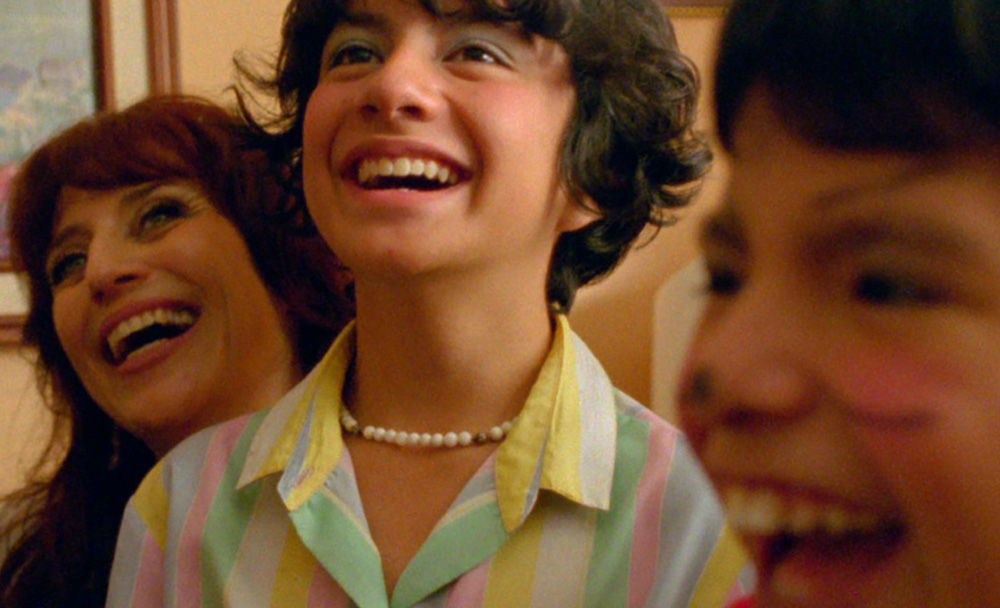

There’s great economy in the scene introducing the family at the center of “Six Months in a Pink and Blue Building,” shown both by them as they work through their morning routine in a mercilessly cramped apartment and filmmaker Bruno Santamaria Razo giving all you need to know about their group dynamics in the process. Having the precocious Jade Reyes as a fictionalized version of himself at 11, singing in the shower, his father Mundo (Lázaro Gabino) is revealed to be sitting right outside on the toilet just as naked as his son is while the matriarch Diana (Sofia Espinosa) comes whisking in to brush her teeth and potentially take a shower as well before realizing she doesn’t have the time. It could be a concern that there are no boundaries among the bohemians, but the ease they have around one another is a lovely expression of how close they are and how they’ve had to often make the best of potentially uncomfortable circumstances, which make it all the more heartbreaking in Razo’s phenomenal third feature when any distance is allowed to grow between them.
Unbeknownst to the family, they will never be this close again, the morning of Bruno’s 11th birthday party where fittingly after a huge celebration, Mundo learns from a friend that he needs to come in for further testing after he shows signs of the HIV virus and suddenly when taking on the task of bursting balloons at the end of the night as part of the clean-up, it is the father who looks deflated when it seems like he’s been sentenced to death. Razo does a remarkable job of evoking the ‘90s when only enough was known about the disease to fear the worst yet the number of deaths that had already mounted led to well-intentioned awareness campaigns that might’ve cultivated greater empathy but also might’ve been misguided. (As Bruno experiences at school, a cartoon outlining the transmission of the disease with a cuddly creature putting on a condom leads to laughs in the classroom as it’s all deadly serious to him.) While Mundo, a boisterous artist known to dress in drag for fun, withdraws from much of his life, preferring to deal with his diagnosis by himself, the burden shifts to Diana to understand what’s really going on, not only unable to have conversations with her husband when he doesn’t want to share, but also informed by her husband’s medical team to start contact tracing, swallowing any of her own pride as she calls any of his potential sexual partners to inform them of his illness.
The actual opening scene of “Six Months” involves Razo sitting his real-life mother down to talk about what it was like during the titular time period that the mostly dramatized film chronicles, making no bones that what you’re about to see is a true story, though the authenticity clearly runs throughout without needing such notice. The director will wield the nonfiction element of the film in a truly unique way when it seems like the narrative will spare the real Diana from having to go into too much detail about the most difficult time in her family’s life on camera while the interview scenes can add some much needed context in the dramatic sections at quite judiciously selected moments as the mother suffers in silence, though Espinoza as well as Reyes and Gabino all do so much with so little dialogue. The hybrid nature of the film also packs an unexpected punch when it allows Razo a formal outlet to express the real processing he’s doing of this formative time in his life in making the film, giving his version of events to his family in the only way he feels comfortable articulating it when his father’s diagnosis had a profound impact at what point he revealed that he was gay.
When the six months immediately after the diagnosis is all that’s covered, Razo is able to get at far different tragedy than might be expected, observing the life drained from Mundo before the physical aspects of the disease can take their toll and witnessing the implosion of the family that feels they have to hide things from each other when they’re in uncharted territory and fear how one another will react. It has a particularly chilling effect on Bruno, whose burgeoning puberty is pushing him towards having unusual feelings for his friend Vladimir rather than Natalii, a classmate that makes her affections known, and as he is made to think AIDS strictly affects gay men, he is disillusioned by wondering what his father and mother’s actual relationship is and whether he’d be accepted when the diagnosis puts everyone in so much pain. Yet though it may not sound like it, there is plenty of joy to be found in “Six Months” when Razo remembers the family’s parties and the jazzercise lessons his mother gave to neighbors in their tiny dining room as vividly as any of the heartache. Just as the director seems to know exactly when to give his real-life family and the cast he’s assembled to play them a chance to breathe, the film has an invigorating aura of catharsis about it, offering not only fresh air for Razo as he finally expresses all he could be conscious of as a young man, but audiences as well when it’s conveyed with such ingenuity and an open heart.
“Six Months in a Pink and Blue Building” does not yet have U.S. distribution.