



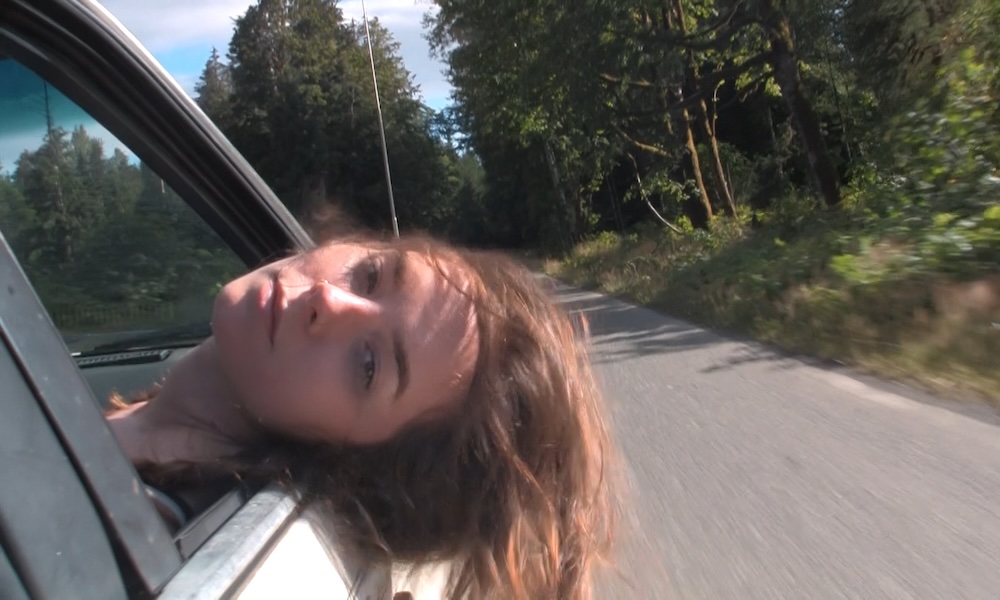

Palmer (Avalon Fast) and Iris (Jillian Frank) share a phone, the latter has to explain in “Drinking and Driving” after she takes a liking to Levi (Ethan Hawksworth), a customer at the restaurant where they’re waitresses as she passes along a number. Palmer threw her own phone in the nearby lake, indicative of the temperamental behavior that can irk Iris, but the two are best friends in a small town and it seems only appropriate that you can reach either of them on the same line when they rarely seem apart. Palmer has to wonder if they spend too much time together when she asks Iris if she’s become bored of her, to which Iris responds definitively no, yet she wishes they had a larger circle of friends who could join them and when they can’t necessarily depend on any place to stay – a brief glimpse of Palmer’s mom suggests she’d rather have the company of a boyfriend than her daughter – they know they have a home in one another’s arms, which can be as dangerous as comfortable to know when they’ve reached the point in their lives that it could be time to spread their wings.
Since making her feature debut “Honeycomb” while still in her teens, Fast has been associated with genre, but she’s had a penchant for making the occult as enchanting to audiences as the heroines in her films, which ironically makes the hard reality of “Drinking and Driving,” co-directed with “Honeycomb” star Frank, the easiest to describe as a horror film or at least the most frightening as it fits snugly in the drama aisle. The two never need to put too fine a point on how inhibiting their rural upbringing can be, captured with the stark immediacy of a consumer-grade DV cam, as the circular nature of their days spent waitressing at a cafe and nights downing cocktails after work comes to look like a vicious cycle. (As Palmer says to Iris only half-jokingly, she was informed that the more nights you drink, the better the hangovers are.”) Shrewdly the two’s relationship isn’t defined as anything other than close when they’re introduced, suggesting a romance between them at first when they canoodle after the TV signal cuts out at Palmer’s grandmother’s place where they have to stay for the night, only to reveal that sex may be a way of staving off boredom and both have boyfriends (notably left off screen), though you wouldn’t know when they have time for them when they work together and play together, going out to the local shore with their other friend Hailey (Payton Berg).
However, another disturbing pattern starts to crop up as the reasons why Palmer and Iris seem stuck after their high school years become more obvious, with Palmer feeling beholden to her ex-boyfriend who’s said to be institutionalized and Iris afraid to tell her to cut bait, among other serious conversations the two resist ever discussing when accepting a doomed fate seems easier than trying to imagine an alternative. The filmmakers insert a gloriously juvenile barrage of bouncing bosoms and butts during an early day at the beach, but any playfulness starts to coarsen as the film itself wears on, culminating in a night of cocaine-snorting where all the fun is seen for the self-destructive behavior that it is when it’s unlikely getting high will alleviate any of the issues anyone young in town faces and a drug addiction simply becomes one unhealthy habit among others that will be hard to shake if trying the move on. (The eerie feeling that the camera is being passed around the room by hand in a harrowing single take is one of the more inspired aesthetic decisions in a film full of them, often transforming its budgetary constraints into visual ingenuity.)
It isn’t only Palmer and Iris who threaten to stumble around by the time the third act rolls around when the film curiously pivots around Levi and his cousin Phoenix (Henri Gillespi), the two guys that the women begin to gravitate towards at late night parties. When one suffers a personal tragedy, the impact is dulled by the relative lack of investment in the character compared with Palmer and Iris and a deliberate rollout of details that can be more confusing than intriguing. Still, it’s a testament to the ability that Fast demonstrated in previous films to channel a certain dream logic that can transfix even when the narrative starts to flail – the climatic scene of trauma being recounted is mesmerizing due to a striking overhead composition and the feeling of intimacy conjured rather than the dialogue that can be difficult to parse. A bold, unexpected ending could come across as abrupt and perhaps as if the filmmakers had run out of ideas in lesser hands, but with any amount of reflection, Fast and Frank arrive at the only conclusion that makes sense with a brilliant expression of wrestling with the seduction of a place that offers comfort in the familiar as well as confinement and how an increasingly limited view of the world encourages the surrender of individual good judgment to continue keeping the peace somewhere that refuses to change. The characters in “Drinking and Driving” may have become too timid to consider any other way of living, but Fast and Frank feel as if they’re on the verge of a breakthrough, having a vision of cinema that can be breathtaking in its originality.
“Drinking and Driving” screens again at the L.A. Festival of Movies on April 12th at 3:45 pm at Now Instant Image Hall. It will next screen at the Brunswick Underground Film Festival in Australia on May 17th at 2 pm at Balam Balam Place.