


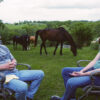


“It was the smartest stupid thing we did,” Lois Dodd says in “Artists in Residence” of the three-floor building she would acquire with two other artists – Eleanor Magid and Louise Kruger – on East 2nd Street in New York in 1959. A decade before Greenwich Village became a hotbed for the likes of Lou Reed, Patti Smith and Julian Schnabel when old abandoned buildings allowed for struggling artists to find their footing without paying much in rent, it took some vision on the part of Dodd to strike a deal with the owner of a funeral home a few streets over to own the apartment that she had lived in since moving to the city from Montclair and create a creative hub for herself, Magid and Kruger without worrying about having to keep a roof over their head, a collective that would endure for nearly a half-century.
Dodd, Magid and Kruger aren’t as obviously provocative subjects as their counterparts across town, but that’s what makes Katie Jacobs’ profile of the artists so compelling when their road to sustainability was no different than more famous contemporaries and their story hasn’t been told. The priorities of the three women are established from the film’s opening frames where Dodd welcomes cameras into her home full of canvases yet no obvious place to sleep — she confesses she has a rollaway mattress she brings out when absolutely necessary — and time and again, Jacobs is careful not to romanticize the trio as their desire to remain independent and in control of their own destiny came with considerable sacrifice, choosing a life for themselves that wasn’t always easy for the kids they raised as proudly single mothers.
Kruger passed away in 2013 – and as it happens, was the last of the three to move into the building — so she always seems slightly more at arm’s length than the very much alive Dodd and Magid despite being presented as an equal. Yet the film observes how all three created a community together that brought beauty to the entire neighborhood they shared while pursuing distinctly different disciplines as artists with Dodd a painter, Magid a printmaker and Kruger a sculptor. Their individual art is lovingly presented, but it is seen as only part of their overall vision when over the years Magid opened up the building to students left stranded by a teachers’ strike in her capacity as an educator herself, Dodd helped found a gallery that would become a showcase for local artists and a meeting place more than a business endeavor, and Kruger kept watch over nearby Albert’s Garden where a group of unlikely greenthumbs sprouted with the shrubbery.
It would’ve been easier for Jacobs to simply look to the women’s work to consider their legacies, but in looking to their children, all of whom are interviewed in the present day with complicated and often ambivalent feelings about the environment they were raised, the film reveals itself to share the ambition that Dodd, Magid and Kruger had to do the uncharted, adding to an appreciation of what they achieved while questioning the cost it had. Magid’s daughter Gabriell now wonders how comfortable she should’ve been as a child walking around a house where nude models would hang out and how her mother would subsist on cigarettes rather than food, leaving little in the cupboards to eat, yet raising her own daughter has allowed her to see that parenting is just another art that her mother had to figure out for herself.
When the film actually does have the material following Kruger’s death to see what becomes of the physical works an artist produces, usually tucked away in storage or in private collections never to be seen again by the public at large, the ability to put the central trio’s full lives on display seems especially poignant, particularly when the three can be seen fighting for recognition throughout their career. However, it isn’t just the three getting their due in “Artists in Residence” that makes it such a moving portrait, but that it really does give a full picture of how creativity wasn’t limited to any one part of their lives.
“Artists in Residence” will screen again at DOC NYC on November 20th at the Village East at 7:45 pm and will be available virtually on the DOC NYC online platform from November 15th through November 30th.