



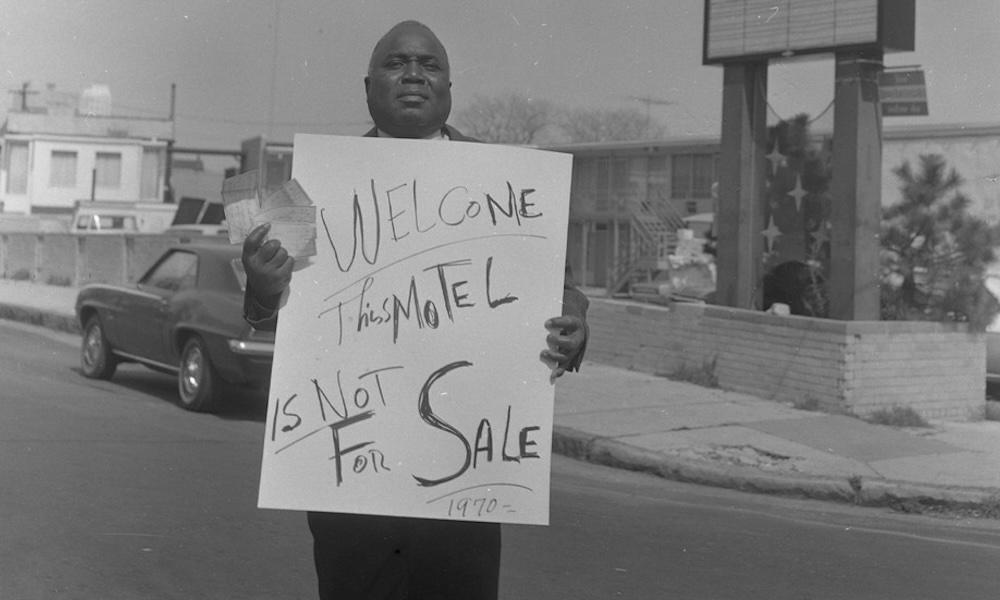

“It means so much more than the balcony of Room 306,” Dr. Noelle Trent says of The Lorraine Motel in Memphis, Tennessee in “The Lorraine,” a landmark best known to most as the place where Dr. Martin Luther King Jr. took his final breaths in 1968. However, the reason that Dr. King had stayed there to begin with is because of the safe haven that Walter and Loree Bailey had built up over two decades as segregation still reigned in the South, becoming a rare Black-owned business in one of its major cities and upon its reference in the Green Book that gave African-Americans a guide to where they could stay without incident during the Civil Rights era, it became a bustling hub of activity, especially when the legendary Stax Records was right down the street.
Alvin Hall and Sam Pollard conjure all the magic that was once there — and has since returned when the site, which lingered for years in infamy after Dr. King’s assassination, was reclaimed recently as the foundation for the National Civil Rights Museum — in their electric new documentary, which traces the Lorraine’s origins from a 75-cent-an-hour motel to a true resort offering the same luxuries to guests as they might find at the then-trendy Holiday Inn, but no worries about being turned away at the door. When Walter Bailey named the hotel after Nat King Cole’s “Sweet Lorraine” as a nod to his wife, it was only fitting that guests would include the Staples Singers, Curtis Mayfield and Isaac Hayes, who was known to take a dip in the hotel’s pool even when he wasn’t staying there, and as Negro League teams came through town to play the local Red Sox squad or the Harlem Globetrotters were putting on exhibition games, one could expect to see their fair share of famous athletes in the lobby as well.
Pollard, who has been making films about Black excellence in every realm you can think of since first taking the director’s chair for a few sections of 1990’s “Eyes on the Prize,” finds a remarkable intersection at the Lorraine where more than a few of the greatest R & B and soul songs ever recorded were first written in their rooms as well as some highly sensitive conversations between Civil Rights leaders that led to great strides for the movement. But as much as anything else, “The Lorraine” allows for all-too-rare glimpses of leisure time for the Black community as they got to enjoy the same quality experience that their white counterparts could regularly expect, an expression of joy that was crucial to the resilience required to fight oppression. The film also plunges into the different attitudes towards how best to take on that battle when some felt it was disrespectful to build anything atop the site of Dr. King’s tragic death, yet the push to create the National Civil Rights Museum became a galvanizing moment to make sure that an entire history was remembered. It’s one that is carried on with great gusto when Hall and Pollard find so many with fond and vivid remembrances of their time at the hotel, from the Baileys’ daughter Carolyn and former employee Mary Ellen Norwood Ford to Queen of Soul Carla Thomas and Andrew Young, and with the film premiering this week at the Tribeca Festival followed up by a stop next at DC/Dox, Hall and Pollard spoke of their sensational collaborations, getting this vital oral history on the record before it can be lost to time and how all the great music led Hall to write some of his own.
How did this all develop?
Alvin Hall: I did a BBC Radio 4 [program] called “The Green Book” back in 2015. During the production of that radio program, we stopped at the Lorraine Motel and I interviewed Carolyn Bailey Champion, the daughter of Walt and Loree Bailey, and heard the story of her mother’s death. I was astonished and it stayed in the back of my mind. Then in 2019, I did a road trip to do a podcast called “Driving the Green Book,” from Detroit to New Orleans and stopped in at the Lorraine Motel and interviewed Dr. Noelle Trent. She revealed that “Wait Till the Midnight Hour” and “Knock on Wood” was written at The Lorraine and I thought, “Why don’t I know this?” Then I came back and started to do research and found that there was all of this rich cultural history. People had met there, civil rights actions had been had been planned there, and it was unknown. That’s what led me to create this film.
Because so much happened there, did the parameters of this make themselves known pretty quickly or did it just keep expanding on you?
Alvin Hall: I think it kept expanding because I started with the Lorraine and the Baileys and then you can’t talk about the Lorraine Hotel or the Baileys without thinking about Memphis at that time and their pursuit of the American dream in the context of segregation in Jim Crow and what was different about segregation in Memphis and how in many ways this echoed across different cities and towns in America. In other places, like in Birmingham, Alabama, where you have the A. G. Gaston Motel, there were people pursuing the same dream in different ways, but this story had so much more to it because it was associated with [Martin Luther] King. It was something known to a broad part of the population and we could expand upon their knowledge
Sam, what got you excited about all this?
Sam Pollard: Alvin! I met Alvin in 2023, at a screening of my Max Roach documentary [“Max Roach: The Drum Also Waltzes”] and he and one of the other executive producers, Joe Wemple, were at the screening and later reached out to me about the possibility of directing a documentary about The Lorraine. Like a lot of people, I only knew about The Lorraine from that event on April 4th, 1968, the day Dr. King was assassinated. So to be able to have Alvin send me a bunch of different books about segregation in the South, Jim Crow, the Green Book, and in a place like Memphis, [where] people could stay at the Lorraine if they traveled to the South, it became like, “Wow, this story needs to be told and needs to be documented.” So we started the journey. Alvin started a long time before me, but he was dedicated, focused, and a tremendous fundraiser to make this thing happen.
Sam, this also intersects with so many other movies that you’ve made – “Lowndes County” was particularly in my mind as I was watching this. Do the films build on one another as far as maybe there was something you couldn’t explore in one that you end up exploring another?
Sam Pollard: For me, it’s a great honor and pleasure to have the opportunity to tell these stories about the African-American experience, which is the American experience. So to go from “Lowndes County and the Road to Black Power” to “South to Black Power,” the one I did on Charles Blow or to the Sammy Davis Jr. film [“I’ve Gotta Be Me”] or “Slavery by Another Name,” it’s all a part of this continuum of me being able to have the opportunity to tell our rich history and legacy. I’m always always proud to be able to be in involved with films like “The Lorraine.” Very, very proud.
Was there anything where this went in a direction that took you by surprise you didn’t expect as you were doing the interviews or found some story nugget in the archival that was really unexpected?
Sam Pollard: Every time you sit down and interview some people – and Alvin was able to connect us to a group of wonderful, wonderful people from Dr. Noelle Trent to Ryan Jones to Adrienne Bailey, the D’Army Bailey’s widow, so anytime you sit down with people, you have your questions and always, always your interview subjects will say something or do something that surprises you. It’s like when when Ryan [Jones] talks about the fact there was a soul singer Nat King Cole, who wrote the song “Sweet Lorraine,” that’s an opportunity to hear the great Nat King Cole. Or, you know, Dr. Trent [says], “I don’t want to say that the death of Dr. King caused problems with the Lorraine, but it did.” Those are some wonderful little nuggets that you say, “ahhhh.” The wonderful contribution of the people you interview, you’re always surprised.
Alvin Hall: I was thinking about how we found Mary Ellen Norwood Ford, one of the executive producers. I met her brother and her brother said, “My sister worked at the Lorraine Motel. We did not know of her before that. So I called her up and she was just brilliant. It’s wonderful to meet someone who was there in that moment and has yet to develop a sort of fixed narrative about it and to talk about it a detached way. It is still living within her. When we interviewed her, it was some of the most rich and moving moments in this whole film.
I imagine as time moves on, it’s getting more and more difficult to get firsthand accounts as people pass on and we’re further removed from this time. Was it a challenge?
Sam Pollard: It’s hard, but we were pretty fortunate with Mary, with Eddie Floyd, with Steve Cropper, with Deanie Parker. These are people who were there. They were on the ground, which is great. And sometimes you don’t have first-hand accounts, but in this case we did, which makes it special.
Alvin Hall: And they tell stories with such warm, beautiful memories [full of] fun and empathy, but also you can see how much the memories mean to them as they tell the story. It cannot help but connect to the audience as they watch this. Two people died after we interviewed them — Carolyn Bailey Champion, the daughter of Walter and Loree Bailey, and then Steve Cropper, who wrote “Wait Till the Midnight Hour” with Wilson Pickett, and he also wrote “Knock on Wood” with Eddie Floyd. So we were lucky to be able to get those.
Obviously, you’re capturing such an important history and as Sam mentioned, the needle drops are both organic from the interviews, but also give the film such energy. What was it like to put a soundtrack together?
Sam Pollard: Yeah, you think about all the different songs and you’ve got to remember Stax Records was there [in Memphis]. It’s the home of B. B. King, Rufus Thomas and so many great musicians, so you’ve been given a wonderful gift to have such wonderful music that came out of that that community.
Alvin, I noticed you even contributed a song with Dan Braun, who’s a producer of this film and well-known to the documentary community as a producer of so many other great films. How’d you both get to exercise these musical muscles?
Alvin Hall: During the filming in Memphis, we were there three times and Dan was inspired by music that he heard, being around the singers, so he started this melody and he said to me one day, “Alvin, I’ve written this song and I have some early lyrics here. Would you like to collaborate?” And because I read poetry and I love music — I have probably 7,000 albums in my house — it’s in me, so I just started making the song a journey that reflects where we’re going and what we need to do. I thought, “That’s how we want to end this film. We want to end it by encouraging people to continue the journey that we’ve shown them in the film of learning [about the history] and joining together so that we can keep the movement going.” That’s one of the lines in there. It was so much fun to do that.
What’s it like getting to this point with this and getting ready to share it with people?
Sam Pollard: Yeah, I’ve done it a lot of times, but I’m excited and I don’t usually say that. I can’t wait for an audience to see this film because we got some wonderful contributors. We’ve got a great musical score. We got great needle drops. What else can you ask for? It was a great team to work with, and I’ve worked with lots of different production teams, but this was absolute aces.
Alvin Hall: For me, it’s unbelievable, [though] I’m a person that not get excited until the day of. I live in a state of total denial. It’s my first film. It started out as an idea after those two visits [to the Lorraine] on the podcast, so for me it’s the realization of something that’s I couldn’t have imagined. In fact, a friend of mine said, “Did you ever imagine you’d be doing this?” “Nope.” So for me, this is like opening a new door to things.
“The Lorraine” will screen at Tribeca on June 5th at 8:30 pm at the SVA Theatre, June 6th at 5 pm at the AMC 19th St. East 6 and June 13th at 11 am at the Village East.