



It was ironic that the practicalities of making a period picture these days led Tina Gharavi to keep a careful eye on letting any signs of contemporary life enter the frame in her vibrant adaptation of Virginia Woolf’s “Night and Day” when it is replete otherwise with nods to the present.
“Much credit to our DOP Sebastian [Edschmid] and our B camera [operator] Robert [Patzelt] as well on that for the logistics of a limited set because we did have the beautiful Edwardian Victorian streets of the Beamish Museum, which is an open-air museum that exists in the north of England, [as a set] so we have these incredible trams and [we had] the extras that can fill this whole environment and situate the drama in something that can make us really believe that 1910 London existed and we could feel what that society was like around Katherine,” says Gharavi, who could feel the pressure herself of tilting the camera a centimeter to the right or the left and dismantling the overwhelming world that the burgeoning astronomer Katherine Hilbury felt she had to take on as a woman ahead of her time when a stranger walking around in a T-shirt from Abercrombie and Fitch could easily break the spell.
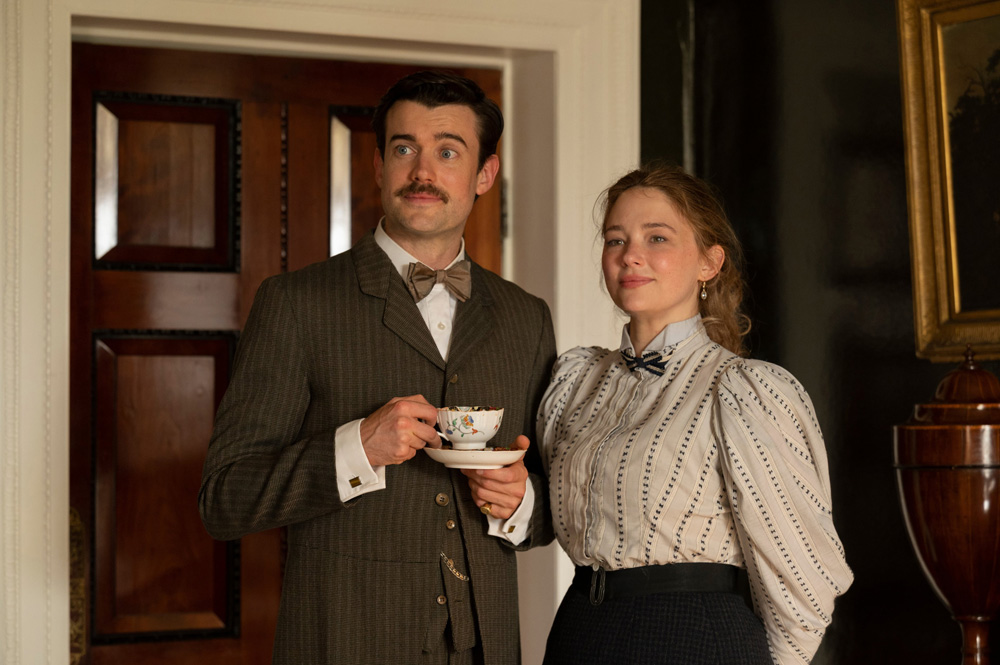
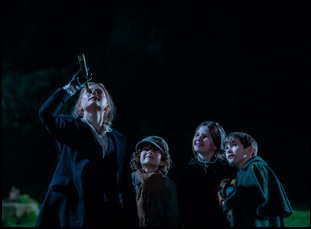
While great pains were taken to ensure everyone was buttoned up on set at all times, “Night and Day” proves to be anything but as a breezy empowerment drama as it follows Hilbury, played by a vivacious Haley Bennett (“Swallow”), as she aims to secure a spot at Cambridge for her studies, despite the fact that higher education remains very much a boys’ club at the turn of the 20th century. It’s fitting that her scientific specialty is looking towards the stars above while she seems tethered to the ground below, discouraged by her father (Timothy Spall) from doing much of anything but finding a good husband (with Jack Whitehall attempting to fit the bill) and dismissed by the gatekeepers in the scientific community where she has to go in disguise to be in on the conversation. Still, as is typical of Woolf’s heroines, she is a woman of extraordinary potential if anyone gave her the opportunity to let her express her talent and bit by bit, she shows she can’t be denied.
The film takes on her relentless energy as Gharavi makes sure Katherine doesn’t feel confined by the times she’s in with lively camerawork to match a quick wit and it can’t help but be a bit cheeky with fun touches such as casting Lily Allen as the host of underground meetings to ultimately win women the right to vote. Gharavi, who began in documentaries, has long inspired with tales of women who find the strength to stand on their own, starting with her 2012 feature debut “I Am Nasrine” and that independent streak makes “Night and Day” pretty irresistible, even to her when as she admits a drama set in turn-of-the-20th Century England wasn’t easy for her to imagine when her eyes have been squarely focused on making progress on any number of fronts. We felt quite fortunate to catch the filmmaker in the midst of making her latest feature (“Häxan”) during a wild month in which her previous two are reaching theaters (the other being “Shadows of Beirut”) and she generously took the time to talk about what ended up appealing to her about revisiting Woolf’s novel, finding the right leading lady for the film and rethinking the structures that govern modern storytelling, both in her own films and around them.
 What got you interested in “Night and Day”?
I actually met the producers when they were making a Virginia Wolf biopic “Vita and Virginia,” which I initially started a conversation about, but they went another direction with that and then they came back to me when they were developing this project “Night and Day.” it’s this incredible story about Katherine Hilbury, an astrophysicist in 1910, but because it was a period piece, I wasn’t sure I was the obvious choice for it because why would I be the one telling this story? Then when I really read the book or talk to Justine [Waddell, the screenwriter] about the script, I really realized it was quite a modern story about what costs there are for women to follow their ambition. It was as relevant today as it was in 1919 when Virginia wrote it. Still, I think in the interview I initially tried to put them off, so I was like, “I would do it this way. I wouldn’t follow these conventions. I’d make it probably more like a teen film.” I was very sure I wanted to try to push the boundaries of the genre. Then we started talking about it.
I feel you did that and it’s interesting because you were coming off of the “Queen Cleopatra” miniseries where clearly taking a new perspective on history was important. Is there actually an appeal about going back to the past and looking at things differently?
I really think that that’s all there is. We calcify the sense of who we are, don’t we, through the stories we’re told. Every time I think about “Lawrence of Arabia,” I think about Peter O’Toole. I can’t even picture the real Lawrence of Arabia sometimes. It’s so infused with how David Lean made that movie, which is an absolute favorite of mine, but I’m not sure how faithful my sense of history is when I really just remember the movie. That’s what the power of movies. It’s so potent. It’s so much about capturing our sense of imagination and belief and us constructing a sense of who we are, so telling it slightly differently and being told by a different type of person, surely that’s important.
This is a generally straightforward narrative, but it inevitably has to hit some familiar narrative beats and does so in different ways, and you’ve said before your background as a video artist leads you away from a more traditional three-act structure. Is that something you’re thinking about upfront or once you’re back in the edit?
I think films are always about collaboration. It’s about who comes on board. There are lots of collaborators in this, but really in terms of the role of the director, I’m the metronome and I’m the conductor of that orchestra and I’m keeping a tempo that maybe goes against some of the grain of how this symphony has been [unfolded] before. And it’s not all me, but at the same time, it wouldn’t be this film without me — I see that’s the work of the director. There’s a subtlety in how it’s done and I’m here directing another movie [now], a whole different thing and a whole different set of people, but I’m keeping them in a unity of vision around this particular story and it’s going be very different the night and day, but it still has me as the spine.
 To that end, I’ve heard you say that “Night and Day” was unexpectedly personal in the strand about the relationship Katherine had with her father. Did that reveal itself to you as you were making it or was it foundational?
Well, I definitely have a father who’s loomed large in my life and in one sense, that story about following one’s passion against societal norms, I definitely related to that and had some of that in my own biography for sure. But there’s so many layers. There’s the writer, which is obviously the original writer, is Virginia Woolf, then there’s the interpretation of that, which I worked on with Justine Waddell, the screenwriter and then obviously there’s also the actor who interprets that too, so all these layers of adding bass notes and the color and the highlights and it’s all collaboration. But what I wanted was to tell a story that felt entirely relevant for today because Virginia was a modernist and you had to think what would she be telling now? We had this amazing opportunity to make this film, so why would we tell something that feels like it’s an aspic or nostalgic for a time that neither Virginia lived in or we really want to invoke. We want society to move forward to be more radical and groundbreaking, as Virginia wanted in her day.
What sold you on Haley Bennett to play Katherine?
I was actually obsessed with Haley before making this film. There’s certain faces and certain energies. She had a really wonderful Instagram for a period of time in which she told stories about her daily life, living in upstate New York I think [during] the pandemic. I just thought that this was a really interesting person that had a really interesting aesthetic and ideas about the world, so I always remembered Haley. Then when we were trying to cast this, I believe this was the first name I suggested and the the producers hemmed and hawed, but luckily that’s where we landed. Haley is dynamic. She has an energy that’s really captivating. She’s electric. You can also read so much on her face, it doesn’t have to be text. She transmits these deep, intense layers of emotion that you’re just captivated watching it. Or at least I was, but I feel like everyone else is saying that too, so I’m glad that I’m vindicated in this.
The other really intriguing casting choice, even though it’s only a small role is Lily Allen, who generally doesn’t do a lot of acting. How did she enter the mix?
Yeah, the producers were like, “Are you sure? How does this work.” But again, I think Lily is one of those archetypes of women that goes against the grain, a thinking woman’s crumpet, as we would say in England. I do know her mom, who’s also a film producer, and I always just thought this is a great role, but I didn’t dream that Lily would accept. It was the first offer we made on that role and she was down for it and that was fantastic. But she is that [character] — an interesting woman and an interesting feminist for our times. That’s what Mary Datchet needed to be was depicted by someone who we I thought was doing something different with the idea of womanhood.
The energy you’re describing becomes a real part of the film’s camerawork, which has a lot of movement and closeups, which are unusual for a historical drama. How did you come up with the visual language?
I didn’t want to make a film that was like people in rooms talking about people in other rooms. That was one of my only caveats for making this movie was it needed to be dynamic and active. When I look for a way of telling the story, I wanted it to always be that we are in motion with the characters and we didn’t feel that static camera as much. In some ways, I wish we pushed that more, really getting into the documentary style of telling stories and making things vibrant and authentic. But even when this is a period drama, it can still feel that we are not just looking onto a stage, but we’re in it and we’re going on this journey with the characters that is forefronting authenticity and connection because period dramas can be mannerist. They can really in one sense feel like they are other and different and I didn’t want to create that distance. I wanted us to feel immediately in it, identifying with the character of Katherine Hilbury, having that experience where you know you go through a catharsis with a character and you leave the cinema feeling invincible.
I’m always working on that, like how do we create more immediate experiences using cinema? How can we use cinema as an empathy machine, as a way of connecting and feeling with stories that maybe we either relate to a lot or that are very, very foreign, but that we can understand through cinema? I still think that film is a political art and who tells these stories is important, how we tell these stories, and what way are they being told. It’s actually everything because it really is a reflection, it’s a mirror of who we are, therefore it is a political act to tell stories.
That’s why it is so difficult for certain people to be able to tell certain stories. There are gatekeepers for a reason. If it didn’t matter, then it would be easy. Because the majority of people on the planet are female. There’s a reason certain things are getting commissioned or funded or supported to get made and I’ve been so lucky. It’s not beyond my understanding that I am on my fourth feature film, which is incredible. That is already such a privilege. But at the age I’m at now, a lot of male directors would have six, seven films under their belts and we can’t put films into festivals that aren’t made and you can’t award films that that don’t exist prizes. So we have to look at like what is getting through, who is getting through, and I really think that there are structural reasons we need to to think about because I don’t want it be to be as difficult for female or nonbinary filmmakers in the future or all the other reasons we don’t have good stories coming out.
 What is your next movie that you’re actually shooting now? I know you’ve said you’re working towards a biography of the Iranian poet Forugh Farrokhzad.
I’m making a Swedish lesbian horror film with Erica Linder and Tania Miller, almost like a low budget chamber play that’s funded by Little Walnut, Moby’s company and he’s going to do the soundtrack. It just happened very, very suddenly. We started talking about it in February and then we started shooting in August, which is really unheard of, but we were very lucky that Little Walnut decided to back the movie. And Forugh’s the next project that’s very, very dear to my heart. I think I’ve been working on that since 2014, even before I came across “Night and Day.” It’s a very difficult film to get made because it’s a biopic about an Iranian Roman poet in Farsi. But I want to take all the skills that I learned on “Night and Day” and “Häxan,” which I’m doing now, to make that. It’s a very important one to tell, particularly with the context of what’s happening around the world and the discussions around Iran, Iranian women, and women’s rights everywhere.
I’ll be excited to see it. And not only can audiences catch “Night and Day,” but you directed “Shadows of Beirut,” which will be in UK cinemas this month as well. What’s this time in your life like?
I’m almost confused myself. I’m like, “Wait, making a movie. I’ve got two coming out. I’m the busiest person in the world.” It literally is a timing issue like buses. I made “Shadows of Beirut” through lockdown and it has been very difficult to get that movie out. It just happened that we put what we could together with it and obviously, what’s happening in Beirut is incredibly difficult and it meant that we couldn’t go back to shoot any additional material, so the majority of the film was shot in Bulgaria during lockdown. But I’m glad the film is seeing the light of the day and it’s unbelievable to have two movies opening in the same month. Who am I? What’s going on? But I’m looking for scripts. Forugh’s on its way, but I’m going to need good stories to dig myself into in the coming years and months.
“Night and Day” opens on September 4th in theaters around the U.S.