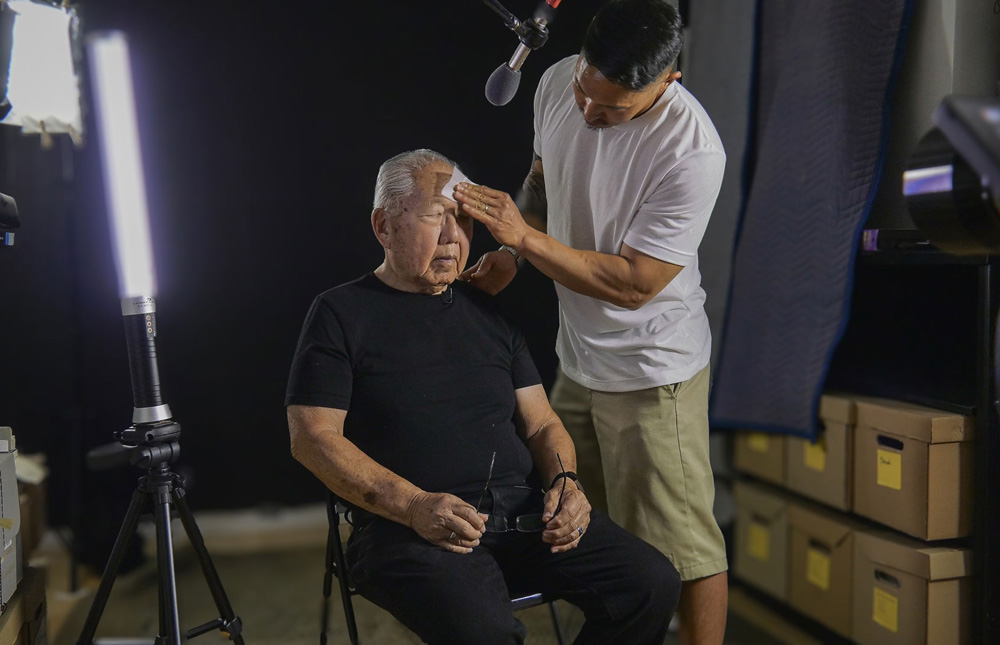

At one point in “Third Act,” Robert Nakamura begins to recall how he first entered the arts, taking pictures for an Asian American newspaper in Los Angeles where he realized that simply by training his lens on the world around him, “I was creating a visual idea of community.” Nakamura would go on to build an organization that continues that work today in Visual Communications, which continues to help finance documentaries about the Asian American experience and regularly presents them as part of their annual L.A. Asian Pacific Film Fest, in addition to his own extraordinary filmography that includes the 1971 documentary “Manzanar” about the internment camp in California where he was incarcerated at the age of six and the sweeping drama “Hiro Hata: Raise the Banner” that took on no less than the entire twentieth century in looking at the tale of a Japanese immigrant trying to make a life for himself in the U.S. The filmmaker was not someone who would want to be looked upon as standing alone, yet as a trailblazer and a talent, that status nonetheless fell to him.
As his son, Tadashi Nakamura found himself in a similar spot when there was no one else but him who could likely do justice to Robert’s legacy in a film, but nonetheless that responsibility is a lonely one, especially when his father’s health took a turn for the worse as he started putting together “Third Act,” having to tell the story of a true lion in his field as Parkinson’s started to rob him of his fierce intellect and passion. There’s a fascinating tension throughout the tender biography about what Tadashi’s responsibilities are as a son versus being a filmmaker and how those can overlap, particularly when it’s Robert that’s pushing for filming to continue given how he would’ve handled the circumstances himself as a filmmaker, and it isn’t just Robert who is driving Tadashi, but his own son Prince, who isn’t old enough to have any opinion on the matter, but surely will want to know more about his grandfather as he ages as Tadashi understands from having that same gift given to him by Robert, who made a film about his father.
Simply revisiting Robert’s films would extend his legacy when they remain as relevant as ever in a time where Asian Americans are still seen as the other as the fallout from the pandemic revealed, but Tadashi shows in his skill as a storyteller that he’s carrying it on in other ways and “Third Act” employs Robert’s place as a witness to history as a means of transcending an individual biography to provide a panoramic portrait of Asian American life no less ambitious than what Robert undertook with “Hiro Hata,” speaking to years of resilience and enduring traditions. With Robert’s passing earlier this year only a few months after the film’s premiere at Sundance, “Third Act” can now be seen as a testament to a remarkable man, but also a living document that can continue to inspire and as the director behind it graciously spoke about how it’s already helped him he cope with loss, he also talked about what it’s been like to be able to allow for his father’s memory and what he captured through his lens to live forever and what he felt he owed to others to push him to keep the cameras rolling.
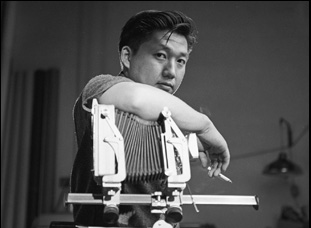 You say in the film that you always felt like you would make a film about your father, but what kicked it into gear?
I think the initial seed was planted when I first saw “Wataridori: Birds of Passage,” which is the film my dad did on my grandfather, and I was eight. When I first watched it, it was like time travel and it was not only cool to see someone I knew in a movie when it was my grandfather, but I was able to hear him and see him as a younger man — as a gardener, as a judo instructor and not just a grandfather. My main interaction was the traditional grandfather/grandson [relationship] who’d give me ice cream when I would come over after he had watched the Dodger games and keep to himself. So that film was such a gift to me that when I started thinking about making a film on my dad, I thought “Well, how can I create the same gift for my kids about my dad?” Initially, the goal was to really just focus on him and do a portrait of my dad as an artist, but also to capture for my kids not only the younger version of my dad, but the present, vibrant person that I knew [now] they probably wouldn’t remember when they’re older since they’re so young.
What was it like for you being able to time travel a bit with the footage your father created in general?
That’s something that I actually probably took for granted. I remember I showed the film to my friend who’s a filmmaker and he was saying how amazing it was that we have all this high-quality archival footage of our family and he said he had never seen that much representation through multiple generations of a non-white family. I realized that’s a privilege when your dad is a photographer and archivist and your mom is also a scholar and archivist. I grew up with just this treasure trove of not only archival photos and film, but it was all high quality and professionally shot and it was great because it’s one thing to hear these stories from your family, but it’s a whole another to actually see photos from those stories that prove that those stories are right, but then you also have the texture, so when I’m imagining these stories, I have some images that that play through my head.
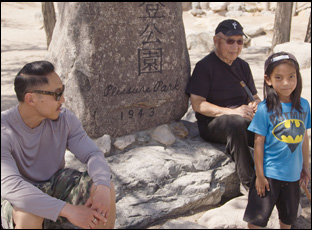 Was there anything in the archives that really brought life to something you had heard about so you could understand it in a way you hadn’t before?
Yeah, as a kid, I never saw my dad express the shame and anger and resentment he had towards his dad. Obviously, my dad featured my grandfather in multiple films of his as well as a lot of photo essays, so I always thought my dad was very proud of his dad and I’m proud of my jichan, but in the interviews when he started admitting the shame that he always felt around my jichan for having an accent, for being a gardener and a migrant, and not being able to do the things that his other friends’ dads did, that came as a surprise. Another surprise that came is that I realized how broken my dad still was even in his late to mid eighties [from his experience in the internment camps]. I thought that he had gotten over it or that it was more of a activist making films to educate people, but I realized that he was very much an artist who was using film and his craft to work out and process his own trauma that he had not only experienced as a child but throughout his life due to racism.
You make such a great guide for this story, but from what I’ve heard, you didn’t necessarily think you would include yourself in the film. What went into that decision?
Yeah, I did not think I was going to play as big of a role as I ended up playing. I always knew I was the one that should make the film about my dad and to be honest, I always felt pressure that everyone else was looking at me to make the film on my dad, but it wasn’t until multiple people had said that — I think executive producer Spencer Nakasako, who was a big mentor of mine, reminded me that only I could make meaning as his son from my perspective — so we really leaned into that because anyone could make a biopic on my dad. But once it became the goal of me telling my dad’s the story through my eyes, that’s when I really had to become part of the film, but then also once [my father] got diagnosed with Parkinson’s, which didn’t happen until the early part of production on the film, then it became a way for me to process my dad’s mortality as for my dad to process that for himself. That became the space when we realized, “Okay, we should probably document the process of making this film because two filmmakers — father and son — that’s a very different dynamic than a traditional director and subject relationship.
When you have a film as something you’re working on together, does it open up conversations that you might be reluctant to have as a family?
That’s exactly what happened. The whole time I was wearing two different hats — the filmmaker hat and the family’s son hat — and I think putting on the director hat forced me to ask questions, to do research and prepare for interviews or conversations with my dad that normally as a son I would never do. More importantly, because my dad is also a filmmaker and he knows the honesty and depth it takes to make a good film, he really forced himself to be vulnerable. All the interviews of my dad were done just in his office with me. There was no crew, so it was just me and him and it was very intimate, but at the same time I think because there was a camera there, that helped force me to ask the harder questions and forced him to be as vulnerable as he could and normally he probably wouldn’t.
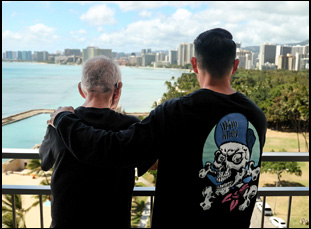 One of most striking moments in the film is when you’re driving him around and talk about whether you should film during certain holidays when obviously it would be important for the film, but also you wouldn’t want it to get in the way of engaging as a family. What was it like to put that dilemma in the film and to outfit your car with a GoPro in the first place to get such a crucial scene like that?
Yeah, the car has always been this this space where my dad and I would talk. We’d always talk at the dinner table, but with everyone at the dinner table, that was more chit-chat. Because both of us are Japanese American men, especially for my dad of that generation, it was very rare or it felt very uncomfortable for us to be vulnerable or even emotional with each other. But in the car, where it’s still an intimate situation because we’re sitting next to each other, we don’t have to look at each other. We both are looking out the window, so our car rides were the time when we would actually have these really deep conversations. I would ask for his help and we decided to use the GoPro [when] it was more of a time when we [thought] we don’t know what this story is going to be, so let’s just try to capture everything.
But [deciding when to film and not to] was definitely the biggest struggle and I thought it was all about getting the film done and that would be the end of this negotiation. That’s the hard part of making a film about your life — there’s that thin line right between “reality” and this film that you’re making, but once the film was out, we were lucky enough to premiere at Sundance and then right after that we hit the film festival circuit and it felt weird for me when on one hand ,I have this film about me trying to be a good son and trying to be a good father, but I’m having to leave my aging father and my young kids to tour this film. So even screening the film became this negotiation. I knew my time with my dad was limited and he wanted me to show the film, but every weekend I screen the film on the road is a weekend away from him or my own family, so that that continued to be a struggle.
It may be too early to ask when not only the film was only recently completed and your son may be a little too young to fully appreciate it yet, but you’ve got this incredible compendium of memories now. What’s it like to have for yourself beyond being able to share it with others?
This film has been a gift in multiple ways. It took seven years to make and I think that gift has evolved and changed. When we were making the film, I had a lot of anxiety about losing my dad and becoming a father — or being a good father — but now the film is now serving as a gift as a tool to help me in my grieving process. My dad passed in June and pretty much ever since then, I’ve been screening the film and I’ve been able to talk about him and that’s really been forcing me to to process his death but at the same time to celebrate him and mourn him at the same time publicly. It has been really helpful and I think that gift will continue because hopefully when my kids are much older, it’s a time capsule on one hand, but it’s like the ultimate family album that I know will change in meaning, depending on who’s looking at it.
“Third Act” will open in Los Angeles on September 26th at the Monica Film Center. A full list of future screenings is here.