




It was nowhere near as easy as you might think it was for Sook-Yin Lee to adapt Chester Brown’s graphic novel “Paying for It” despite the fact that it covered the time they spent together as a couple. It wasn’t the fact that their time together was unmemorable or from his perspective, but the filmmaker who has lived so many lives – as a musician, a VJ for Much Music in Canada and a director – isn’t one to dwell so much in the past. Yet as she was preparing for the production of the film, she went downstairs to her house and found a collection of water bottles that Chester Brown had filled up and dated in the event that they would ever need it during inclement weather and all of sudden everything came rushing back.
“There is such specificity in that weird detail that says everything about his character,” Lee remembers. “And then people say now, ‘Oh my God, [that scene] rings so true. I do that too.’”
There are plenty of details like that in “Paying for It” that ultimately make the story recognizable to so many, though often it is about a subject that rarely surfaces in public when concerning how Brown’s thinking evolved about companionship. The comic book artist entered into a relationship with a sex worker after he and Lee tried out an open relationship at her request and while he and Lee remained friends, their romantic parting gave way to an enduring romance that might be frowned upon by society at large. It might’ve been a difficult time for all involved, but upon reflection with all the creativity that artists like Brown and Lee could bring to it, the real-life events have become a fizzy romantic comedy where Lee remembers her own time being thrust into the limelight as a VJ at a time when popular culture was moving away from indie rock at the turn of the century to boy bands and a certain conservatism was setting in all facets of society, making Brown’s own search for sexual satisfaction particularly fraught.
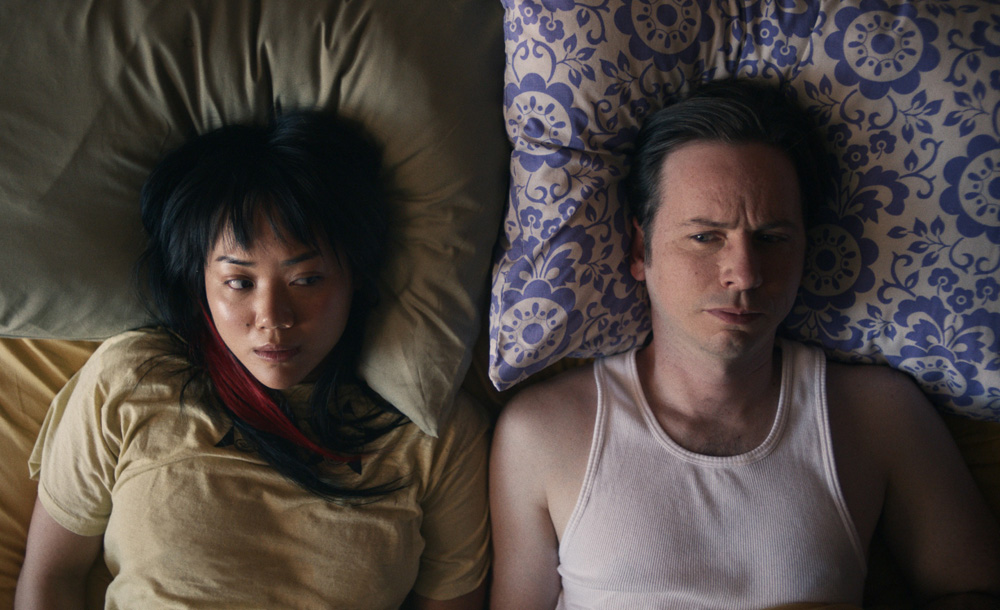
The sex positive attitude that “Paying for It” seems refreshing even now and the film is given plenty of life by Lee filming in and around Toronto’s vibrant Kensington Market neighborhood where cultures gloriously collide, as do the fictional versions of Chester (Dan Beirne) and Sook-Yin surrogate Sonny (Emily Le), who decide to continue living together even after separating from each other as lovers. They also only remain somewhat faithful to the idea of not bringing their new partners around the house, leading to as many sparks flying for the wrong reasons as they do for the right ones when Chester starts to become enamored with Yulissa (Andrea Werhun), who works in many fields ranging from historical docent to sex work. The film finds as much fun as it does tension in the complicated dynamics at play and its warmth clearly comes from the affection that Brown and Lee clearly have for each other and the nostalgia they now have for this time that they grew from.
After the film made its world premiere at the hometown Toronto Film Festival in 2024 and Lee criss-crossed the country in the year that followed with the film, “Paying for It” is now making its way across the border for a U.S. release where screenings in New York and Los Angeles will be accompanied by Q & As moderated by special guests such as Elliott Page, Mae Martin and “I Like Movies” director Chandler Levack and graciously, Lee took the time to take a few questions from us beforehand about this delightful comedy, finding such exciting casts for her films and how all of her work has to have a real foundation.
 This seems like a particularly crazy undertaking given all the personal connections, but how’d this come about?
Chester Brown is a great storyteller and a fantastic cartoonist. I was a huge fan of his before we even met, and I’m a musician first of all, so when I was touring, I went to Toronto and we met and we hit it off and we fell in love and then he moved back to Vancouver with me, so he’s been a constant in my life for more than half of it and is still my best friend. His book “Paying for It” came out in 2011 and I was blown away. It’s a very bold, brave book and it’s complicated to wrap your head around, but Chester is very nerdy and introverted, has no ability to like hang out and socialize. Meanwhile, when Chester and I moved to Toronto, I got a job as a VJ on Much Music, which is like Canada’s MTV, and I was jettisoned into this totally extroverted lifestyle of interviewing bands and going out to shows, so our interests started to go different ways. I’d drag him out to a concert and he’d be in the corner reading a book.
During that time, I developed a crush on someone that I had met and I couldn’t douse it, yet I was still very much in love with Chester. Back in the day, many people in the underground arts community were in open relationships and I didn’t want to cheat on him, so I made a proposal like, “You want to try opening up the relationship? I think I’m developing a crush on this person.” Chester is very much a freedom loving person – his own but also very respectful of everybody else’s – and he could see that I was interested, so [he said] “Why not give it a whirl?” And I got the green light to try dating as well as juggling our relationship. He, on the other hand, had no ability to flirt and didn’t want to be in a relationship, so he was celibate for a long time until it was unsustainable and he began to be curious about paying for sex. That was the basis of his graphic novel, and he had the wherewithal to understand that what he was experiencing would make a great story.
He very much had observed the lack of rights [for sex workers], which puts them in harm’s way and his graphic novel was a polemic for the decriminalization of sex work. The back of the book is full of academic notes and interesting political ideas. One of them articulated the parallel between queer liberation and sex worker rights. In the ‘80s, if you were a gay guy in Toronto at a bathhouse, oftentimes they would be raided by the police and you would get arrested. It was criminal behavior. We’ve come a long way since then. Now in Canada, gay marriage is legal and a lot of rights have been hard won. But when that book came out in 2011, it had everything to do with human rights to me, so I loved the book and wanted to make it into a movie.
 From what I understand, it was not an easy adaptation. How did you figure it out?
Chester had been approached by a lot of world-class filmmakers to make the film, but he granted the rights to me because he trusted me and liked my work, so at first I thought, “Oh, this is easy peasy. It’s a comic, so right here is the storyboard.” The first draft was a direct transcription of his book and Chester and I read it and [thought], “This is terrible.” We realized very quickly that a graphic novel is not a movie. His was very episodic, and what I needed to do is figure out how to transfer that to a three-act structure with characters that make decisions and have flaws and transform. When I told this to Chester,” he said, “I have no flaws.” He’s extremely confident. And I was like, “Wait a minute, that is a flaw. I’m going to write that down.” [laughs] [The book] is myopically from his perspective. He was very, very protective over the details of the sex workers in his graphic novel, so oftentimes they’re framed out and I am a character in his book, but I provide only in the inciting incident of opening up the relationship that jettisons him on his course. Other than that, it’s really from his perspective, but I really wanted to bring the sex workers to life and he would not share any of the details because he was very, very much protecting their privacy.
So it took me years to figure out how to turn the book into a movie. I had to do my due diligence to interview sex workers, look for clues in the source material, and it was not until I, having read the book for the umpteenth time, saw that he had seen a sex worker on my birthday, and a pang of jealousy came up. I was like, “What? That was my day.” And then I realized, “Wait, this was interesting. If I only expanded the canvas of his graphic novel to incorporate all the stuff that was happening in [both] our lives, because we were living in Kensington Market in this tiny house, I thought, “Well, here is a situation where a very close couple has opened the relationship and have very different responses.” It was only then that I realized it could address some questions he had around possessive romantic monogamy and I added a bunch of stuff happening in my life, then it started to come together. So the movie is really a combination of the two of us. It’s a double act of portraiture. I try to uphold his memory of himself as he sees himself in his memoir and then I construct a character called Sunny, who’s based on me and she’s a work of auto-fiction. So it’s a very much an anomalous film in that it is rendered from real life, but then also it’s a very strange [fictional] thing.
 All the more beautiful because of it. Once you get the actors involved, how much do you share of your own experience versus allowing the actors to create their own characters?
As a director, you’re assailed by many questions and you need to be able to all of them. All the key creatives want direction, and because it came from real life, I had all this documentation – the kinds of clothes that I wore, the kinds of examples of stuff I would do on television. It’s a low budget film, so I called in tons of favors. I shot in my house, where the real-life events occurred and drew from my friends in Kensington Market and shot in my friends’ places. I was like, “Oh, your place looks like a brothel!” And they’re like, “Yeah, people knock at the door and ask if Lip still works here.” I’m like, “Perfect.” [laughs] And I called up my old boss, who let me shoot in his TV station on the weekend, so it was really a galvanizing of many people in my community. I feature music videos from back in the day from my peers and bands who had great production value in those era-specific videos.
In terms of cast, they did want to see. Dan Beirne, who plays Chester, was already a big Chester fan and knew of his comics. When he did the audition, he was like, “Sook-Yin, I’m a-okay with full frontal and I will shave my head bald.” I’m like, “No need to do that. That’ll be a continuity nightmare, but great.” [laughs] And they’re very similar people – I just made sure that I cast everyone who was of the right feeling. A lot of the actors who portray sex workers in the movie have a nuanced understanding of sex work. They’re stand-up comedians, they’re activists, they’re dancers, they’re musicians. Some of them are filmmakers who deal with sex work in their own movies, so to have that veracity was really important. I could lean on them for the authentic insight.
I’ve made a couple movies with John Cameron Mitchell, “Shortbus” and “Hedwig and the Angry Inch,” and he really is a mentor to me. I see with him a person who creates a very positive set and has an understanding of what’s going to go on, but also was very much open to improvisation, so all I could do was root for them, tell them specifically what I was looking for and and articulate to them [after a take] what it was that was lacking, and they were very, very good at taking those directions, absorbing them and making it their own.
Emily Le, who plays Sunny, I saw her in a tiny role in “Riceboy Sleeps,” and I [thought] “Who’s she? “She’s making me watch this scene and the scene is not about her, but she’s great.” So I brought her and Daniel together for a chemistry read [over Zoom] for the scene where Chester passes Sunny a book that he’s painted the cover of as this beautiful present for her and the two actors were able to seamlessly trade off the book between computers. I was like, “What? And these two characters really test one another, but there’s an abundance of love that grounds the relationship. These two actors just had an abundance of care despite kind of bugging one another.
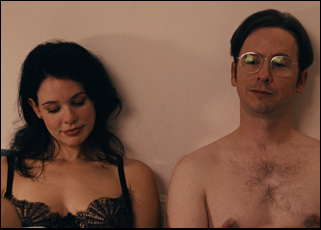
Then Andrea Werhun as Denise is a writer and a filmmaker and was one of the consultants on “Anora.” This is her first feature film role, and coming into it, her own style was very big and comedic and I just gave her a couple of directions and she [got it]. The same with Hannia Cheng, a musician who had never acted in a movie before. She came in there and I’m like, “Okay, Hannia, you’re a musician. Right now you’re at 10 volume, bring it down to one. And she was like, got it. Suddenly I’m watching, I’m like, “Holy sheesh, brilliant. I’m working with baby geniuses.”
I think to be a great actor, you just have to be smart and for me, it was just knowing how to talk with each person and what they need.
Do you actually look for people of different backgrounds to give the film that unexpected energy?
I love working with professional actors and people with less experience acting and I just love to have a movie filled with characters where I love all the characters, even if they’re in the background for 30 seconds. You get a sense of a life and you remember them. I worked with Cristin Milioti on my first film and her first feature film, “Year of the Carnivore.” And I leaned on Susan Shopmaker, the casting director who did “Shortbus,” but actually it was Randy, Susan’s assistant, who came up with five people who were knockouts when I was like, “I’m looking for a great lead. Do you have any suggestions?” When [Cristin came in] I was like, “Oh my God, who’s this wide-eyed silent film star?” She has a really wonderful presence and funny, and down to earth. I love to work with people like that.
On that same movie, I worked with Linda Uyrehara Hoffman, an actor who plays Miss Nakamura, and she was a taiko drummer, but I loved her and she was rough. Some of her line reads are pretty bad, but I got Ali Liebert, who worked behind the scenes with her and it was like Marlon Brando. Miss Nakamura was amazing in the movie. She blew so many people away. Casting people with less experience, they can be so good that they make the professionals look like phonies — I actually did one movie with a friend of mine in lockdown who had never acted or made a movie before, and he was so good. When I saw “Rest and Relax,” I was like, “Oh my God, beside him, I’m the Phony Baloney. I’ve got to dial my character down.” So you have to be careful tonally, getting the right feel.
“Paying for It” is derived from a comic, so there is a comic sensibility to it in that people are so memorable [to begin with] and then the way I shot it was very much inspired by Chester Brown’s tableaus in his comics. And also Edward Yang, and I love Leos Carax. I didn’t have a lot of time so I could only afford a couple of setups, and I had a tendency to keep it fairly wide and have the actors move in that frame and land everything. Of course, those are very difficult shots because you’re not cutting away and I find that if you cut away, part of the energy goes away. Sometimes you have to cut away because actors can’t sustain the whole scene or [directors] want to dazzle, keeping attention by constantly cutting to a new angle. But I find that if the actors are really good and you just follow in an interesting way, there’s nothing more riveting than seeing actors be able to do an entire scene.
 Because of the autobiographical elements, was it surreal watching your life play out or were you divorced from it?
I named [the version of me in the film] Sunny because I didn’t want to say “Hey, Sook-yin. That would have been a mind warp for me.” So it really helped to call her Sunny to have some distance. But I think that real life is so grist worthy. Even in “Shortbus,” that last scene where my character Sophia ends up climaxing, I asked John [Cameron Mitchell] to keep [the camera] just on my face because I truly did. I knew there was a transference of ideas and energy in the audience watching and what they’re seeing. I know that from being a musician too, you’re playing and if it’s just you on the stage, meh. But you need the audience to go back and forth and that energy does go back and forth, so having those little [realistic] touches, life is incredible. Each one of us has an incredible story. Storytellers often say that the universality comes with a specificity, as opposed to being very general or reductive, so this is chock-a-block full of detail – garments that I wore that Sonny is wearing on “Much Music,” and it was great to shoot in my house because it was like, “Oh, where’s that book Chester painted? “Oh, it’s here.” The prop was not a prop because it was an actual object.
The last thing you want to do is get mired in your own attachment, but a lot of my work is derived from my own experience. Even “Octavio is Dead,” which is a supernatural story, was inspired by a real-life encounter that I had with the ghost in Barcelona, so much of my work has been derived or inspired from real life, even when I fictionalize it and I’ve been making videos and films ever since high school. Even my impulse as a teenager was to draw upon my life to make stories. I made my first weird little short film called “Escapades of the One Particular Mr. Noodle.” It’s online and it is based upon my job walking the streets of Vancouver dressed as a 10-foot egg noodle where you couldn’t see my face. I ended up getting into all kinds of wild situations, including getting beaten up by a gang of skinheads. There was so much foam on the costume that it didn’t physically hurt me, but I was really upset [and put that into creative energy].
I feel it’s all embedded in child play. I used to do really intense, long serialized pretend games with my best friend Julie, who I’ve known since I was zero. We would meet in my rec room after school and we would live the alternate lives. We were like five or six and it was ongoing as we would be 17-year-olds living in the city, sharing an apartment. It was like having a quantum reality where we were living the lives of two young women in the city. Suddenly, being a teenager and the world is overwhelming and chaotic and it’s like you’re mute, you can’t speak and you turn to art to articulate yourself. Art saved my life.
“Paying for It” will open on January 30th in New York at the Quad Cinema, February 3rd in Los Angeles at the Laemmle Royal with special screenings at the Laemmle Glendale on February 4th and 6th, and Tacoma at the Grand Cinema, February 12th in Seattle at the Northwest Film Forum and February 13th in Chicago at the Gene Siskel Film Center.