


One of the great pleasures of attending True/False from outside of Columbia, Missouri is discovering how much homegrown talent there is at the University of Missouri when students will often have their work showcased as part of the official selection at the world class nonfiction festival. Notably, you won’t find any distinction in the lineup that films made by students from the Jonathan B. Murray Center for Documentary Journalism that have found their way into shorts programs, though typically one is prompted to look up such names by their quality, only to realize by a lack of other credits that this is only the start of a worthwhile career, lining up right alongside seasoned veterans. It was just a little over a decade after David Wilson and Paul Sturtz believed a documentary film festival could be an opportunity to create community in their beloved Midwestern town that the Murray Center, named after the “Real World” co-creator who has generously donated both a considerable amount of time and money to his alma mater, was founded as part of U of M’s revered Reynolds Journalism Institute and become an institution in its own right.
New Yorkers fortunately won’t have to travel far this weekend to see all the excitement that they’re up to at the Murray Center with the Stronger Than Fiction showcase, though it’s likely they may want to make the pilgrimage after when it’s but a small sampling of what’s going on in Columbia where where they’re plotting a sustainable future for nonfiction film with not only teaching the mechanics of film to the next generation of filmmakers but also how to operate in an industry that has forever felt volatile. True to the spirit of what the Murray Center leaders Robert Greene and Sebastian Martinez Valdivia have developed as an study plan for their students, there’s something a little new about the event this year while honoring what has worked before as it celebrates its 10th anniversary in the Big Apple, but its first at the Metrograph after long being a pillar of the Museum of the Moving Image’s annual event First Look.
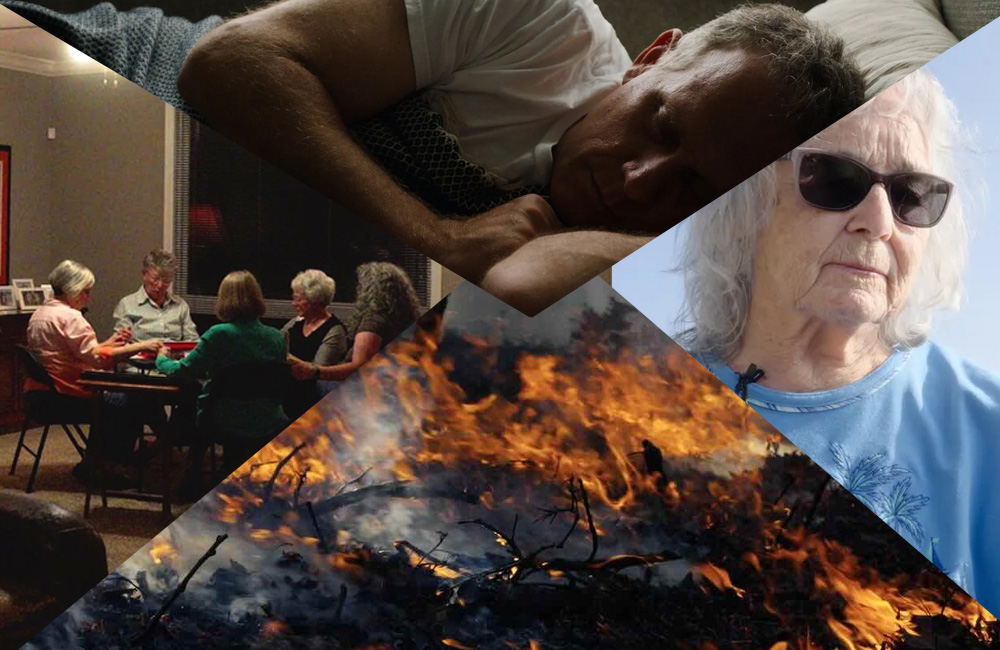
As always, the centerpiece is a March 21st screening of the films made by graduates and undergrads of the Murray Center, all selected by a jury from the U of M’s own Stronger Than Fiction film Festival that takes place at the end of the spring semester (and generally includes the likes of winners of major international festivals such as Nanfu Wang and Lana Wilson). A strong quartet of shorts has something for just about everyone with Tommy Gleason’s “Burn Control,” about forest conservation, Jj Measer’s “Pass Time,” chronicling the dissemination of misinformation ahead of the presidential election, Molly Fox’s personal rumination on living with hearing loss “What Can You Hear?” and Benjamin Zweig’s “The Long Game” about a love of mahjong among elderly Jewish women. However, this year is a double bill when there will be an additional secret screening of one of this year’s True/False world premieres that has yet to make its New York premiere and Greene has convened an impressive panel including “Strong Island” director Yance Ford, who served as a visiting artistic director of True/False this year, and legendary Ukrainian filmmaker Sergei Loznitza (“In the Fog”) to talk about technique, ranging from the birth of a film to seeing it through to its exhibition around the world.
Quite literally, students from the Murray Center will be part of the conversation, which obviously has required a concerted effort on the part of the program’s filmmaker-in-chief Robert Greene to help elevate his students to such standing from outside the coasts, but over ten years, it’s become just as obvious that they belong on such a stage, clearly having something to say in producing truly bold and thoughtful work. It’s a reason among many others that Greene should be seen as one of the most innovative forces in nonfiction filmmaking, first cracking open a dialogue about form from his films such as “Kate Play Christine,”“Bisbee ’17,” and “Procession” where flirting with fiction afforded subjects to face the truth of history that couldn’t be understood in the moment to now emboldening so many from various backgrounds to tell their stories in the way they see fit, bringing vitality to the medium simply when they haven’t had the opportunity before.
When I was able to reach Greene a few days removed from the craziness in his own backyard of this year’s True/False where the Murray Center regularly holds a concurrent symposium “Based on a True Story” that on its own would be worth a visit, he was in the midst of preparing a pitch for a new feature at CPH:DOX and gearing up for his guest programming gig at this year’s Full Frame Fest in North Carolina where the lineup for “Extremely Rich Theater: Staging Performance and Elasticity in American Nonfiction Film” promises to create plenty of ice breakers in line with fellow moviegoers when watching the work of Edwin S. Porter (“Life of an American Fireman”), Shirley Clarke (“The Cool World”), Garrett Bradley (“Alone” and “America”) and Nathan Fielder (“The Rehearsal”). Not only has Greene found himself at the center of the documentary universe, but he’s brought along anyone willing to go on the adventure right there with him as the Stronger Than Fiction event shows and graciously making the time to talk in the midst of such a busy few months, he spoke about how his students have given him such energy, the evolution of the Murray Center and its annual showcase and why he’s bullish on the future of documentaries.
What’s it like to reach this milestone?
It’s amazing. We started the Murray Center eleven years ago, and this is our tenth Stronger Than Fiction. It’s exciting to show these films and to partner with True/False and Yance [Ford], who just got done serving as the visiting artistic director for the 2026 Fest. And it’s exciting to come to the Metrograph, the coolest theater in New York. We’re always trying to find ways to show that our program is more than just than just a documentary film program and that we’re collaborating across the industry. We want people to see our filmmakers as the filmmakers that they deserve to be seen as, so that room will be very cool because it’s going to be packed with filmmakers, alums and current students, and the films are good — that’s what it comes down to. It’s just going to be a great night.
When you first got to Missouri, was the job you accepted – filmmaker-in-chief – strongly defined or did you get to create it for yourself? Because it’s amazing to me how an event like this really involves career-building in the documentary space beyond what you can learn about filmmaking.
Yeah, there was no job [like this before]. We have created what the Murray Center is over the last decade and I’ve been the filmmaker-in-chief, a title which was made up for me by Stacey Woelfel, who was the founding director of the Murray Center. I was like, “I can’t be filmmaker in residence. That doesn’t make sense because I’m here too long.” But filmmaker-in-chief was a name that he made up and I’ve taken that role to heart because I’m because I feel like I’m just helping get getting films made in various ways over the years and when Stacey retired, my colleague Sebastian Martinez Valdivia, who’s the supervising producer of our program now, and I have taken the ball and run with it. Now I teach all the core Murray Center classes and just constantly trying to get [the students] to the next level of making their best films, but making their best films doesn’t necessarily mean [them] getting out into the world [in a meaningful way], right?
While doing all these, I’ve made all my best films as well. I had just finished “Actress” when when I took the job and then made all the films that I’ve made since then while teaching, so I’m always in tune with where the industry is. So we have a a few methods for how we get things out there in the world. One is we bring in the best visiting artists in the world, like Ramell Ross, Kirsten Johnson, Yance Ford, Tabitha Jackson and Brett Story. We just had [“Selena Y Los Dinos” director] Isabel Castro and Poh-Si Tang, the director of “American Doctor” here in class. We’re always getting the most interesting voices in documentary to come and spend time with our students, talk to our classes, and also help with the filmmaking process. [“Predators” director] David Osit is about to come in as a story consultant. We had the great [“Fire of Love”] editor Erin Casper do story consultancy the last couple years and Caitlin Mae Burke from Sandbox and Kristen Feeley from Sundance help advising pitching. It is a who’s who of documentary people that come through our doors. Not only do that does that get buy-in for our films but it also connects our students constantly with this cohort of of amazing people.
Then just recently, we got a brand new $10 million gift from Jon Murray to start Murray Center Phase Two [for a grant program called the Method M Film Fund] and a big part of that is that we just gave away $250,000 to filmmakers that are alumni. We’re the only program in America that does that. Was that the original idea? No, certainly not. But it is a way to constantly be finding answers to the problem of what do we do now? The way I think of it is that I’m teaching them to make good movies, but as we know, good movies don’t often get rewarded in the marketplace, so we need to do everything we can to make sure with these other ways to connect them with the industry, they not only are making good movies, but they have sustainable careers. And we want to celebrate all that with this Metrograph event.
It really sounds like you’re able to create a microcosm of what’s going on at the school with the New York event when the program involves a panel discussion with no less than Sergei Loznitsa in addition to a screening of a True/False premiere besides the screening of the student shorts. What goes into thinking of this as a true showcase?
Metrograph is in the center of cinema culture in New York City and it felt like a place we can collaborate and do some interesting things. And that panel, we’ll have Sergei Loznitza next to Meg Vatterott, who is a graduate making her first film, and then we have a couple of industry folks — Chris Boeckmann [of Impact Partners] and Jason Ishikawa [from Cinetic] and Farihah Zaman, who was just named as artistic director [at True/False], but she’s also a great director and producer in her own right, Stephen Maing, a director and cinematographer, and Yance Ford, one of the most accomplished filmmakers we have in our business. And I’ll be moderating that conversation.
I really want just want to get a broad look at what it actually means to be making documentaries in 2026. What is the future of this form? It’s not doom and gloom from my perspective. People are scared of AI and the lack of distribution models, all these things. But I think the opportunities are immense for us to do amazing things. When you see the program that Yance put together at True/False, you know see the form is alive and well, so I’m very excited to do that and to be at at the Metrograph, which I consider one of those New York institutions where like cinema lives. To be able to bring our documentary conversations to those rooms just elevates what we’re doing and I hope that we honor the space.
Now that you’ve been able to actually see a few classes graduate and start careers, what’s it been like to actually see what you laid the foundation for working?
I love it. I don’t separate my own filmmaking from teaching at all. It’s one big conversation. I consider all these films to be films that I’ve produced, first with me and Stacey and then me and Sebastian and it is an incredibly rewarding process. I go into the process basically saying, “I cannot teach you how to make a good movie, but I can give you the space to figure it out yourself basically” and throughout the process, I treat them as collaborators. We just had a filmmaker, Jj Measer, who’s whose film is going to play at Metrograph as one of the award winners and he premiered his short film “Pass Time” at True/False — and that’s where my life changed was at True/False — so to see, students get the opportunity to have the same experience is just so incredibly rewarding and meaningful to me. I love this position. I love our program and I love what we get to do.
“The Murray Center at 10” will be at the Metrograph in New York on March 21st with a screening of the Murray Center Class of ’25: Award-Winning Shorts at 11 am and the Future of Documentary: Secret Screening and Panel at 1 pm.