

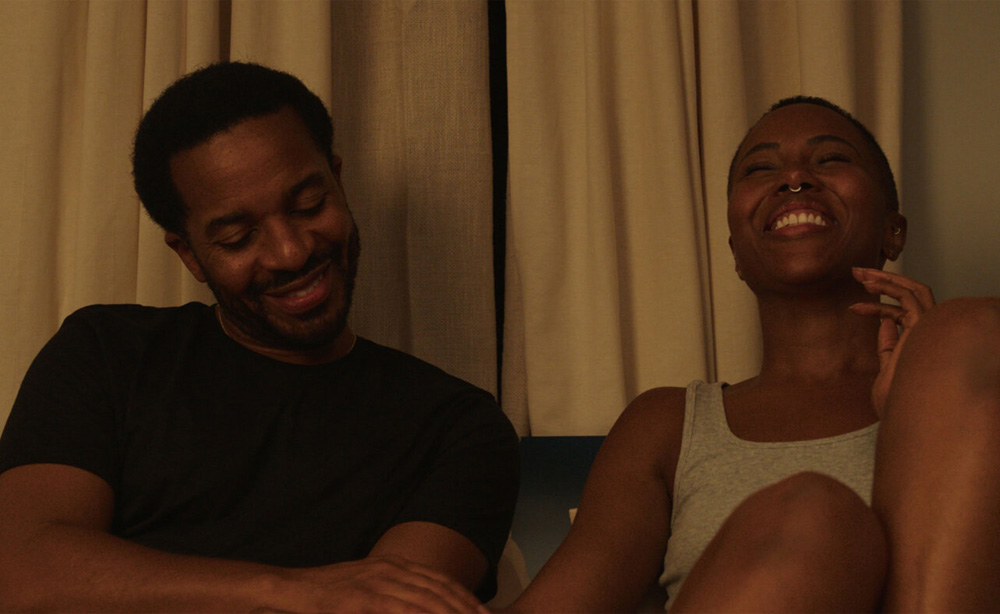

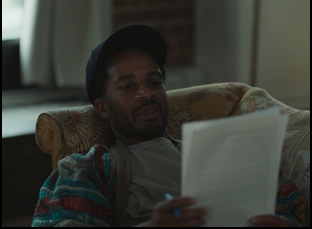
Everything seems a bit slippery for Roger (André Holland), who has his hands full in “Love, Brooklyn” in both his professional endeavors, on the clock to finish a novel where the words just aren’t coming, and in his personal pursuits, having two women in his life that he has been romantically entangled with, but neither wants him as a steady boyfriend. If it feels like the ground beneath him is constantly shifting, it’s because it actually is when his neighborhood isn’t immune to the gentrification that seems to be spreading throughout the city and the mom-and-pop shops that brought him to the community in the first place are slowly disappearing and in nearly every aspect of his life, he’s stunted by what’s no longer available to him than thinking about what is.
For superficial reasons, Rachael Abigail Holder might not have seemed like the obvious choice to send Paul Zimmerman’s script to when “Love, Brooklyn” was originally written for a white male lead, but the director could easily see the same story unfolding in the Black community she was a part of where by the virtue of originating from a historically privileged perspective, the story wouldn’t linger in lamenting cultural erasure, but rather shed light on a reasonably affluent artistic class crucial to carrying communities through turbulent times when applying their gifts to expressing what can’t be said otherwise.
“One of my North stars was to not run into the room with a machete, but to open a window and let it be a part of the sky,” says Holder, who proved to be a natural fit for the material as bone-deep love for the borough and the people that actively protect what’s special about it by looking out for one another was all that was inherent to the script in the first place. Holder uses the backdrop of change for a sly romantic comedy in which Roger is caught between his ex Casey (Nicole Beharie), a gallery owner with whom commitment never seemed like an option when they were dating but are clearly more comfortable around one another than anyone else, and Nicole (DeWanda Wise), who doesn’t want a serious relationship herself when she’s got a child to think about after losing her husband, but nonetheless is spending too much time with Roger not to raise expectations. When all show the value that something has to them by holding onto it rather than letting go, they become a reflection of the city they inhabit where what remains and what’s discarded can seem arbitrary and unfair, making what connections there are truly resplendent and become the foundation for moving forward.
It isn’t just the massively appealing trio of Holland, Beharie and Wise, as well as their co-stars Cassandra Freeman and Roy Wood Jr., that make “Love, Brooklyn” so breezily enjoyable, but the way Holder pulls the tranquility of warm, summer day in the city into the frame as the film has the pleasures of watching life unfold on its own time, but just a little bit better than what exists outside of a movie theater. You would not know from how effortless it all seems that the film required six years of heavy lifting, some of which was shouldered by its star Holland, who wouldn’t let go of an all-too-rare opportunity to play a romantic lead and enlisted “The Knick” director Steven Soderbergh as an executive producer to help put the film into production. The film now serves as a strong showcase for not only his range, but Holder, who delivers a romantic comedy that’s as thoughtful as it is funny. With the film ready to extend the feeling of summer as it hits theaters in the final week of August, the director spoke about how she ended up directing a script that wasn’t hers for her debut after starting out as a playwright, the communal effort that made “Love, Brooklyn” a reality and injecting a breath of fresh air into the film.
 You’ve said before that the original script you received was quite different in the world it was set in, but when you started out as a playwright, how did you end up looking at other people’s scripts to direct in the first place for your first feature?
Yeah, it’s a wild one. I have my MFA in playwriting and I always thought that I would be a writer. I’ve been creating stories since I was small and back then, I [thought] I hope when I have to get a job that I’m still able to do my stories, so it was always this thing that I was doing on the side. Then when I got my first industry job [after] Warner Brothers bought my Web series [“I Love Bekkah and Lucy”], it was my first real directing job because I’d never directed for the screen before and that was just the track that I went on. I could have gotten into a [writers] room and staffed, but from the Web series, because it was like a visual resume, I think people could see what I can do with my eye and then I was in the DGA and that became my bread and butter for eight years now. So my team and I were trying to find a script that I would really love to direct because being a television director, no one was trusting me my own material, even though I’m this almost backwards director. I feel like most directors want to write and don’t or can’t and it’s the other way around, so I’ve j been waiting to find the perfect project to show what I can do so that I can eventually direct my own writing.
This nonetheless feels like it’s yours. Did having a sense of place in New York give shape to the story in your mind?
Absolutely. I build decks for anything that I’m creating, even television shows where I’m coming on for an episode or two, just so that on the day [of filming], which can just feel logistics-heavy, we have created a pattern of language together as artists and as heads of departments because in indie filmmaking, every day is a new day. Then being from here, living in Brooklyn when I was in grad school and my family’s church was in Brooklyn growing up, it was a place that was my backyard my whole life, so my intention was to have people visit Brooklyn while watching this movie, but also have it be unlike the Brooklyn that we see in most movies, [more] like the Brooklyn that my family lives in right now where there’s lots of green, it’s calm, and beautiful and pointedly that we’re still there.
One thing I noticed at Sundance was all the actors talking about how refreshing it was to play against type themselves. Were you actively thinking about that or did it happen organically?
I had a few North stars — I don’t know if you can have many North stars or if that’s the point of a North star is that there’s one, but I had many. [laughs] And one of them was that we were going to make a movie about Black people that we haven’t seen before in modern times. I think that there are movies in the Seventies and the Nineties about us in love, a romantic film where we’re quirky and soft and sensitive and nothing horrific is happening to us, but it’s just been so long since then. So it was really important to me that Casey was weird, that Nicole was not too gender specific, and that we’re just showing the versions of us that we don’t get to see. We’re not a monolith as Black people, or any people, and I just really wanted to show parts of myself, parts of my cousins, my friends, my family that I don’t see in the movies. And when doing that with a universal story like ours, it opens the largest story to the larger mass of people.
How did Andre Holland get involved? It seems like he was a real collaborator in this process beyond just being an actor.
Andre was one of my favorite actors, just this pie in the sky person that I hoped we could get. I Skyped with him while he was shooting in Paris, and just to explain the evolution of our relationship as collaborators, I had a special ringtone for his number, so that I could calm myself when he would call me. Because he did start out as an actor in our movie and just this guy in films that I liked, and then we lost all of our money during COVID and he became more of a producer. He made several calls to put this film together and put a lot of himself in into it by asking a ton of favors, and everyone loves Andre. So he got a lot of yeses for us and is the reason why we have the film in the first place. Now, he feels more like a cousin.
 It has sounded like all the actors really got a chance to invest themselves into this in their own ways. I’ve heard Cassandra Freeman actually lent her apartment to this, for instance.
Yeah, what’s great is that all of our actors are artists and they’re not just here to shoot their whole sheet. They’re a part of it. They’re great and fabulous collaborators. For instance, DeWanda is a director and writer herself, so she pitched that beautiful blue dress that she wears to the party. That’s her own dress and it would’ve been half the budget, but we’re all collaborating here because we all like to play.
Did they bring things that you didn’t expect that changed your ideas about it as far as the relationship dynamics?
Yeah, there were a lot of conversation about Blackness. This film was written by a white man and he was writing about his twenties, so [we were trying] to take it and be as specific as possible with culture, so it wasn’t just like dipped in chocolate. Andre is from Alabama and spent a lot of his adulthood in Brooklyn. I’m from Long Island, but spent my twenties and early thirties in Brooklyn and my parents are not from this country. My parents are from Guyana, so our way in to the discussion of Blackness visually, and also character-wise was always coming from a different place. It forced, at least for me as the director, these moments of pause where I had made decisions already and it opened doors to like whole new ideas.
For instance, that moment where Casey and Roger kiss and the music stops. When Andre pitched that idea to me, I was so mad because I [thought], “That’s not the movie we’re making. It’s grounded. Can’t we just have something that’s magical, but also grounded?” I really wanted that for us. But [Andre] was like, “I don’t think that people are going to be taken out of this,” and when I let him try it, I thought, “Okay, not only is this magic, but this is so Black, and I couldn’t see that before,” so it was just really cool to have a mix of cultures to come up with the defined culture that we decided for our world here.
I really get what you’re saying about keeping this grounded at the same time it’s cinematic. You just allow this movie to breathe in so many ways when there isn’t a lot of score and there’s a gentle rhythm to the edit. Then you’ve got all these great colors to freshen things up. What was it like to find the right mix?
Yeah, silence is hard and it’s kind of scary, but I’m not afraid of it. How we are now with all of our gadgets, I think most people don’t watch a screen without watching another screen. I really wanted people to pay attention and to slow down to create that solace and calm feeling that you get walking in nature and Shawn Paper edited our movie and was just a brilliant collaborator and partner. Especially after COVID, we’re all socially awkward in our own ways because we were alone for so long and I think we’re uncomfortable in silences and because we feel we can’t sit in the nothing for a moment, so I really wanted to incorporate that it could be something.
Then having a lot of green be a part of our film was intentional to create that feeling in our audience, but also giving it breath was compelling them to take it in so that they would have to have that feeling once they were done watching the movie. Martim [Vian], my cinematographer. I just adore his eye, and we talked so much about light and color and developed this language together that I want to speak into everything that I make now. And I didn’t really know what a colorist did [before this], but watching Roman [Hankewycz], our colorist, in the coloring session for the last time, being able to pull out those reds and yellows within our greens, I just owe a lot to those guys for that.
 It came out so well. What’s it been like getting it out into the world?
I’m excited. It was such an honor and so fancy and cool to premiere at Sundance, but it felt like I was just giving it to the industry and not to the world, so I’m I’m really pumped to give it to everybody. We worked really hard on this, all of us — Patrick [Wengler], Kate [Sharp], Liza [Zusman], Andre, Maurice [Anderson], Sophia [Harvey], I’m just naming people — because I just want to make sure that people are getting credited for the work because it was really a labor of love. There’s so many hands on this that made it beautiful and living in the corners of our industry right now has been fun and exciting career-wise, but as an artist and a human, I just really can’t wait for people to see it in the movie theaters.
“Love, Brooklyn” opens on August 29th in New York at the Angelika Film Center and expands across the country on September 5th. A full list of theaters and dates is here.