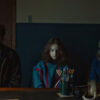
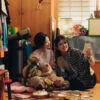




It is indicative of the choices that Phillippa Lowthorpe makes throughout adapting Helen Macdonald’s memoir “H is For Hawk” that on screen, MacDonald, as played by Claire Foy, opts for the more dangerous of the options in front of her when adopting a goshawk. In the wake of her father’s (Brendan Gleeson) sudden and unexpected death, a foray into falconry seems like a welcome distraction, but after requesting a gentle bird, the goshawk she comes to call Mabel can’t help but intrigue when the man selling it to her has mixed up his orders, with its eyes shielded with a mask when it’s been raised as a predator and something tells her she ought to keep the one with the killer instinct.
MacDonald’s beloved book could’ve easily been a lackluster movie if Lowthorpe hadn’t embraced the same spirit as the film’s lead where the danger really lies in not taking risks. A drama about contending with grief that feels buoyant rather than grim, the film follows Foy’s Helen from worrying about her next move as a professor at Cambridge with an opportunity to pursue a fellowship in Germany to wondering if she can move at all when she’s paralyzed with depression. With her friend (Denise Gough) trying to get her out of the house, she is eventually led back to driving around the countryside in her father’s car, playing rock’n’roll as loudly as he once did, and the memories flow as freely as gliding down the road, but it is only when she acquires Mabel that she feels as if she can truly take off again, gradually acclimating to the world once again in training the ferocious goshawk to the same.
Lowthorpe previously made her feature debut with the enjoyably rowdy 2020 comedy “Misbehavior” about the women’s liberation movement’s protest against the 1970 Miss World pageant (boasting a ridiculously loaded ensemble that included Keira Knightley, Gugu Mbatha-Raw, Jessie Buckley and Lesley Manville) and honors the depths of despair that Helen must wade her way through, yet keeps a film about great loss consistently lively. With a nervy performance from Foy, who dispenses with any politeness in playing the slightly ornery professor, the film conveys how difficult grace is to come by in the grieving process, making how much of it that it finds along the way all the more impressive. Following premieres last fall at Telluride and the BFI London Film Festivals where it was apt to draw a few tears, the film is rolling out to theaters across the U.S. this week and Lowthorpe graciously took the time to talk about all the savvy aesthetic touches that make the drama so light on its feet.
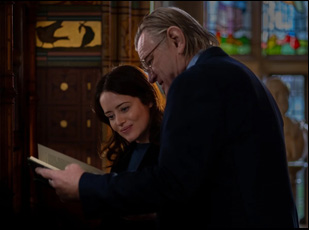 How did this come about?
I was lucky enough to be asked to come on board this wonderful project after I’d made a particular series for television in the UK, which Plan B, Dede Gardner and Helen [MacDonald] liked, so they asked me if I’d be interested in making this or coming on board the journey to make this fantastic film.
What was it like to work with Helen?
It was amazing. Helen has been involved right from the very beginning. They watched my little videos of my hawk training that I did with the hawk trainer and also all the versions of the scripts. Helen was so helpful, giving us little ideas and anecdotes about their dad. Also when it came to the filming, they lent us so many treasures — feathers, skulls, pictures, and also their brother got together all the photographs that the dad took in real life for the lovely eulogy scene, so they were very, very kind.
What was it like to structure? You create this fluidity between the past and present so the scenes of Helen in the film and her father don’t feel like flashbacks.
I really like the fact you say that because they are like little shards of memory that we wove together. They were [flashbacks] in the script, but when we got into the cutting room, we moved them around and tried them in different places. I always knew that we would do that in the cutting room because it’s very hard to do that when you’re writing. You just need to place things in. And I really love the way the editor Nico Leunen made those memories like little ribbons being plaited together. It was a real joy to play with the material that we’d shot actually in the edit when we got there.
There’s a golden glow throughout this that really leavens it, even in what are the darkest of moments both figuratively and literally. How did you think about lighting this?
That amber color was one of our key colors throughout the film. Charlotte Bruus Christensen, the [director of photography], and I spent a lot of time testing pieces of material for Helen’s house because when she brings Mabel into her home, she shuts the outside world away by drawing those curtains. And when you first have a hawk and you’re gentling it — where you just get the hawk used to you — you do it in a dim light. So we knew we would have to find how could we make this light dim, but very warm and very seductive. That’s why we use that very gorgeous amber light. And then we had these amazing references of Tarkovsky’s polaroids that we loved for the outside scenes and also some of the inside scenes. They’re so beautiful, like fragments of memory and they have a mystery to them, but a rawness and a beauty. And that’s what we were trying to get photography, use those slightly muted, soft colors where it doesn’t feel too present. [It feels like] you’re sort of reaching for it, and that’s what we felt like Helen is doing in her story. She’s reaching for her memories of her dad.
What was it like to find the right locations for this?
We wanted it to feel authentically where Helen had done these brilliant hunting scenes [with the hawk], and of course the first place is Cambridge, where Helen was [to teach] at the time of the story, which is a magical city and has its own haunting atmosphere. The countryside around Cambridge is very flat, so we wanted to find those big, flat, open spaces, which make you feel the big, wide world of nature and it diminishes us as human beings and makes us remember the vastness and the mystery of nature.
 There’s also a contrast in the music – this elegant Emilie Levienaise-Farrouch score with the rock and roll that often accompanies car rides. What was it like to figure out the soundscape for this?
Emilie and I worked very closely together on finding the sound of the music and the tone of it. We wanted it to feel very earthy and not too pretty, but very emotional in places, haunting and quite tense. And Emilie wrote her piece for 12 strings. We started off with just four, but we persuaded them to give us a bit more money, so we were able to have 12 and Emilie’s music is so interesting because she uses instruments in a very different way. Even though they’re acoustic instruments, she gets really weird sounds out of them and then manipulates the sound, so it becomes its own weird commentary on what’s happening. That felt very, very appropriate to Helen’s journey and her descent from happiness and joy into the darker places when she’s going a bit crazy and can’t see the wood for the trees [as] Mabel’s no longer healing her and she ends up crawling in that box near the end of the film,
That was in contrast with what we call our “dad music” for Brendan [Gleeson]. Dads have a kind of music, don’t they? And we thought because Helen borrowed her dad’s car after he died and bombed around in it, so the idea that she would play his music in the car was really nice. It reminds us of her dad. It brings us more to the dad than just having her driving around in the car. And The Shadows are [a band] that my dad loved and also our lovely editor Nico’s dad also loved, so that’s why that was in.
What sold you on Claire?
Well, Claire’s just the best, isn’t she? I’d worked with Claire on “The Crown” and Dede Gardner had also worked with Claire on “Women Talking,” so when we got the script in a good enough state to show people, we thought we have to show Claire because we both loved her. Lucky for us, Claire said yes straight away, so there was really nobody else we even thought about. She’s such an instinctive and intuitive actor and when you’re filming her, you just feel that you can look straight into her soul because her eyes are so expressive. She’s just an outstanding actor.
There’s a scene that’s really stunning when she’s “gentling” the hawk, as you described it – obviously, Claire had to spend months preparing for that, but you get the spontaneity for the scene where the character is getting the hawk Mabel comfortable. What was it like to capture that moment?
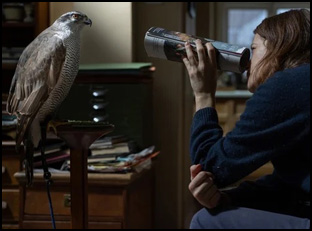
We did have to make the conditions right to do that scene, but you couldn’t organize it, so we had to capture it. In those places where we were filming, all the crew had to hide upstairs. Nobody was allowed on set apart from Claire, Charlotte, the director of photography, and Lloyd, our hawk trainer, and me, hiding behind pieces of furniture. Charlotte was there with her handheld camera. She’s very, very good at handheld and we just decided we would film whatever happened. Of course, we knew we could only do one or two takes at the most, preferably one, so we had to just hope for the best and that Claire’s falconry training was enough for her to improvise her acting along with what Mabel did.
It was so incredible filming that scene. We were absolutely on the edge of our seat. It was like bringing wildness into the house and it was mesmerizing. We just did that in one continuous take. There are a couple of little cuts in there, but it was honestly one of the most exciting things I’ve ever filmed, watching Claire be Helen at the same time [as she was engaged with this bird]. When we first sat down and watched the assembly of the film, Nico, the editor, said, “That is mindblowing, that scene.” There’s always one scene in a film where you think, oh my goodness, that’s gold. It just says everything about what Helen was trying to do. The visuals are like a metaphor for her trying to tame her own grief. It’s so powerful, yet it just works in another way of a human being relating to a wild creature, like “The Old Man in the Sea.”
What’s it been like sharing this with the world so far?
It’s been absolutely amazing. We’ve done quite a lot of screenings and it makes such a hugely deep connection with people, often to the point of people needing a hug after. Everybody has lost someone or has experienced some kind of grief, even if it’s not a loss of a human being, maybe a separation, so it’s something that people can deeply relate to, also because Helen’s not perfect. She’s a messy person, yet at the end she still emerges. I think it’s very human to be a messy, messy individual, isn’t it? You don’t have to be perfect. And yet there’s this hope and love at the end, which is great.
“H is for Hawk” opens in theaters on January 23rd. A list of theaters can be found here.