


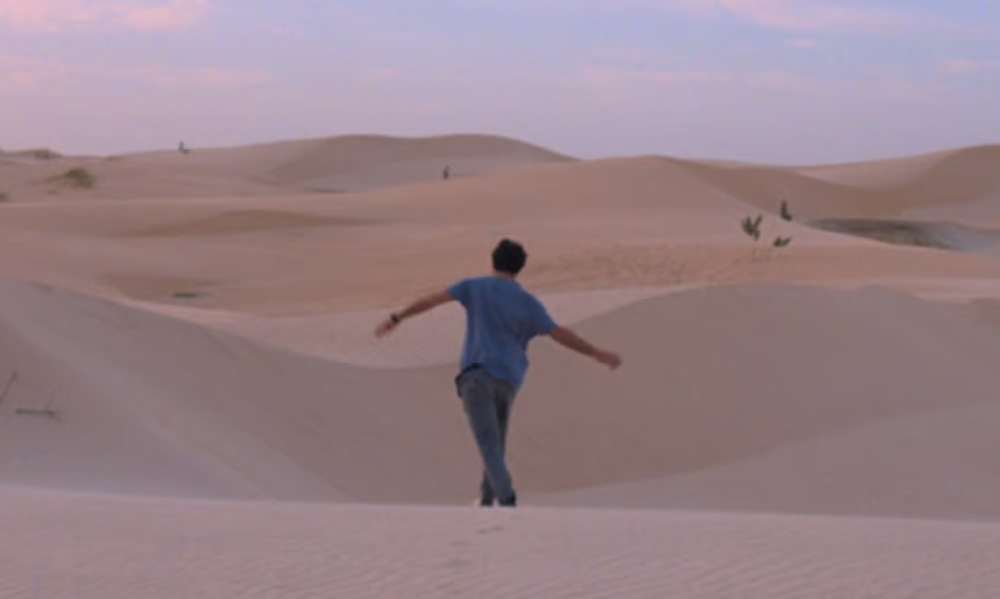

There isn’t a more ideal spot to find Sergio at the start of “I Only Rest in the Storm” than to be lost in the desert as he makes his way from the metropolis of Lisbon to Guinea-Bissau, a country that has struggled with independence ever since being released from Portugal’s control in one form or another since being colonized in the 19th century. Sergio’s long drive is fueled by good intentions, hired to conduct a study that ideally would lead to a highway that could connect the rural parts of the country to more developed areas, recognizing the need when his own car overheats and it takes an eternity for a tow truck to reach him, ultimately landing him at a mechanic who works his own hours well off the beaten path. While he waits, he’s treated to some tea by the mechanic’s wife who gives him a pillow to sit down on the sand and he realizes he’s on their time, not any that he’s familiar with from his experience in the city.
To step into Pedro Pinho’s beguiling drama requires a similar surrender, but as Sergio finds, there are plenty of rewards in doing so as he takes the time to listen to the locals and becomes enamored of the rhythm of their lives. His job requires him to ask questions, but increasingly he finds himself having to ask them of himself when he’s merely one in a long line of outsiders that have come to the community promising big things, presumably to empower residents that have found them to come up empty nearly every single time. He can barely be bothered with when he tries to get his neighbor Diara (Cleo Diára) to lower the volume on the music in her apartment next to his rental, celebrating the birth of her brother’s daughter, but as is frequently the case, Sergio discovers it’s better to give in than to resist the natural way of things in the region where people have learned to lean on each other with less resources and have come to create different set of values that’s worth protecting in the face of a consumerist society that looks upon them with pity.
Pinho has freely acknowledged the issue with being behind the camera for such a story that he comes to as an outsider himself, but his approach to “I Only Rest in the Storm” is inspired when he’s created a way of filming based in a documentary background where any control over what happens is wrestled away from him, allowing for long, dynamic conversations to get the air they deserve as he gives over the screen to real-life denizens of Guinea-Bissau to share their experience living there and how it’s evolved over time as they express it to Sergio. Although the director frees this dialogue from any imperial gaze, it isn’t unmediated as Pinho brilliantly takes the history or ideas being discussed and gives them a visual dimension to honor how lively the verbal engagement is, yielding a pair of sex scenes where the provocation isn’t in what clothes are taken off but rather the power dynamics that manifest themselves physically and setting scenes in locations that come alive in reflecting what’s being addressed and how. Filming chronologically, the filmmaker could not entirely know what was coming next himself when he invited such spontaneity from the film’s participants into the production and even across an epic three-and-a-half hour run time, “I Only Rest in the Storm” has the kind of frisson that seems inherent to the fabric from which it was through the alchemy of committing it to celluloid.
Following its premiere at Cannes earlier this year where Diára was honored with a Best Actress prize in the Un Certain Regard section, Pinho graciously took the time to talk shortly ahead of “I Only Rest in the Storm”’s stateside premiere at the New York Film Festival about working with highly combustible materials of all types in taking on the legacy of colonialism in his native country, working towards a process prizing equity between those on camera and those behind it as creative shareholders in the production and seeing audiences start their own conversations after the film.
 I know thematically this is connected to your previous film “The Nothing Factory,” but I’ve also heard in terms of the creative process, this also might have been a continuation. How so?
I’ve realized lately that all my films tend to [have] the same general theme, which is this idea of Europe, and of course, it comes from my personal life, the way I passed time in this region because my first documentary was shot there and since then, I came several times to meet friends and to pass [through]. This film is a result of all the experiences and the things that I’ve lived and saw during this time.
In the beginning, I wanted to make a very triangular film with three characters that had the same space in the film, but after discussions in the writing process, I realized that this triangle had to be a pyramid because I had to project my own gaze in the film. I had to find the entrance door to that reality through the character of Sergio, so Sergio somehow is a silent, reluctant [protagonist] that doesn’t act at all. That is his main characteristic. He only listens. He doesn’t act. And this allows us to reach the voices and the polyphony of perspectives that I wanted to have in the film with several perspectives about the same subjects that give us the polyhedral view of these themes.
Did this particular setting immediately come to mind for this story?
This country, Guinea-Bissau, is one of the ex-colonies of Portugal, but it’s a very interesting territory because it’s very linked with the story of history of resistance – to European colonialists, but also to the Arabic-Muslim invasions and all the empires that passed through this territory. And it’s a very small country, but it has many languages and all these cultures are very alive today – spirituality-wise, politically-wise, and philosophically-wise – and they somehow have been able to resist all these presences along these centuries. If you know the story of the end of Portuguese colonization in the ‘70s, it was the territory where the Portuguese fascist and colonialist army was beaten militarily, so this [setting] was very important for me because it’s also the story of Portugal, but also the story of resistance against capitalism, colonialism and fascism that somehow was won there. We, as Portuguese, owe our freedom to the fighters that died in that territory, so it was very important for me.
One of the really exciting elements of the film is how you find visual expressions of the dynamic conversations that are happening about the legacy of colonization – I found it inspired that you set one scene in a club as the subject is literally danced around. What was it like to think about this very potentially dense subject in those terms?
Yeah, I wanted to explore this idea of having a very dense and explicit discursivity and I had this crazy idea of mixing it up with scenes of dance and discos. Because I felt that several times, where you are drunk in the disco and you are having a very dense discussion with someone in a corner, but everything is happening behind you. Of course, technically, it’s very difficult to do this, because there are several energies that you have to balance and technical aspects of the sound, of the discourse and all these things. It’s the opposite of what you should do. But it was a pleasure in the end to mix these totally different materials and totally different energies and to explore this thing that’s not very usually it’s not very cinematic, in all its explicitness and its expression as a matter for cinema.
There were a lot of conversations in the film, amazing scenes set in the community where as you mention Sergio is an observer and it seems like they couldn’t possibly have been scripted, so I wondered how you facilitated some of those scenes to have those lively conversations.
All the scenes are scripted, but I don’t share the dialogue with the actors and I create a situation where we discuss the ideas in the narrative and dramaturgic ideas that are present in the scene and then we improvise based on each character [based of the actor’s] lived experience, so everyone brings their own way of speaking, their own vision of the world. It’s with that material I know that I’m going to edit a lot and I’m going to use several [takes] and dialogue off [script], but all the scenes were somehow written, even if we find, especially by the end of the film when Sergio goes to the villages many times, the perspective of the person that we are filming that surprises a bit. It [upends] the writing. I’ll have written something else and then the person says this thing which is much more powerful than what was written and of course I’m open to it. I have to be available to these kind of accidents.
I understand you like to shoot chronologically, so when the film starts taking a shape and you have that process, are there things either with the characters or with the story itself that take you in a direction you didn’t expect that you can get really excited about?
That is the most exciting part of the work is to feel where the film is taking you to. Of course, the film shapes us a lot in our views and our ways of seeing and facing these issues. Not only me but I think the actors and the crew because the [production] lasted six months and we were really living the problems and the issues that we were [depicting]. With all the pain and all the violence that these issues contain, we were living them. Somehow I had a facilitated life because it was quite obvious and evident for everyone what we were talking about. But it leaves emotional scars for everyone and I think that’s a beautiful part of it. Today we are very friends with the crew, the actors, but it was tense many times.
I’ve heard that it was a two-year editing process and I imagine that interrogating your gaze not to fall into colonial rhythms must have been difficult. What was it like to look at the footage after you had shot it?
Yeah, it was a very long process. I came out of the [filming] totally exhausted and not totally confident that I had a film. It was a long process of falling again in love with that material, cleansing myself of the harshness of the shoot and rediscover the beauty of the material that we got. I always shoot to edit, but it’s not that I have a clear mise-en-scene. I know that I will cut a lot and I will construct the scenes in the editing where [it’s like] I will pick a word there, a word there, a gaze here, a presence there and I will write the film in the editing. So it took quite a long time and there is also a longer version of the film, a 5:20 version, which is the original version that I edited, and then the commercial theatrical version, which in the end was supposed to be 2:30, but in the end is 3:30 and the producers said, “Okay, let’s keep it.” So it was a compromise between me and them.
I hope both become available you really did something transfixing here. What’s if been like to see the film out in the world so far?
It has been very impressive. The film has only been released in France until now. I was there for several screenings and people were there after three-and-a-half hours and they didn’t want to leave the room for another hour. They had something of discussion and they were still there – five hours inside a screening room! I was really amazed with that, the fact that the film produced this effect of wanting to stay there, wanting to stay inside and to think and discuss and talk about those things. It’s a great joy for me.
“I Only Rest in the Storm” will screen at the New York Film Festival on October 5th at 6 pm at Walter Reade Theater and October 6th at 4:30 pm at the Howard Gilman Theatre.