

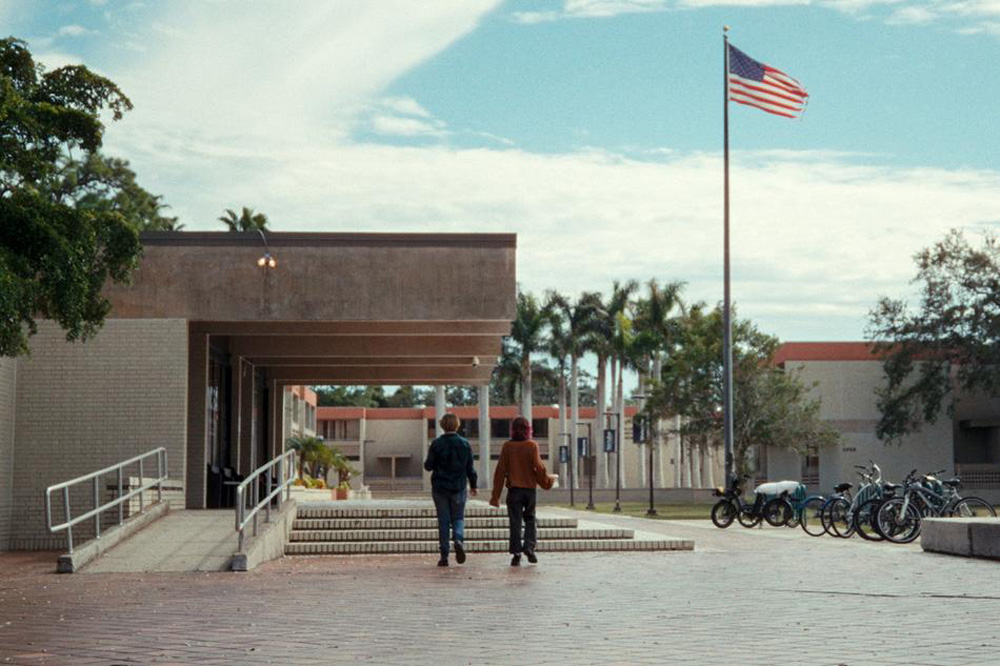

There’s a slight irony to the opening minutes of “First They Came for My College,” a quick cut succession of scenes detailing how New College of Florida became one of the top liberal arts schools in the U.S. since its founding in the 1960s, reaching #1 in the Princeton Review in 2006, when director Patrick Bresnan can only spend so much time away from the unfolding emergency at hand. While the remarkable achievement of the first half-century of the school becoming renowned the world over as a bastion of intellectual nourishment and a place where artists and creative thinkers could thrive is condensed to a handful of minutes, the work of decades to build such a reputation is shown to be able to be undone in only a couple of semesters as Florida Governor Ron DeSantis completely changed the mission of the school, far more geared to train baseball players (despite not having a proper field anywhere near campus) than to encourage academics.
Although “First They Came for My College” is a horrifying chronicle of bad actors being emboldened by the current president of acting on their worst impulses with political cronies of DeSantis installed as regents who can make sweeping changes with a new majority on the board and both students and faculty are forced to leave the school – along with all their institutional knowledge, the very existence of the film is encouraging as an act of resistance. Bresnan, as he previously did when covering the highs and lows of a Florida high school with co-director Ivete Lucas in “Pahokee,” enlists the students to capture their own experience as their school is falling apart, observing the increasingly hostile atmosphere on campus where the athletes and academics struggle to coexist and quite literally books are pulled from the library to be burned. The filmmaker regularly attends board meetings where the far-right firebrand Chris Rufo beams in from New York to encourage capricious budget cuts in his new position on the board as teachers on the ground passionately make a case to support the work they’ve been doing for decades to much success and though no metaphor is needed for the school’s quick devolution, visits to the garden that the students have cultivated for years that is threatened by the new administration’s priorities in addition to Florida’s natural weather pattens comes to reflect what a tragic situation there is unfolding when so much growth is being stymied.
“First They Came for My College” ends up capturing the eye of the storm in so many ways when the same brutish takeovers are cropping up in all aspects of American life, not only destroying great establishments but repurposing them in such a way that will ultimately appeal to no one, but it does take away hope in a generation that may be able to overcome the bad hand they’ve been given when their skepticism turns into action rather than resignation and proves to be galvanizing. After premiering earlier this year at SXSW in Austin, a home base for both Bresnan and producer Holly Herrick, a New College alum who now serves as head of film and creative media at the Austin Film Society, the film is now starting to roll out theatrically across the country and Bresnan kindly took the time to talk about how he got involved in the film, being able to show all perspectives on the crisis at the school and all that can be achieved with empowering the young.
 From what I understand, Holly Herrick came to you with the idea for this. I know you’ve shot much of your work in Florida, but what got you excited about this?
I had worked with a lot of high school students in Florida. I find Florida a fascinating place to storytell because a lot of the things we see unleashed on the U.S. or things that change the political climate start in Florida. And having lived in Austin for a long time, Holly is someone who is such an incredible proponent of independent film. We’d had travel and film grants from her [at the Austin Film Society]. She hosted screenings for us and you rarely get a chance to give back to people in the industry who have supported you so much, so it was really a very special project to be able to support someone like Holly and then tell such a compelling story.
And what was exciting is that the students are so smart at New College of Florida that they were documenting this from the takeover of their school happened on January 6th, so a number of the students just started filming. Some of the alums came in from out of town and the alumni of the school started having these huge Zoom meetings. Holly was on those and Harry Hanbury, another alum who also worked in film, and they were like, “We need to make a film,” so Harry raised some initial seed money and Holly was put in charge of finding a filmmaker. Then I got a call from Holly to go down to a shoot where they were going to deny professors tenure [with plans for] a development reel. I went and we never looked back. Those students that had originally been shooting, we brought them into our team in paid positions as PAs and assistant cameras and hired them to continue shooting when we weren’t there.
You had some experience covering this kind of thing with “Pahokee,” when you shot at a high school. What was it like to expand on that here?
I love situations that are this complex and I really enjoy being in chaotic situations and being like a street photographer. There was so much happening and there was so much national press that I was really able to be under the radar and be an ally of the students and what really excited me was that the students were so smart, so organized and so motivated, they just needed some basic tools to tell the story themselves. So I really saw my job as supporting them emotionally and use the budget that we had to support them financially. We weren’t hiring sound people or expensive camera people. We were diverting that money to the students to buy them new iPhones to shoot and also taking them out to dinner and lunch every day that we were there so we could really learn from them what was going on. What we did is we create this underground film school.
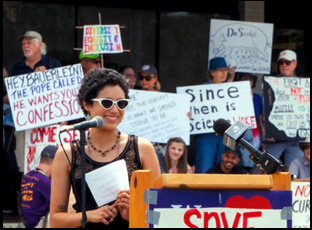 When you empower the students like that to shoot their own footage, what’s it like to get it back and start processing it?
What was so exciting was the footage that the students would shoot and the video journals that they would make where they were revealing how this was affecting them or recording a dorm room party — it was very important to show that you could still find joy in these types of moments despite the fact that their school was under siege. The areas of their campus that had been traditionally safe spaces like the library or the gender and diversity center and the garden, those spaces were under siege by the administration, so it was really beautiful to see in that footage that they were creating new spaces as these old spaces were being taken from them and I always thought that this film could be a blueprint for students at other universities to get through these terrible situations. And when you look at footage from the ‘40s and ‘50s when we see Jim Crow — it’s not the same thing, but students who have a different political ideology, different sexual orientation, and different beliefs being told they don’t belong and they’re not wanted, this is a terrifying historical document in that respect.
You mention the garden, which becomes a real through line for the film. What was it like to figure out the storylines to focus on?
Yeah, the professors were really trying to protect their students and trying to protect their jobs. They were terrified. The administration was firing people. And the first person that allowed us to film was Professor Maria Vesperi, the head of the anthropology department who ran the student newspaper. She was at the end of her career, but her husband was an anthropological filmmaker and after several meetings with her in the student newspaper, where they were breaking some of these national stories [about New School], they agreed to let me film in that space. So that was our foundational space.
But then what’s always been remarkable to me about Florida is the natural environment. Students at this college are very aware of that and they have this incredible food forest and a garden classroom. That’s where a number of them were going to de-stress at lunch and that space became pivotal because Lindsay, the young woman who we see have her garden destroyed, was also one of the first people filming, so that was a really a safe space for the students. And it was always a safe space for the film team because we could go to that area, be hidden and catch up with the students. So we had the newspaper and the garden space to process things that were happening and then we always had these just insane Board of Trustees meetings, so we had some really good spaces to take us through the film.
 Once the administration really started cracking down, did it make the shoot harder?
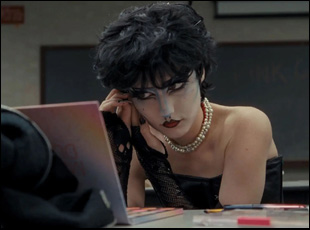
At a certain point, I realized I needed to approach the administration and these people who were taking over. I have a very good friend [“Boys State” co-director] Jesse Moss, who [said] I want to know what the baseball players think. And really good filmmakers can get access to these folks. So the president of the college set up a fire pit and a bar where he drank outside his office on occasion several times a week. And I just knew I had to go to that fire pit where these administrators were drinking bottles of wine and smoking cigars and say, “Hey, I’m Patrick Bresnan. I’ve been filming all these Board of Trustees meetings. You guys look terrible in them. You’re doing something here that’s going to be documented. Can I tell your story? And they were very favorable to that idea. I think it was because the press person at the school had previously worked for a minor league baseball team and “Pahokee” was so much about the football team that when I shared the trailer for that with him, he was really excited by it. So I had to access them for the last year-and-a-half of shooting and be really out in the open.
Like “Pahokee,” you’re able to watch these young men and women really grow up in front of your eyes. Has that been a special part of these projects?
It’s really astounding. When I first arrived, these students were in shock. They didn’t know if they were going to transfer. New College is a very affordable college. Many of them are first-generation college students, and they had found their paradise, so there was incredible emotional pain and depression. And it was remarkable in the 300 hours of footage in two-and-a half years to see them turn into young adults who could take agency over the situation. Some of our students had to leave because it was a matter of survival. The students that stayed, specifically Gabby Batista, the way she leads is so humble and so honest and sincere and she has such courage that we see her completely transform and grow through this film. I was with her all three years of her college and I’ve never seen anything like that. In that sense, there’s a lot of hope in this film.
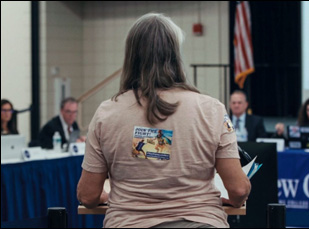 What’s it been like to start screening the film, particularly in Florida?
The [New School] alumni community is quite remarkable. And the professors and teachers unions in Florida and people who care about this have been selling out all of our screenings. When the students and professors come up to do the Q & A, it’s like a rock star welcome, which is really a beautiful thing because the agency of directing this film has been handed over to the community. It’s really their document and I just happen to have a credit in it. So it’s been a a healing process showing this film, but the amazing thing is these incredible professors who lost their jobs and careers, and showing the film has been a way to regain agency over their life. That’s been profound.
“First They Came for My College” opens on September 25th-October 1st in New York at the DCTV Firehouse, October 2nd and 3rd in Austin at the Austin Film Society, October 9th-15th in Orlando at the Enzian, October 10th and 11th in Los Angeles at Vidiots, October 17th in San Francisco at the New People Cinema, October 10th and 11th in Tallahassee at the Tallahassee Film Festival, October 23rd-29th in Sarasota at the Burns Court Theater, and October 22nd in Columbus, Ohio at Wex Unorthodocs. A full list of screenings and dates is here.