



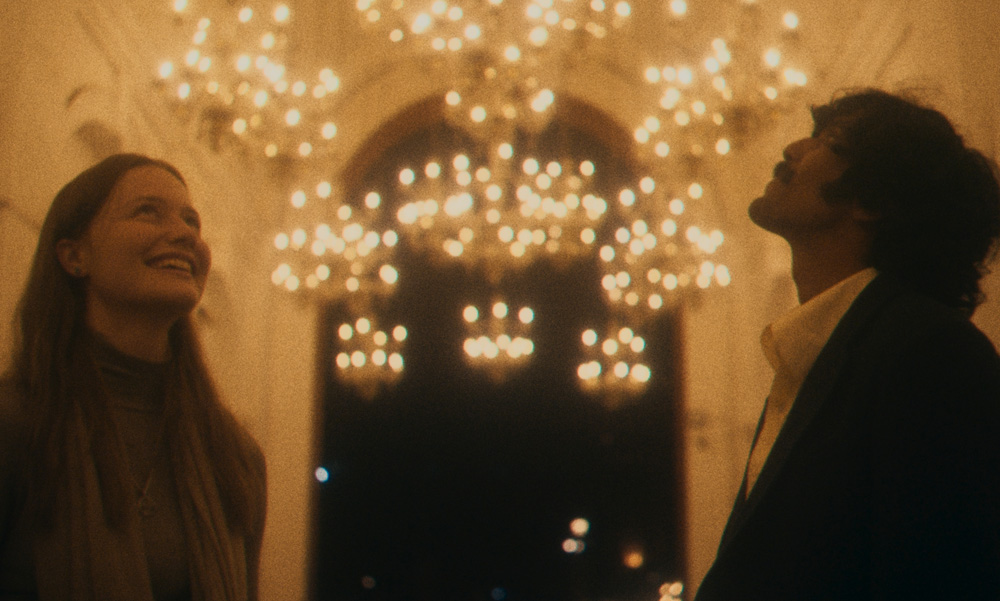

When Lotta von Schedvin first met P.K. Mahanadia in Delhi in 1976, she did not see a confident young man. She was taken with him as he sketched her on the streets, a service that slowly lifted him out of the lower caste he was born into and collected money from tourists to draw their portraits, and his timidity was part of the charm, but he was sure about one thing – that in Lotta, who had come with her family from all the way in Sweden, he had found his soulmate as he started to capture her spirit with his pencil.
The chance encounter that leads to a lifelong romance is the kind of thing you’d only see in the movies, but remarkably none had ever been made from Mahanadia’s memoir about his remarkable travel on bike across Asia to Europe until now with the Oscar-winning director Orlando von Einsiedel (“Virunga”) at the helm. And while Mahanadia needed to figure out how to actually get from Dehli to Borås, suggesting his naïveté was an advantage when he says “My strength was my lack of geographical knowledge,” von Einsiedel, who has navigated war zones (“The White Helmets”) and complex narratives related to his own grief (“Evelyn”), might’ve entered into something a little bit more difficult than he could fathom when he became enthralled by the story, only to realize that beyond dramatizing it entirely, it would be difficult to bring it to life on screen when only a handful of pictures exist from Mahanadia’s travels.
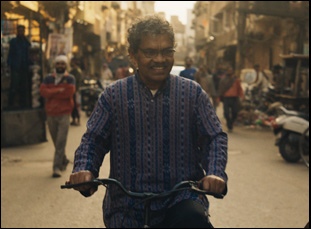
The resourcefulness of both Mahanadia and Von Einsiedel are on full display in “The Cycle of Love,” which never lacks for passion when Mahanadia eagerly recounts his quest to connect with von Schedvin following their brief, intense moment together, but the film also brings it to life in the present tense when von Einsiedel takes the novel approach of recreating his subject’s journey step-by-step with an actor (Chirag Lobo) playing a younger version of him, thrust into the same environments that ultimately helped him build up the courage to ask out von Schedvin when they finally reunited. From Tamsa, India to the Caspian Sea, the film observes as strangers embrace P.K. as he starts out with about $80 to his name and some dried fruits to subsist on and although the encounters were initiated based on the memories Mahanadia had of individual places, the show of compassion that people that take the fictional P.K. in those towns is something that clearly cannot be faked. The result is a disarming film that actively demonstrates the best of humanity, not only as it relates to Mahanadia’s desire to connect with others against all odds, but how people will respond with open arms to authentic outreach.
After premiering this time a year ago at Telluride en route to a celebrated festival run, “The Cycle of Love” is now riding into theaters across the U.S. and von Einsiedel generously took the time to talk about how he couldn’t resist bringing Mahanadia’s adventures to the big screen, how he found his footing in terms of making sure it had all the energy that he experienced from being on the road himself and recognizing that it was an even bigger story than Mahanadia crossing continents to find true love.
 How did this come about?
I was giving a speech in Sweden and two young people came up afterwards and handed me a book and said, “This is our parents’ story. We know your work. Might you be interested in looking into it as a possible film?” And I took the book and eventually flicked through it and I [thought], “Oh my God, this story is mindblowing.” And I was lucky enough to meet P.K. and Lotta and they are so warm, generous and open-hearted, it’s hard not to fall head over heels in love with them. You want to spend all your time with them and then luckily we all had a shared vision for how their story could be shown in in filmic form.
From what I understand, you had an idea of how to approach this from your previous film “Evelyn,” though it is definitely different. What could you build on?
P.K.’s story is full of magic and destiny and the kindness of strangers and love and all these amazing themes. It’s a cracking adventure too, but the problem, as a documentary maker, is that there was very little archive. P.K. didn’t have a documentary crew following him in the 1970s and frankly, [the lack of archival material] was terrifying. But also it was an opportunity to try and think creatively about how to do something different and my past work was where I ended up drawing inspiration from.
I made [“Evelyn”] almost 10 years ago now, about about my family and my brother who took his own life, and in that film, we walked the length of the UK visiting places where we’d spent time with my brother when he was alive and one of the most extraordinary things in the film is meeting strangers and having these really extraordinary conversations, so I wondered if that idea of meeting strangers and having conversations could inform this film if we followed parts of P.K.’s original journey. Could it speak to this key emotional idea at the heart of P.K.’s story about a man who didn’t have self-belief and needed to learn to love himself because that P.K. spoke movingly about how strangers along the way touched him — they hugged him [for instance], things that he hadn’t experienced while in India — and that taught him to believe in himself.
So we set off with P.K., who is one of the most unique human beings I’ve ever met, and we took two very talented actors with us on this journey — Chirag Lobo and Mina Dale, and almost everybody else in this film are real people we met along the way. And PK himself, would watch us as we shot these scenes and he’d give feedback. He really helped us capture it in as emotionally authentic way as we possibly could. Sometimes I’d turn around and I’d see PK watching what we just filmed and he was crying and saying, “well, obviously I didn’t meet this person, but what I’ve just witnessed was so similar to my own experience.” He found it very, very moving.
 As you’re putting together a story in your head for yourself, what was it like visiting these places and letting the environment inform you?
Yeah, I’ve always liked as a filmmaker to throw myself into into the thick of the experience. It’s very difficult for me to make a film remotely or to not be on the ground for the majority of the shoot and then feel connected with the material. In this case, we try to embrace P.K.’s story as much as possible. We were in the deserts, in the Himalayas, in the jungles of of Odisha. And P.K. spoke so movingly and powerfully about what he experienced, we felt we had to be there. And some people have looked at some of the footage and said, “How could you do that on a documentary budget? Is that AI?” And we did this the the slow, hard way, traveling uncomfortably, freezing ourselves in the mountains or burn roasting under the peasant sun. The whole thing was a real experience making it.
Was there anything that happened that changed your ideas about what this was?
I thought originally I was going into this making just a straight-up romantic love story. And what this film actually is is a story about love, but it’s not just about romantic love. It’s also about learning to love yourself and it’s also a story about love for our fellow human beings, so it definitely stayed as a love story, but it became this much bigger, all-encompassing story of different forms of love.
I could see a lot of filmmakers holding back on when Lotta would come into the picture since P.K. is on this quest to find her, but you introduce her quite early in the present day. Was it difficult deciding how to structure this?
It was really difficult. There’s so many layers to this film — emotional layers, temporal layers — and then of course, like any good love story, it’s got to be a will they/won’t they, right? That’s fundamental to any love story that we want to watch, so pulling all of that together, making it coherent, fun and dramatic was really, really tough. I’ve got to give massive credit to our editor Katie Bryer, who did an extraordinary job making it work. There were lots of versions of this film that didn’t and if we didn’t balance things right, PK comes across as too keen or Lotta doesn’t look caring enough, so it took a long time, but hopefully we got there in the end.
 I feel that you did. And it’s been remarkable to me that none of your films has been formally very different from one another, even with the connection this has to “Evelyn.” Is that formal challenge something you actually seek out?
I think you’ve got to keep developing to stay interested. If I only made the same style of film every time, you fall out of love with the craft. It’s fun experimenting and I love playing with documentary form and I think as you progress through your career and you try different different forms of documentary, you’re emboldened to try new things. This film I’d like to think that we’ve tried something novel, but it but it very much stands on the shoulders of the work of directors like Chloe Zhao and Michael Winterbottom and the Ross Brothers, people that are either scripted filmmakers predominantly, but play with documentary elements, or the documentary directors that have played with some scripted elements. That’s what that’s what we’ve been trying to do.
 What’s it been like sharing this audiences so far?
It’s so powerful. I’ve found that when there’s a Q & A, the whole cinema has become this extraordinary forum of group therapy where people stand up and share either their own experience of love or of dreams. People talk about their own destiny and It’s been really moving. I think people really are responding well to P.K. and Lotta’s story. There’s also this idea at the heart of this film that this story about the kindness of strangers and it’s not the narrative we get on a daily basis. It’s very easy to turn on the television and we normally get a view that most people around the world outside of our own country maybe are not kind or they don’t think like us. And that’s the opposite of my own experience of of the world. My experience as a filmmaker who’s been privileged enough to travel is is that the vast majority of people on this planet are good and they’re kind and they’re gentle and they want the same things as all of us — love and shelter and meaning in our lives. And I think P.K.’s story really speaks to that really powerfully, so that’s something I hope people come away with and feel about our fellow human beings.
“The Cycle of Love” opens on August 28th in New York at the Angelika Film Center and September 4th in Los Angeles at the Laemmle Royal.