





“You’re young, you’re strong, and you can handle this,” an obstetrician tells Jawny (“Duster” star Rachel Hilson) early in “Water Angel,” insisting that she shouldn’t be alarmed by the pain in her stomach that felt a bit different than the kicking she’s felt in general from her unborn child. Still, there’s reason to be concerned, not only by the breezy diagnosis that sounds like she’s being pushed out of the office as quickly as possible to make way for another patient, but by the assumption she’s a single mother from the color of her skin, shortly before her husband Jamal (Jacob Romero) steps into the clinic. A lack of trust not only imperils Jawny psychologically as she starts to second guess how her own body is making her feel when warned against overreacting, but ultimately physical torment when in fact the pregnancy doesn’t go as planned with all the warning signs ignored by the staff entrusted with her care, a situation only made worse when they’re fearful of running afoul of new laws regarding the termination of a pregnancy that could put the mother’s health at risk.
It is the type of situation that director Nijla Mu’min hopes to counter when releasing her latest work far and wide, a powerful 13-minute short that recently made its debut on YouTube and Paramount Plus and tracks Jawny as she finds herself helpless on a hospital bed to aiding other women with the knowledge she wished she had as she was carrying her first child. As in her debut feature “Jinn” in which a young woman (Zoe Renee) witnessed her mother’s spiritual transformation as she converting to Islam and had to decide for herself what parts of the faith she’d adhere to, Mu’min allows her lead to discover her own agency as seemingly reasonable doctors tell her to stay off the internet about her condition, but it is women in her yoga class sharing their own experiences that have a greater ring of truth to them when they feel as if they’re directly addressing her rather than some idea of who she is from the limited information on her chart, and although the film points out systemic issues that put Black women in particular at higher risk of being mistreated, it takes a poetic view of Jawny’s empowerment as she’s never far from the ocean as a competitive swimmer and as she starts to make waves as she imparts what she knows to others.
“Water Angel” is just one of two shorts that Mu’min currently has making the rounds, an exciting prospect for audiences who could appreciate her rare ability to take on difficult and important subjects with grace as she did with “Jinn.” Her other recent film “Noor,” which premiered at the Bravemaker Film Fest in Redwood City over the summer, concerns a romance between a Black woman and a Palestinian bodega owner and while the short hints at the complications of such a relationship at a fraught moment for both, it seems like the start of something special both within its specific narrative and the larger one of Mu’min’s career when she has spent the last few years developing a feature-length version of which she’s offering just a taste of now. At such a momentous time for the filmmaker, it was a privilege to catch up with Mu’min to talk about weaving in a larger social consciousness into her intimate dramas, how she found her way into “Water Angel” in particular and how the weather affirmed that the film was meant to be – and before the Q & A, you can see the short below:
 What got you interested in this?
“Water Angel” came about because I was hired by the MTV Staying Alive Foundation to make a short film about reproductive freedom. I had pitched a lot of different ideas to them, but this specific story seemed very relevant, just because of the maternal health crisis in this country and the [issues] specifically African American women encounter in the medical system. In all of my films, I’m really concerned with the inner lives of Black women and girls – the quiet moments, the unspoken thoughts where you can really understand the emotion and the internal conflict in a character, so I really tried to privilege those moments in this story, even though it’s about such a large subject.
I have to admit, I got a little bit of a thrill when that scene with Jawny after the diagnosis where I felt your presence in the movie as she shares her thoughts as in such a poetic way. I thought you really made it your own.
Yes, those parts were artistically really important. Getting Jawny’s inner monologue was really important, so I ended up using some of the poetry and prose that I actually wrote, based on my own reproductive health struggles and inserted that into the story, which gave it a specificity and uniqueness for the character and it wasn’t just the voiceover, but also the shots of the ocean. That is like her home – her safe space – because the character is a swimmer and a surfer. If the film was longer, we would be able to really break that barrier and go into the water with her and Jamal, who’s also a swimmer and a lifeguard. But [at least in that moment] we’re seeing how being by the ocean is this freedom for her and an intuitive force where she’s in touch with her body in a way when she’s by the water. And when she’s in the medical room, in the hospital room, it’s like being trapped and suffocated in a way. My [director of photography] Mariscela Méndez and I wanted to build a contrast between the colors of the ocean and the natural light of the beach and the static feeling of being in the hospital, [making it] two different worlds.
Was the idea of water, which is so visual, a foundational element from the start to express this?
Yeah, it was very early. It was always called “Water Angel,” but the first iteration of this story was actually more of a magical, realist fantasy that revolved around someone who, very much like Jawny, loves the water and goes through this traumatic experience, but then she transforms into this water spirit. That’s where “Water Angel” actually comes from, and that first draft of the script really saw her become this otherworldly spirit of the water, like a mermaid or African Yoruba mythology and then she’d come back and help other women in that situation. But that version would have taken a lot of resources, so I revised it, but water was always so important to Jawny’s vision of herself. She wanted to have a water birth for her child, so all of that was like a part of the original idea.
What was it like to work with Rachel Hilson?
She’s amazing. I loved her work in “This Is Us,” so I was just a fan and she’s very socially and politically active and very passionate about different social justice issues, so I thought it was very important to have performers and actors who were tapped into this particular issue and felt strongly about it and wanted to embody this character. So I really loved working with her and just the different layers of her performance. She really became Jawny in a very refreshing way and I always love when you have a character you wrote and you think the character will be this way, but then an actress embodies that character and there’s also some surprises that you didn’t expect. I loved working with her and I loved working with Jacob Romero, who I worked with before on other projects. It was just a great match between them.
I was reminded of “Jinn” in how the camera relates to the actors, really moving as a way to pick up on the emotions of a scene. Is the process intuitive and reactive to the performances or more planned out?
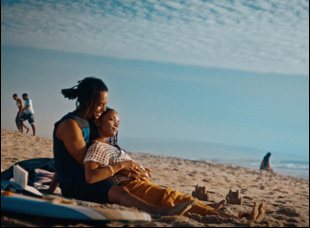
We really just look at the feeling in the scene and how that determines how we want the camera to move, but it was definitely planned out. When we were on the beach, we wanted to have more fluid movement, so we’re handheld and in that first scene, we start on that shot of their hands on Jawny’s stomach and we follow it up to their faces. Then when we get into the hospital scenes, those have a certain aesthetic to them, but the first has more measured movement, not as flowing, not as free and then as we move into other scenes like the water birth [as Jawny reflects on her attempt to deliver the baby], we have more of the movement that we established at the beach and the colors we use, especially in the water birth scene where we have blues and greens and more colors that match the beach and are associated with nature. When we’re in the doctor’s office at the beginning of the film, it’s very cold. Even the doctor’s eyes are very blue. It’s just not really a warm setting and that final scene where the sunset is pink and orange, it’s just magic and we reached that point of the characters having this joyful moment together.
Did you actually pick a good day to the beach to shoot the exteriors?
Yes, it was just amazing. We had a beautiful sunset, and when you shoot outside during magic hour, you only have a finite amount of time to get the shot. If you don’t execute within that that time period, you’re just not going to get it and we didn’t have a lot of time at all to shoot this film. So we were racing, but we got it and I’m so grateful because I’ve definitely had other experiences where it can get really scary. But we were blessed to get what we needed within that short period of time.
 What’s it been like to start sharing this with audiences so far?
We haven’t had an in-person screening yet, but the film was released online on YouTube and Paramount Plus and from the comments online and people sending me messages, it has been really well received. A lot of people telling me that it’s an emotional watch for them and that it moved them or that it reminded them of maybe an experience that they had or someone that they know, so that’s been really beautiful. I had someone e-mail me [to say] the film changed their life, so it’s been overwhelmingly positive. And I will also say it is a bit of a hard watch, especially if you have experienced something like this, so some people if they had an experience like this might not want to watch it, but this is just the reality. To make a film about the Black maternal mortality crisis, you can’t not show certain aspects of it, so we had to really lean into the truth of what that looks like. And that’s what I did.
You’ve actually got another wonderful short in circulation as well in “Noor,” which shows your light touch with tough subject matter and I know that’s actually been designed to become your next feature. What’s it been like to have these both out there?
Yeah, I’ve been trying to get my next feature for a while and that other film is based on a feature script that I started writing in 2010, a love story called “Noor,” about a Black woman and an Arab man who meet in a bodega and have a passionate, high stakes romance built out of this tragedy that happens. It’s something that has been so important to me over the years, so we have this short film as a proof-of-concept and seeing how audience responds to it when I have been able to screen it, they have been very moved, so I’m really grateful for that. It’s just a tough time trying to get original stories made that are different than what Hollywood wants, so it’s definitely been a wild ride.