



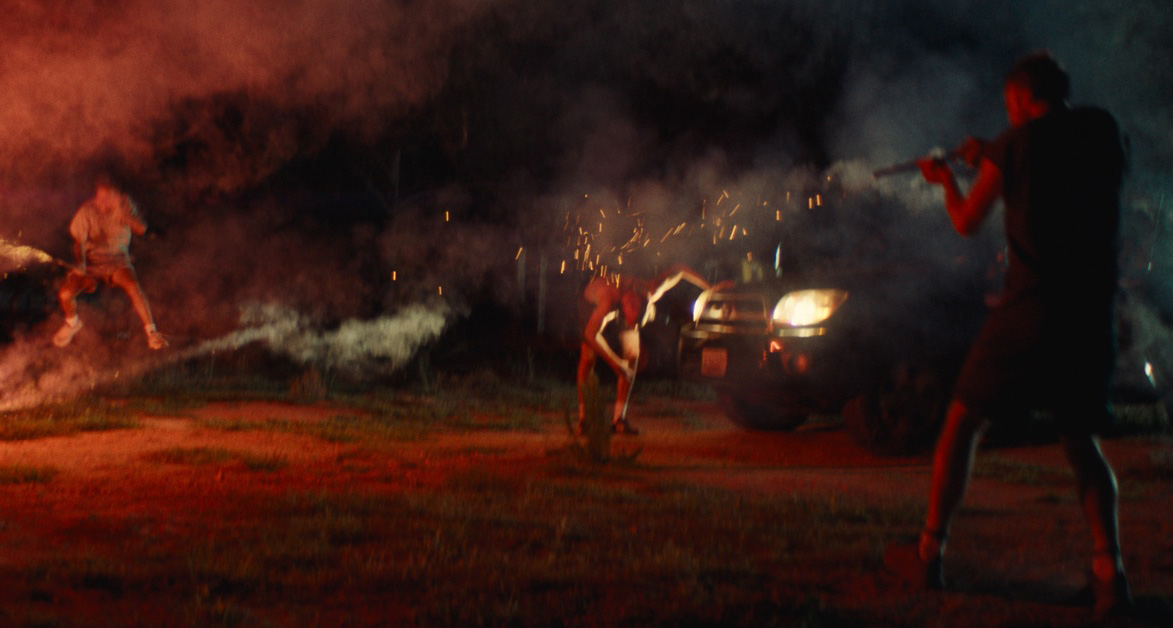

The drapes are pulled down in the house where Tye (Robert R. Palmer), Ross (Joseph Basquill) and Stretch (Armando Rivera) wake up in the morning in “Last Man Up,” but the daylight that creeps through hits hard. It’s clearly a joke from how they’re splayed out on the floor like dirty laundry in various states of alertness when Tye bellows, “Wake up, it’s time for church” as only God knows what they’ve been up to when the word “fuck” is scrawled out on an outside wall. The rest of the home may not be much to look at either, but it’s the only one these guys know and before going for their morning run Tye is unusually mum when asked by Stretch, “What’s the deal with the house?” when it appears as if he’s torn down an eviction notice from the front.
While there’s no need to move out just yet, the living situation becomes untenable in Hazel McKibbin’s tense dramatic short, the latest of films from the rising director set on the precipice of a personal implosion. In films such as “She Always Wins” and “Doublespeak,” the director has turned heads by getting inside the minds of women at life-defining moments, weighing the risks of speaking out about their true feelings or consigning themselves to a future they do not want. The men in “Last Man Up” appear only to live for the present moment, launching fireworks or racing through the wilderness with no real responsibilities from the look of things, which has been documented for posterity by Ross, who is always holding a DV cam in case something really cool happens. Yet that carefree existence being imperiled in any way induces a rare bit of stress for Stretch, who continues to get more and more anxious with each of Tye’s dismissals that anything is awry and it seems like only a matter of time before tensions boil over.
Originally penned by Palmer and later refined by McKibbin, the film ingeniously weaves together the frenetic footage captured on DV cam and the far more polished and fluid cinematography of Bradley Credit almost as if the thin veil of civility between the trio is let down to reveal their inner animal, playfully roughhousing each other and fighting for position as they race across the nearby forest until it no longer looks like it’s much fun but rather some primal form of aggression. There may not be much revealed about why Stretch is more concerned than either of his friends about being potentially left out on the streets, but when that moment arrives he like the others becomes defined by what it will take to survive. With “Last Man Up” ready to explode onto the screen when it premieres this week at Palm Springs Shortsfest, McKibbin and Palmer graciously took the time to talk about how they came to collaborate on the film, having a strong foundation for the camaraderie on screen beforehand and finding the right setting.
 How did the two of you come to collaborate on this?
Robert R. Palmer: Yeah, this was very out of the blue. For a number of different reasons, I thought Hazel would be a great fit for this project, whether or not she thought that [laughs], but I sent her a cold e-mail as a fan of her work. And the inception of [“Last Man Up”] really was just being an admirer of her previous work and [thinking] that this might be an interesting avenue to go down in terms of I’m looking to tell stories about masculinity and she’s been a feminist filmmaker, so there was a bridge there that was interesting to me because it felt like two different sides of the same coin in a way.
Hazel McKibbin: Yeah, usually I make films about women and I hadn’t directed anything like this before. There’s not a woman in this film and I wanted to do something that would that would push myself as a director, but also I really feel the commonality is there’s a level of tension built into the film that really aligns with the kind of work that I like to make. Generally, I like films where people aren’t honest with each other and where there’s secrets and it’s hard to tell the truth. That was in it, so when we worked to build that more in, the construct was there, but I wanted more of what I already liked.
The aesthetic nature of having one of the characters carry a consumer grade DV camera, filming everything, while you’ve got your regular cameras going really creates a good texture for the film. Was that ingrained as part of the idea from the start?
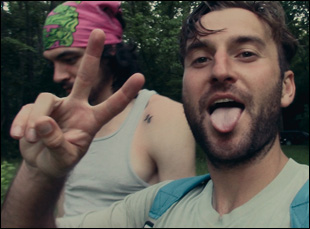
Hazel McKibbin: That was in there from the start, the idea that Ross would be filming the whole time and I think it allowed us a level of exposition without it feeling expositional that helped. But then using it as part of what the film ultimately looked like came about as we were deciding what the what the look of it would be and also in the edit. We decided on set that he would have the camera rolling all the time and Robert and Joseph [Basquill] filmed when they were driving cross country to set, but we found [the braiding of the two types of filming] in the edit. I wasn’t sure if any of the footage would be usable — if we would always see the crew [for instance] – but Joseph, who plays Ross, was keeping an eye on it the whole time. It became part of his character, but he also really was making sure it looked good and wasn’t totally unusable.
Robert R. Palmer: I think we were calling “action” on the camcorder and we were also calling “action” on the [main camera].
Hazel McKibbin: We were slating both, so we could match it up because otherwise it would have been impossible.
Robert R. Palmer: Yeah, the camcorder was in the script from the start, but I don’t know that I was brave enough or had the technical know-how to know whether or not that would work. And then once Hazel was like, “Yeah, we should do that,” I was like, “Yes, please.”
 Robert, I love hearing that you and Joseph drove cross country for this. Did you know who was going to be in the film with you from the start?
Robert R. Palmer: Joseph and I go way back. I’ve known him for seven years and coincidentally, Armando [Rivera] went to the same drama school that Joseph and I went to, so we had known about him, but we didn’t know each other. But we got along oddly well, and it was one of those things where we didn’t even question it, and after we left, it was like “Man, that was kind of abnormal how well we got along.”
Hazel McKibbin: Yeah, you guys immediately bonded. It was always going to be Robert and Joseph and when we were talking to Armando initially, he and I live in New York, so we met up and we had coffee. Usually I’m like looking for actors who look compelling on camera, even when they’re not doing anything and Armando really has that. But Robert and Joseph knew each other so well [already] and then when Armando [arrived], it became such a little bonded trio.
Robert R. Palmer: Yeah, it ruined every experience I’ve had since and will have in the future for that reason.
Hazel, the locations are often quite central to your work as well. Did you have a place in mind for this?
Hazel McKibbin: Yeah, we landed on shooting in and around Atlanta early on and I went down with our producers Clarissa [Blau] and A.C. [Smallwood], who I’ve worked with a bunch earlier on previous projects and we were trying to find something that would work for the [central] house, and we basically all lived in the house that we shot it in. Then Robert, Armando and Joseph were in a trailer parked on the property. And the property was really expansive, so we could do the running on location and all the stuff in the house was all in the same place. Most of it was shot in one spot, and given how much we were trying to cover and how much action there was in the film, t was really important for it to feel close from a logistical standpoint, but also it meant that we were just always together all the time, which created this energy that I think is really evident throughout the film.
Did anything change your ideas of what this would be once you reached the set?
Hazel McKibbin: Yes, we lost a location — our overlook location — and then ended up in a different place. But there’s always stuff changing and part of [this] was responding to the location. I rewrote stuff once we settled on where we were. Then I rewrote it again when we lost our location and found another one a couple hours later. We lost a bit of a day, but I always start with the script, then in rehearsal we work it out with the actors and even the lines get changed a little bit. Then with the locations it all gets changed again, and what’s really important to me is it all feels like the words belong in their mouths and they belong in this house. It all matters.
Robert R. Palmer: Also just by nature of having all the camcorder footage, I’m sure that was a very unpredictable editing process. We didn’t know how the film was going to end. We knew how it was going to end in the script, but there were dozens of different ways we could have gone with incorporating the camcorder footage and we didn’t know that’s what we were going to land on. It took us months to get there really.
 Hazel, the films you make always feel as if they’re constructed a bit like time bombs, selectively parsing out information. Was this an interesting one to structure?
Hazel McKibbin: Yeah, part of that is because my background is as an editor, and usually I write it and there’s more [exposition], but in the edit I take out as much as possible so that it all still makes sense because I feel like you never want to not have filmed something that ultimately ends up being essential, but once you have the basic structure of the edit, it’s about pulling it out, so it’s more subtext than exposition. Certainly there’s a lot of stuff that we shot that ultimately didn’t make it in the film because I [thought], we don’t need that line, but there’s an element of rewriting it in the edit that I love and I worked on this with Steven Rico, who is the editor of the film, but I can’t help at the end but get my hands on it.
There are literal fireworks in the film – did you actually save that till the end of the shoot to blow off some steam? It’s wild.
Robert R. Palmer: It was not at the end. And that was a big moment too. We were scared.
Hazel McKibbin: We were all a little scared of them.
Robert R. Palmer: I had a ton of fun. I was looking forward to that moment for a really long time.
Hazel McKibbin: Safety is so important and there was so much buildup of making sure that it was all safe that it made me more nervous about it. Also, I’m from New York and I’ve never shot fire. It’s totally illegal here. So I wasn’t sure what it would be like. But we had to do the the last shot [of the film] after that. I think it was this the second to last day [of filming], so it was in the middle of the shoot and we were trying to time it so that we weren’t doing too many crazy long nights. There was always an element of day and night, but it was fun and worked better than I could have possibly imagined. It wasn’t nearly as scary as I thought it would be once we actually started doing it
Robert R. Palmer: I was begging to have that included.
Hazel McKibbin: Yeah, you were excited about it.
Are you excited now for the premiere?
Hazel McKibbin: Yeah, we’re really excited. It’s always such a long process making even a short, and you’re always doing it in and around other work and it takes so long that when it’s finally out, it’s a real sense of achievement. Also for it to be at Palm Springs…Armando’s from Coachella Valley, so there’s an element of homecoming that is really nice.
Robert R. Palmer: It’s exciting to just be able to share it with audiences and our friends and family. It’s been a long time coming and it was about finding the perfect home for it to finally show it to people, so that feels good. I think this is something we’re all pretty proud of and we had so much fun making it. I’ve been reliving it now since I’ve just spent so much time daydreaming about how fun it was.
“Last Man Up” will screen at the Palm Springs Shortsfest as part of the shorts program “Social Animals” on June 25th at 2 pm at Festival Theatres 5.