



It would make sense to assume that the character closest to Alice Winocour in “Couture” is the rising filmmaker who comes to Paris at the behest of a designer to make a short horror film to introduce their latest collection at Fashion Week, yet it was a world that the writer/director did not know before spending a year-and-a-half inside to learn its ins and outs once she came up with the narrative engine behind her latest film. Her mind actually gravitated there when she could go public with something private in a way that was quantifiable and still a bit illusory, ultimately leading to a film that, as it’s title actually translates to “Stitches,” resembles the fine lattice work she was constantly seeing in her research where the most fragile garments represented the most careful and dedicated labor there could be.
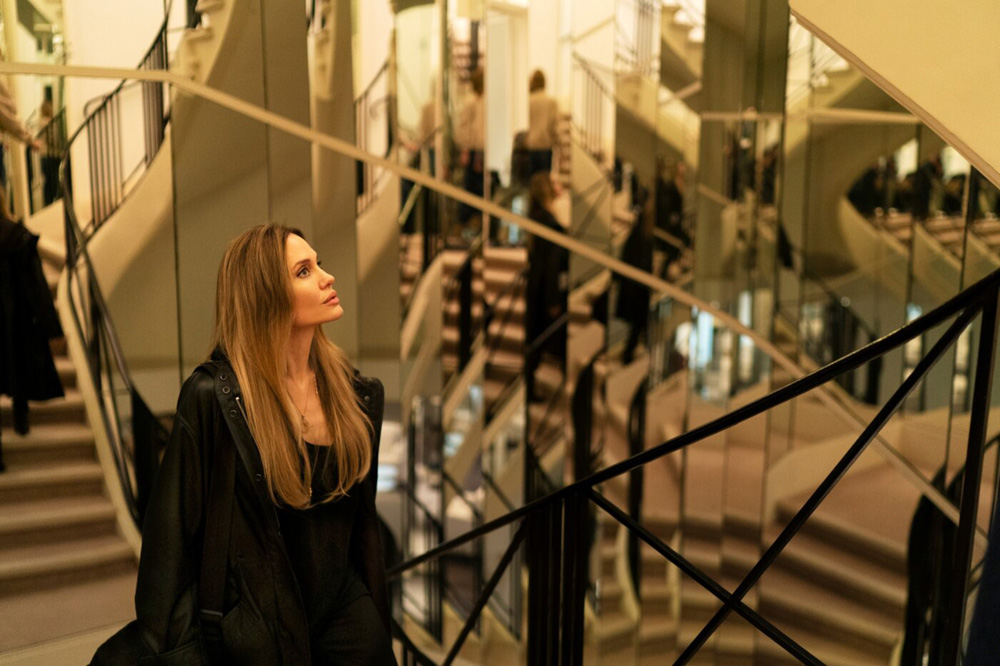
Winocour pours her heart in “Couture,” though true of the profession on display, it only pierces through a cool veneer at choice moments as she follows Maxine, the budding auteur who is already eyeing the fashion shoot as a warmup for her next feature with her cinematographer Anton (Louis Garrel), into the frenzied lead up to a major runway show. That she got Angelina Jolie to star wasn’t out of vanity, but a deeper connection the two had shared when both had health scares, which Jolie had been quite public about, and made it seem possibly less intimidating to the director to offer the “Maleficent” star a role in the ensemble drama where beyond recounting the sensitive process of discussing a mastectomy, she’d have to perform the part in French, a language she only knew vaguely from hearing her mother speak it. It turns out to be a remove that like a costume allows a deep vulnerability on the part of both the film’s star and director to bring an unusual level of candor to the film, and Winocour finds in an industry where appearances are prized above all, there’s much going on beneath the surface as she also turns her lens towards Ada (Anyier Anei), a striking Nigerian whose perfect cheekbones have the potential to lift her family out of impoverished conditions back home, though her father would much rather see her go to college than model, and Angèle (Ella Rumpf), a makeup artist who reads Marguerite Duras on the side to be inspired when she yearns for a career in writing.
When the trio are all making strides in their careers, the film’s occasional cutbacks to a seamstress (Garance Marillier) putting together the perfect gown in all of its intricacies acknowledges how much goes into the work of building a life and just how easily it could fall apart at a moment’s notice, as it would seem to for Maxine, who wants to press on with the production of her next movie, knowing how hard it was to even reach this point, despite the insistence of her physician (Vincent Lindon) to get treatment as soon as possible. Like all of Winocour’s films to date, “Couture” doesn’t equate the transmission of intimacy to something of small scale but rather felt enormously, usually setting her films in outsized environments as a result, whether it was the pulse-pounding Matthias Schoenaerts/Diane Kruger bodyguard drama “Disorder,” casting Eva Green as an astronaut in training in “Proxima,” or tracking Virginie Efira as she could see the City of Lights once more after experiencing in terrorist attack in the triumphant “Revoir Paris.” For that reason and more, “Couture” feels major and it was a great privilege to recently talk to the director about how she makes her films personal without being too autobiographical, tending to a story with as many layers as this has and how she has justified putting herself out there as much as she has with this film.
 From what I understand, you had no real connection to the fashion world and I’ve heard you say that the more personal something is, the more foreign you want the film to be – it reminded me of “Proxima,” which was about motherhood, but set at NASA. What makes you want to have that distance?
Yeah, the more it is intimate to me, the more it has to be far away. In “Proxima,” I was talking about the relationship between my daughter and I and my mother, so because it was motherhood, it was so intimate and it had to be so far — in space. This time it was not space, but it was fashion, which was a bit like space for me and I was talking about something so intimate — about the illness and actually in Toronto I was not ready to talk about it. I didn’t talk about it to even my closest friends, but then there was this urge to do this movie. Sometimes you write stories with your unconscious. So to me when it’s so intimate, it has to be set in a very different world. I could’ve set the story in the cinema world, but I thought it was more interesting to discover a world I didn’t know and also I thought it was interesting to have someone confronted to the idea of her death in a in a world of glamour and glitter. It was a cool contrast.
You’ve said you spent a year-and-a-half doing research in fashion houses. How did these three characters end up being who you wanted to focus on as a way into this world?
Because to me there was something political about not telling an individual story. Of course, I did a lot of portraits of women and it had been all just one story. But I thought there was something more contemporary about this idea of telling stories of many women and all of these women are the same woman because the film is a self-portrait. So it’s a woman in her twenties, a woman in her thirties, a woman in her forties, but it’s the same woman and I’ve identified with all of them. The woman in her twenties, the one who is hesitating between modeling and [working at a] pharmacy, it was a bit like me hesitating as I was studying law and I was not really sure I wanted to get in this world of cinema. And when I was seeing all the directors, it’s a bit like the model when she arrives and she sees all those models with those crazy rules, she doesn’t really know if she will fit in.
Then the woman in her thirties, it’s a bit like me when I was starting to write at school and people were giving me shitty advice, like “You should write that way…” and I was trying to find my own voice. And in the forties, it’s a bit like me when I got the news of the illness. So I met all those women, they’re real women and the film is really part of stories of their life and they gave the movie a lot of secrets. Like the real Anyier [Anei] was at the time of the film hesitating between modeling or going back to pharmacy. She had lied to her father. It’s true [what happens in the film]. The Ukrainian model was really coming from Zaporizhia. She was working between Kyiv and Milan and Paris, taking the train through Poland to go back to war. So it was a very emotional experience to have all those voices of women and to welcome those voices in the core of the film. It was also to me important to put those women on the map of cinema — Ukraine and South Sudan, you don’t have representation of those countries. You know them only by war, but there are many other things.
How much did you actually want the actors to bring themselves to the role versus what you had on the page?
I had written a South Sudanese girl because there are so many in fashion right now, and most of the girls unfortunately have the same kind of story and they have to earn money for their family, sending money and they have a lot of pressure on their shoulders. But then when I met Anyier, it was similar, but I rewrote the character with her adding details about pharmacy and it’s actually the real little brother of Anyier who is playing in the part [in the film] and it’s her mother that we hear also speaking. We hear Swahili, which is the language of the brother, and Dinka, the language of the mother, because they moved to Kenya and I thought it was also interesting to represent those languages in the film. Also with [Julia Ratner] the Ukrainian girl, I was really inspired by her because I had met her while I was writing and in those meetings, I like to have a a documentary approach when I write — to go back and forth to add details I got from reality and add them in the fiction — and then it becomes the reality of the film. I don’t even know what is real, what is part of the fiction, but in that special case of that movie, everything is super real.
 Something that becomes a really special part of the film, and something I imagine was difficult to preserve when people are pressuring you about keeping a certain runtime, are the fleeting encounters that give so much to the overall feeling of the film – such as the time Julia and Ada spend together in the city before Julia leaves for the airport for her next job or the hospital waiting room encounter between Maxine and Anna, an older woman played by Aurore Clément, who faces a similarly devastating health scare. What was it like protecting those?
I’m glad you mentioned those because they are the scenes I prefer in the movie [showing] solidarity between women and it’s solidarity of trauma. When you share that with someone, there is no barrier, even if you come from a very different country or social class or generation as we see in the corridor of the hospital. It’s funny because this scene with Aurore Clément in the hospital is something really that happened to me and when I met that woman, I had this this little thought, “Maybe I can make a movie of this.” It was really when she asked me my name and I asked her hers and it was like really being in the corridor of death and meeting someone. It was a very strong moment. I also think [the other scene you mentioned] was interesting to have those two girls coming from the war in this glamorous world. It’s something so strange and it reveals the craziness of our world. There is war going on and at the same time there is this other reality and it’s the same world at the same time.
That collision is often brilliantly presented visually, such as the carnival that sits on the other side of the street from Maxine’s apartment. How did you get that particular location?
Actually, this was a coincidence and a lucky one because when we were shooting uh in this hotel we could hear like the screams of people from this carnival and it was scream of fear and of excitement at the same time, so I thought it created a very special atmosphere in the scene Anton [played by Louis Garrel] where we see [Maxine played by] Angelina seeing this carnival from outside and then in the end the camera goes to find [whirlygig] because it’s turning and it’s like the turmoil of life where people are screaming but it’s the idea we live and this is what is so good about life
It’s an incredible juxtaposition. Was this difficult to balance once you brought it back to the edit and you’ve got all of these various stories you need to keep afloat?
It was a very complex editing process because we’re jumping from one story to another, so it was we really did have to sew all the stories together. Sometimes I had to get rid of scenes I really loved because when we were staying too much with the character, we were losing the rhythm of it and it had to be an operatic thing, jumping from one story to another and to be fluid. It was very fragile like a dress I was making and like haute couture, we were following the thread of the story.
 I really did sense the quiet seamstress was the most autobiographical character in this.
This woman is a bit me doing the movie. But like I said, I’m all these women. Angela writing is a bit like me writing the movie and trying to tell the story of others and and yes the seamstress is making this dress and it’s a very emotional moment when she sees the dress finished in the atelier and everyone is is around her. There’s a relationship between this dress and the life of Maxine because at first it’s a bit like a fairy tale, then there is the blood on her finger [from stitching], she’s in a way connected to Maxine [because it’s a memorable first encounter], like she’s doing this dress that at the end we see it’s like the body of Maxine she’s working on. It was an idea to have that connection with those two characters.
On the seamstress’ face I know there’s a look of relief and a little bit of exhaustion and exhilaration all upon finishing the dress. What’s it been like for you putting this out into the world so far?
It’s been a strange experience [and has been from] when I wrote it. I wrote with my unconscious with this feeling of urgency and I never thought that I would have to talk about the movie and that there will be this marketing [process]. Because it was so intimate, it was quite a violent experience at the same time because I’d done this film to put the illness far away. And I find myself in a place where I talk about it all the time, especially because I had decided not to tell anyone. It’s a bit like the opposite.
Also I’ve been working on trauma as a part of the DNA of my work. My film “Revoir Paris” was about a terrorist attack, so working on trauma is really strange as it’s also cathartic, but all those things go through your body at the same time. It’s a bit like an actor who’s playing tough scenes then you have to live with the ghosts and with those stories so it’s a bit strange. But the idea was to bring hope and to celebrate life, so I really hope it will be received like that by some people in the world.
“Couture” opens in theaters on June 26th.