



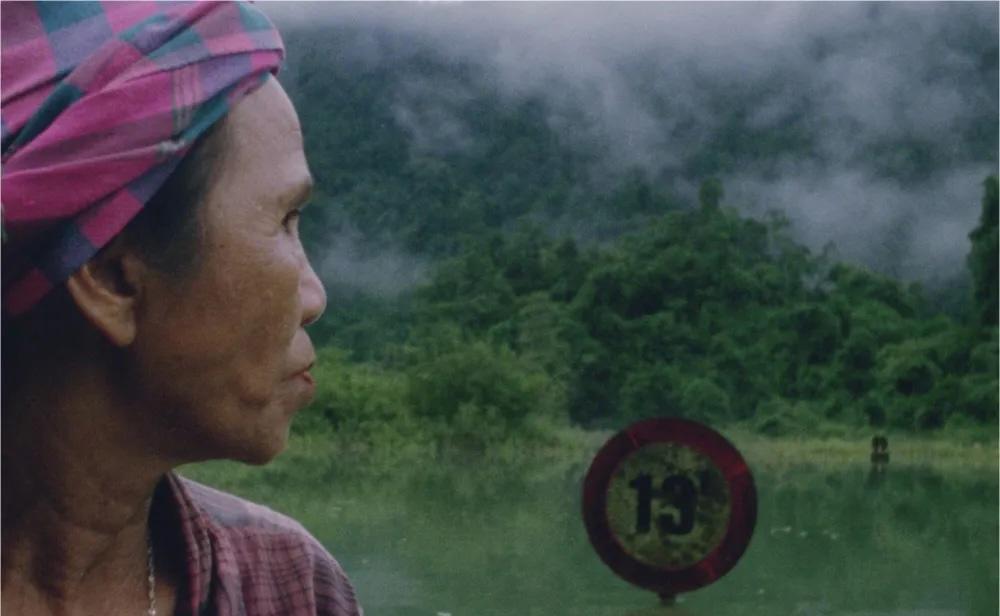

An irresistible rhythm starts to develop in “Hair, Paper, Water” as directors Trương Minh Quý and Nicolas Graux cut back and forth between the words Cao Thị Hậu shares from her regional Ruc language, a subset of Vietnamese, and her experience of the area it emerged from with the dialect’s name even coming from the action of “water trickling through rocks and caves.” As the grandmother describes, she was born in a cave and when each individual word she speaks at first is given prominence on screen, presented in big red letters with the sounds of the area accompanying her own pronunciation, it can feel as if it’s a cleansing of the senses to experience the words formed by the environment as the climate has shaped rocks and shrubbery over the centuries, an especially earthy quality given to the film by the filmmakers’ use of a Bolex with the inherently grainy texture of 16mm.
After Quý reenvisioned a coal mine as a galaxy full of stars in his 2024 narrative sensation “Viet and Nam,” he and Graux see Thị Hậu’s small plot of terra firma as a world unto itself yet vulnerable to the creep of urban influence when its Acacia trees are cut down to pulp for paper and the city promises employment that divides families that can’t afford to make the move with one salary not enough to live on in the city and two depriving children of seeing their parents outside of work. That turns out to be why Thị Hậu is beckoned to take her first trip to Saigon to visit her granddaughter after she gives birth when her own parents are too busy to show their support, and though Thị Hậu isn’t intimidated by the surroundings, shown to be calmly lighting up a cigar when she arrives, the roar of hundreds of motorbikes crowding the streets that the film cuts to is far less tranquil than what she’s used to.
“Hair, Paper, Water” is a sensorial wonder first and foremost, inviting any outsiders to feel the contrast themselves with its immersive sound and careful camerawork honing in on the most minute details that are the building blocks for any environment, but the film presents Thị Hậu as a woman who wears her responsibility lightly of protecting a way of life but takes it seriously when it’s yielded a safe and rewarding existence for herself. Upon hearing of COVID, she reached for the ra-ra plant, which her parents once treated her with when she had a cough, steamed with some lemongrass, and she knows what indigenous fruit to rub against the skin to ward off leeches. Knowing better than to let this knowledge die with her, she can be seen imparting her wisdom to the handful of children in the village, taking an interest in one boy in particular whose parents have an unhappy marriage and seem likely to divorce.
The film looks after its audience as tenderly as Thị Hậu does hers with the education it passes along, gently encouraging the idea that simple things shouldn’t be taken for granted. While there’s an endearing playfulness to the edit that speaks to childhood as it jumps around to hold attention, it also affords audiences with the ability to connect the dots without having to put too fine a point on it when the way a place shapes the people living in them can be too profound to be articulated, with verbal communication only a starting place for a full meaning of what they hold. “Hair, Paper, Water” eventually becomes a dialogue on a number of different levels – between generations, across cultures and between nature and humanity, exhibiting a reach that’s extraordinary.
“Hair, Paper, Water” does not yet have U.S. distribution. It will next screen at the New York Film Festival.