
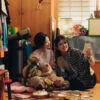




It wasn’t a part of Sara Shahverdi’s pitch to constiuents to become a local representative in Iran that she’d treat every member of the community as she would her own family, but it’s a campaign promise she could’ve made good on. In “Cutting Through Rocks,” which captures her groundbreaking tenure as one of the only women to hold such an office out of Iran’s 300 village councils, her election may have only happened when people already felt that way about her, delivering half the children in the village and on occasion their children as a midwife. However, her fierce advocacy can be seen as she is introduced in the heat of a battle within her house where she became a primary breadwinner after her father passed when she was just 16 and there is tension when the women in the family were pressured to sign away their share of the inheritance, yet Shahverdi demands to see those agreements when one of her sisters complains that she can’t even drink water in her father’s house and the confrontation alone is enough to afford them some equity.
Shahverdi recalls how her father wanted a boy when she was born in Sara Khaki and Mohammadreza Enyi’s deeply inspiring profile of the unorthodox politician, having no sons as the family grew to seven when she was born and raised her as he would’ve if that had happened. But the toughness and sense of self-reliance that came with being taught construction and learning how to ride a motorcycle only emboldened her to become a strong leader for women’s rights, giving motorcycle lessons of her own to young girls to feel the freedom that she did when she was 10 and ultimately using her position on the council and oversight over zoning projects to carve out a piece of ownership for the wives of husbands who want to build homes and are usually deprived of such a title. Khaki and Enyi depict resistance to her efforts, but over seven years of filming, they capture the incremental impact Shahverdi has on bringing greater equality to her community as she will gather women together just to see how much collective power they can have and continues the work of tending to the young girls she helped deliver as they come into their own and seek more independence than the generation before them.
After winning the Grand Jury Prize at the Sundance Film Festival earlier this year, “Cutting Through Rocks” has become a favorite at festivals all over the world when it isn’t only what Shahverdi has achieved the’s so remarkable, but is such a delightful person to spend time with with her no-nonsense attitude and while the film shamefully hasn’t picked up proper distribution yet despite being one of the year’s finest, it is having Oscar qualifying runs in New York and Los Angeles that shouldn’t be missed. Recently, Khaki and Enyi graciously spoke about how they came to follow Shahverdi on a historic campaign, putting in the time to capture change as it was happening and all the unexpected benefits that can inadvertently come from making a documentary over the course of so many years.
 How did you decide to want to tell this story?
Sara Khaki: I was born and raised in Tehran, Iran, and I witnessed many stories of strong women who were fighting for independence, but I moved to United States at a young age. Now having lived equally between the two worlds, I see that a lot of the themes that are explored in the film, mainly gender injustice and the way in which women’s bodies are being targeted and become battlegrounds — are shared concerns wherever you look at it. Through extensive research, I came across the story of Sara Shahverdi, a woman who lives in the northwest of Iran, who rides a motorcycle and had been a midwife. We spoke over phone for several months until she said she was thinking about running for a council seat. I knew that there was a story here and I knew that this needed to be told in a cinematic way, but I was in New York and I also knew I wouldn’t have been able to tell it by myself as a female director. I needed a co-creator to partner with me on this journey and Mohammadreza was in Iran and I had the pleasure of working remotely [before], so I knew who to call.
Mohammadreza Enyi: And I was waiting for this moment because I liked Sara and it was a chance to spend more time together. Also, I really respected her vision of documentary filmmaking and cinema. It was a fantastic chance to work together and I was also coming from the Azari-speaking community and more than 30% of Iranian people speak this language, but it’s very rare to find films coming from this region. And I witnessed a lot of similar stories of limitations for women, asking for more space, but it was not possible for me as a male director to go and make an intimate film about women because of the culture and Sara Khaki made it possible for me to go to the region and make a film. For me, it was a response to my culture and being there and we knew that this is not a local story. This is a global story and Sara Khaki brought a lot of knowledge about inequality, so we both entered the village and made this film.
From what I understand, you not only had to earn Sara Shahverdi’s trust, but that of the entire community. What was it like to make everyone comfortable?
Mohammadreza Enyi: They accepted me in a second. They were like, “Mohammadreza is one of us,” and I grew up with my mom’s songs, so the connection was something beyond just capturing their lives. It was also spending a lot of time behind the camera. I had a habit of going outside, taking pictures with my phone and talking with people to understand what is happening there. And the magic of being a couple, they accepted us. They invited us to their houses for lunch or dinner. They were like, “They’re a couple with a camera.”
Sara Khaki: We became a couple. We got married through the process of making this.
 Sara, was it interesting coming at this from a distance, quite literally in Brooklyn and you might have a certain idea in your head that has to adjust to the reality?
Sara Khaki: Certainly, it was very different, but not in the sense that I wasn’t familiar with what the women are going through. I was very much familiar with the struggles they had. I had some ideas [about the area in general] because my grandparents were not from the village, but from the region and they spoke the language. I also grew up with some songs and I embraced the culture and it did really feel like I was re-immigrating back home. It took me a while to get used to everything. But obviously, I felt welcomed by the community and it was magical how it all came together because we just couldn’t have had a better outcome if we weren’t a male/female duo collaborators.
Mohammadreza Enyi: And good news is that Sara learned the language in the process.
Sara Khaki: Yes, over time, and then once it came to the part where we started editing, I knew everything.
Mohammadreza Enyi: It could be a new technique for learning new languages. Go and make a film in the community, so that way you can learn the language. You couldn’t be more curious. [laughs]
You have a truly amazing scene to open the film when it’s not only riveting to watch, but sets up so much about the family Sara Shahverdi comes from and her own attitude towards taking on injustice. How did it fall into place as an introduction?
Sara Khaki: What we saw in the beginning of the film and later creating land ownership, we found a connection between her will and desire to create space for women and girls.
Mohammadreza Enyi: Storywise, we wanted to see how Sara is dealing with her family and her attitude of giving power to other women. We wanted to show that it starts from the family itself, and for Sara, experiencing what is happening in her family. What Sara is doing in the film, you can see [took root] in her personal life. Being victim of a forced marriage, just having the problem of sharing the land in her own family and also Sara being the only [female] motorcycle rider and then fighting for other women to also being able to ride motorcycle. She’s a good representative of women in the village because she’s had the same experiences.
A great parallel is drawn with Fereshteh, the 12-year-old girl, she comes to mentor who would otherwise have to enter into an arranged marriage. Did she come to mind early as a focal point?
Sara Khaki: It was interesting. There were so many women that Sara had supported along the many years and there were so many stories that didn’t end up in the film. Before we started production, we found out that there was another woman that stayed with Sara throughout the years, continued her education, and now she’s a midwife. So with that in mind, we wanted to make sure that we followed a specific character like Fereshteh to see how her life ends up. Seeing these two young women [Zahra being the other] are representative of the entire society there — one of them going through that horrifying moment, being pressured by her uncle for riding a motorcycle, that was a moment we wanted to see how it evolved because we had Sara continued normalizing the idea of riding a motorcycle [within the community]. Seeing the women being accompanied by their parents at the end of the film and how that journey is going forward was really essential for us because that’s really not really an ending. It’s a beginning of a ripple effect of a hopeful change that we are hoping for.
Mohammadreza Enyi: Yeah, Zahra and Fereshteh are representative of many other teenage girls in the village and by choosing their stories, we can tell the story of many other women in the village and in the region.
 Was there anything that happened that changed your idea of what this was?
Sara Khaki: Every time we would go to production. We had eight sessions of production over the course of seven years and the longest production trip was 90 days, so we would spend a long time in this space. And every time we would go, we would feel like, “Okay, this is the last production trip.” Then something would happen that definitely was worth exploring and in the process, the case that was created for Sarah definitely had elongated our production. We were stopped from filming at some point, but that deepened our desire to want to tell the story and at the same time, it also created a deeper connection between us and Sarah Shaverdi because we understood each other as more conflicts and more obstacles came in our way.
Mohammadreza Enyi: Yeah, for fiction filmmakers, it’s like having a script and capturing everything in two months, that’s it, but for us, [it was about] being there and being alert every day to the stories and what is happening there. We both got a lesson from the Iranian filmmaker, Abbas Kiarostami, who said “Just be a good observer of life and explore the drama from real people.” And we took that lesson [to heart] while making this film. Many times we just wanted to be honest with our story, our characters, and being observant of Sara Shahverdi offering a change for the village. We wanted to stay there and see the change, the setbacks, [her] opponents and also the effect of Sara Shahverdi’s revolutionary acts on the lives of teenage girls.
What’s it been like to see the film connect with audiences around the world?
Mohammadreza Enyi: It’s very humbling. The film has gone to 60 film festivals all around the world and we are getting a lot of fantastic messages from people in different places saying that we connected to the film. We knew that this is a global story. Sara Shaverdi joined us for the first time in South Korea to experience the film, watching it on the biggest screen with audience and it was surprising for her because after the screening, many teenage girls and women came to Sarah asking for autographs, taking pictures and talking about the similar stories of inequality. And Sara [told us], “You made a film about my life in the northwest of Iran, and the film is connecting with people in Asia.” And [we told her] “Even in the United States and Europe, people connecting to your story as a woman who fights for equal space, and it’s a very global and relevant story.” As independent documentary filmmakers, it was important to spend the time for a story that really matters to us and seeing the resonance to people, it’s the biggest reward.
Sara Khaki: To see the film resonating with so many people across the globe is a true testament of the importance of the stories that we are telling through this film, but it’s also an ongoing struggle as independent filmmakers because we continue to seek U.S. distribution. We are doing everything on a grassroots level and in the same way that Sarah is creating a path in her world, we are creating paths for ourselves in the independent filmmaking documentary world as well, so it’s a combination of feeling humbled, but combined with lots of hard work.
“Cutting Through Rocks” is now playing in New York at Film Forum and opens on December 5th in Los Angeles at the Laemmle Royal and the Encino Town Center.