



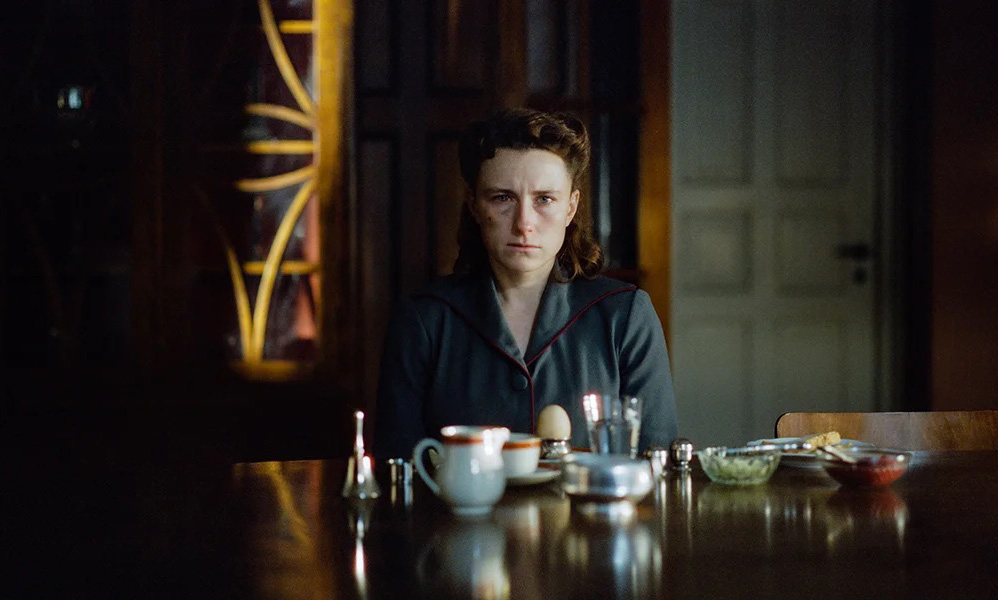

The awkward position that Marie (Mathilde Arcel) finds herself in at the start of “Woman Unknown” pales in comparison to the truly uncomfortable place that director May el-Toukhy reveals she’s in in the director’s phenomenal third feature, set just after the end of World War II in Copenhagen. The allies have won and Marie has found a fiancée, though the happy ending isn’t clean, either when those suspected of being Nazi sympathizers are routinely dragged onto the street to be brutalized publicly despite efforts to move forward in peace and Marie’s engagement is to Christian (Carsten Bjørnlund), a man that initially hired her to be his maid before his wife took ill, the head of a factory too rich to care that much how it might look to have found comfort with her in his grief, a luxury that she doesn’t exactly have, but she also can’t afford to be too proud when financial security like this is going to be rare in a country rebuilding after the occupation. There can’t help but be some pride in instructing the new maid hired to take her place when it’s meant she’s made it to the other side, but also assuming the role of Christian’s wife, going so far as to wear the deceased’s old gowns per her fiancée’s request, can feel a bit demeaning even if no one is overtly shaming her for it.
If el-Toukhy demonstrated in her previous film “Queen of Hearts” (memorably remade into Catherine Breillat’s “Last Summer”) that her own comfort zone is making people squirm as a woman looking to rekindle her lust for life begins an affair with her son-in-law, “Woman Unknown” may just be her first masterpiece as it observes Marie suffocating when she should be enjoying rarefied air. Despite being handsomely mounted, any of the film’s historical trappings fall away in part because of Arcel’s heart-racing turn as the bride-to-be and its eerily modern parallels when she is an inconvenient fit for the country she’s in, fearing an association with Nazis when she did what she had to survive when they occupied the country by acceding to any of their demands yet could hardly be described as a willing collaborator, having more of a reason to hate them intensely than any of the resistance movement eager to rid the country of any remnants of the Third Reich.
Opening with a marvelous introductory shot that grows only more reverberant as the film wears on, with a camera pointed upwards towards the sky, gradually exposing the walls around it as if falling backwards into a hellscape below as it settles into the building where Marie and Christian have a flat, the film unfolds in the days leading up to a dinner party where the couple will essentially make an entrance into proper society. Marie doesn’t move with much confidence or grace as someone might if they felt entirely taken care of as the wife of a luxury glove factory owner could reasonably be expected to be, but she seems to have managed an ascension from domestic worker to fiancee without rocking the boat, with none of the other staff openly resentful of her as she still performs some duties of a maid and Christian’s young daughter accepting of a new stepmother, even if she continues to keep a photo of her late mother under her pillow. Marie is damned to know that she’ll always be overshadowed the past, both her own and the family history she’s entering, but the marriage of convenience for all appears as if it will work for all until she is out running errands and stumbles into Karl (Thorbjørn Hedegaard), someone well aware of her life before meeting Christian and not shy about calling her by her old name Karen-Marie in front of others.
Just like Trine Dyrholm’s long-suffering wife in “Queen of Hearts,” Marie isn’t absolved from responsibility for the questionable decisions she’s made, but el-Toukhy and co-writer Maren Louise Käehne brilliantly show those choices weren’t made in a vacuum when Marie’s routine regularly takes her past mob violence in the streets and swastikas are painted on front doors of buildings where there’s even a whiff of suspicion, compounding any regret she has with fear of ever being open about what happened, surely paving the way for further calamity. The jagged and graphic handheld camerawork that captures the public floggings of women more than once stand in stark contrast to the serene and immaculately composed scenes set inside Marie’s apartment, but they can still be seen as two sides of the same coin when all are presented as places that Marie has to always think twice before entering, a diminishment of the soul that can be seen from Arcel’s eyes alone yet increasingly appears unconscionable for society as a whole and while “Woman Unknown” charts erasure, both self-induced and culturally prescribed, it becomes unforgettable.
“Woman Unknown” does not yet have U.S. distribution. It will next play at the BFI London Film Festival on October 17th at 3 pm at the BFI Southbank, Screen NFT1 and October 18th at 5:30 pm at Curzon Soho Cinema, Screen 1.