




David Paul Kuhn wouldn’t have began to write “The Hardhat Riot: Nixon, New York City and the Dawn of the White Working Class Revolution” in the mid-2010s if he didn’t think it would have any currency by the time the 2020 election cycle rolled around when it was first published, but what he couldn’t predict was just how more prescient a recounting of a Vietnam War protest that laid bare fissures in the Democratic Party coalition that would only fully reveal themselves during the 2024 presidential election when Sean O’Brien, the president of the Teamsters became the first union boss in generations to speak at the Republican National Convention, putting concerns about economic sustainability over progress on social issues the party had long been known for.
“It’s a little surreal, right?” Kuhn said on the eve of the premiere of the adaptation of “Hard Hat Riot” as a documentary for PBS’ “American Experience.” “I started this almost a decade ago and the roots of even that go back to the Obama era, so to see it come alive in a film, you have perhaps a naive hope that it breaks through in a way a book can’t, and that it helps create some empathy for our polarized sides.”
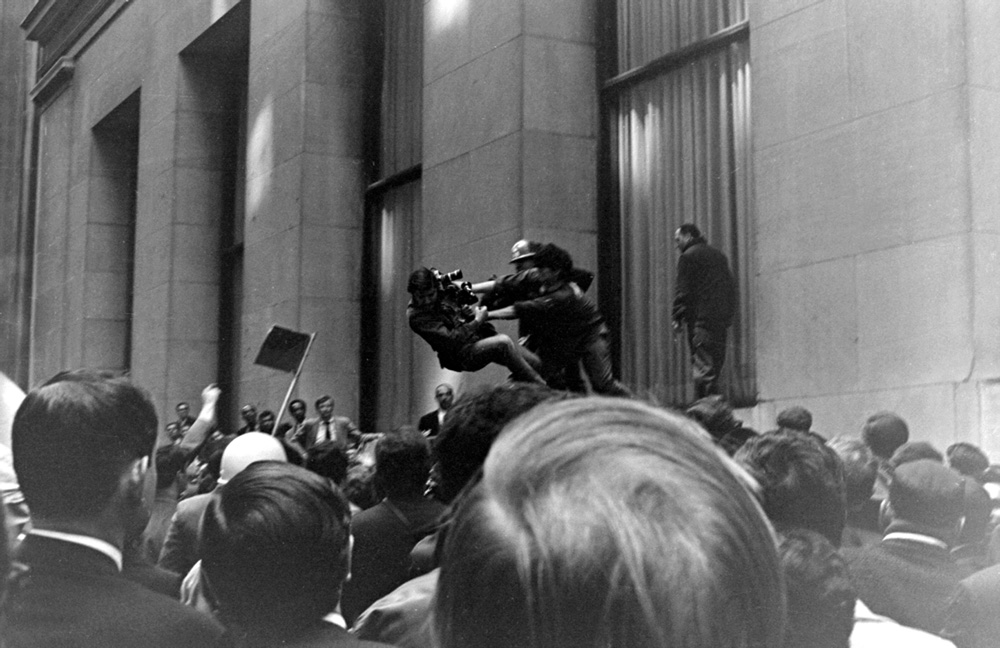
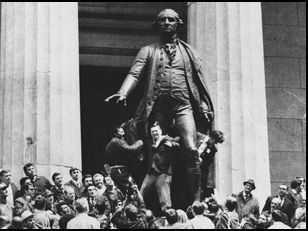
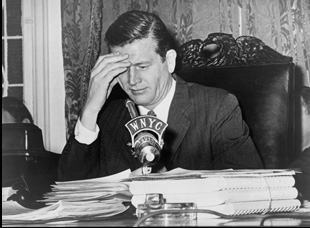
There couldn’t be a more vivid illustration of the conflict within the party known for its big tent approach to building consensus than one week in 1970 when peace activists descended on the New York Stock Exchange to bring commerce to a crawl as the war in Vietnam raged on, yet were met with resistance from the construction crews that could be relied on to vote for Democratic candidates and causes since the New Deal, but found their livelihoods imperiled by any work stoppage on the skyscrapers they were hired to erect. No one involved may have actively supported the increasingly futile-appearing effort abroad, but the demands of those that needed to put food on the table versus those that were concerned with the lives of people they’d never meet created a deep division, only exacerbated by John Lindsay, the mayor of New York at the time whose own beliefs were hardly a neat fit as a Republican who stridently opposed the war though his lineage as a Yale Law School grad made him hardly a figure of admiration for the activists and certainly not to the blue collar community.
Although news of the protests didn’t make it far beyond the city line at the time, it was of great interest to the White House where officials in the Nixon Administration were keeping tabs, seeing an opportunity for a prospective new voting bloc by shifting their image from the party of business leaders to those in labor, and the protests themselves were captured for posterity by the New York Cinetracts Collective, a group of film students with a young Martin Scorsese as one of their advisers as part of a documentary called “Street Scenes.” All of that “Hard Hat Riot” feel still ahead of its time rather than a look at the past, particularly when made with such energy by Marc Levin, the director of “Slam,” “The Last Party” and “Brick City” who effortlessly brings the present-day parallels to light while sticking with the footage that he has as well as illuminating interviews from participants who have had the time to reconsider their political allegiances over the years.
With the film’s premiere tonight on PBS and streaming thereafter on its app and online, Kuhn and Levin graciously took the time to talk about revisiting this under appreciated pivotal point in American history to make sense of the times we’re in now, working with archival material that could really bring the story into the present moment and how they worked towards creating a dialogue between parties that disagreed during the production.
 How did the two of you come to join forces on this?
Marc Levin: I was actually introduced to David by two executive producers, Mikaela Beardsley and Cary Woods, who had optioned David’s book and said, “Hey, you’ve got to read this, Marc.” And I did read it and I saw they had put a little trailer together and it had some of that footage that you see in the documentary, which I’d never seen before. I was just stunned and jumped aboard.
David Paul Kuhn: Yeah, in 2016, when Donald Trump became a serious contender [for president], I knew I wanted to write this book and that this was a lesson of history to show the breaking apart of the Democratic Party, and it would be a microcosm of the divides that haunt us still. I hoped I could find a great deal of documentation because there were lawsuits related to the riot and when there’s lawsuits, there’s discovery and discovery should not be destroyed. Long story short, I got the documentation and I will never forget the day where I was poring through thousands of pages of records and I found this footage, and I had to go through the footage on a crank reel viewfinder. And as I was looking through that footage, I was ecstatic. As you probably know, sound is different from visuals at this time, but then I got some audio — not nearly as much [as we had recording for film] — but I was so happy to get the visuals and I was able to get it in such high definition, I already knew this was a cinematic event, but that really made me think this could be literally cinema.
It must be interesting to revisit this only a few years after finishing this book and it’s only become more relevant. Were there opportunities of a film you were excited about given the time that’s passed and a different medium?
David Paul Kuhn: Some of this was really expensive to digitize, and I had dispatch records of the actual NYPD dispatch that day, which is very rare — even for 9/11, I don’t think that we have the actual dispatch — and because there’s more money for a film than a book, I had transcripts, but it’s different to hear it, so we digitized [the dispatch] and we got some of it in the film. That is real dispatch of that day, and you can’t write books and make documentary films if this stuff doesn’t excite you, right? The minute you find that little artifact, you’re ecstatic. That was true throughout the process. Film is three-dimensional in a way a book isn’t, so anything visual and audio just, obviously got me most excited. And I was so happy with Mark to translate it into a documentary.
Marc Levin: One thing that came up at our premiere because it was in David’s book and we made two versions of the film — a festival version and the broadcast version — I didn’t know that Ronald Reagan on the campaign trail in September 1980, with the Statue of Liberty behind him made a speech about how he was going to represent the working man and it ended with, “We’re going to make America great again.” I had never seen that clip and that was how the festival version of the film ended, but because of the climate we’re in now, PBS felt that that might be inappropriate. I’m still not clear exactly why, so that was edited out, but it was in David’s book that I first came across it. I was like, “What, Reagan said that?” So it goes back and forth in terms from the book to the film.
 Marc, in your director’s statement, you mentioned being at a bar nearby where all this was happening enjoying the Lakers-Knicks playoff game. I imagine you’re a film student around this time as well, so I wonder, what was it like being able to dig into all of this where you were living the experience and at the same time, not entirely conscious of it?
Marc Levin: Yeah, it was fascinating because I reached out to friends from the year. In fact, my high school girlfriend who I was living with [at the time], I sent her a note and asked if she remembered and she said, “what’s the Hard Hat Riot?” She had to look it up in Google. And I was in the Maysles editing room. I was a 19-year-old kid that had dropped out of Wesleyan and loved film and I was listening to [the radio] because I wanted to see if Willis Reed was going to play in game seven against the Lakers. That’s when the newscast came on. “There’s a disturbance down on Wall Street. Looks like the construction workers are attacking the anti-war demonstrators.” And later that night, I was in a working class Irish bar on the Upper West Side and we’re all buying each other drinks and hugging each other and high-fiving at the Knick victory. I couldn’t help wonder if some of these guys were downtown earlier beating in their heads of colleagues of mine and I could have been there, so it is weird to go back.
You look at things differently. I certainly looked at Nixon differently in making this film, going through a lot of footage. His ability to respond to Pat Buchanan and some of the other [Nixon Administration officials], Stephen Bull and Michael Balzano, who related his own past. He was poor, working class and was rejected by the Ivy League Eastern establishment, so he had that resentment and related to the hard hats in a way and his intuition [presaged the move of] the Republican Party from the blue bloods to the blue collar. I don’t think I ever really understood that until I read David’s book and working on the film that rage of a young teenager back in 1970. I looked at Nixon a lot differently.
David Paul Kuhn: And that’s kind of a microcosm for what the goal of the book and the film was with the working class because they have been caricatured as pro-war. But they disapproved of the Vietnam War after the early 1968 when the Tet Offensive occurs and it seemed unwinnable to most Americans. With the book and the film, we wanted to see this part of America in three dimensions because the story of the ’60s and ’70s has really been told from the student’s perspective and we just wanted to show this other perspective and keep a balanced story, [as well as] making sure the students were not cartoons as Marc was very concerned about. I think it will be shocking to some people who watch the film who [think they know] so much about this blue collar perspective because it really hasn’t been told in the stories of this era and I think this is the best impulse of documentaries and journalism to tell the stories that not only don’t get told, but perhaps of what are the less favored people, the unfashionable people.
Marc Levin: From the filmmaking point of view, the biggest challenge — besides finding the characters, some of whom are in David’s book, but some are not, especially the hardhats who had participated and were willing to go on camera — was that really wanted to try to create this propulsive narrative set in that first week in May to give people a sense of just how dramatic and historic that week was. That required weaving the context of Vietnam, New York City, of John Lindsay, and a number of other things so you get the full understanding of the background of the culture of the hardhats and the neighborhoods they grew up. Weaving that all into this week where we’re moving forward from Nixon announcing the incursion in Cambodia to the Kent State tragedy, to the student strikes, all the way to the hardhat riot that Friday, that was the biggest challenge for us in translation from the book.
What was it like getting interviews for this? I imagine some people have passed, but there’s also people that might’ve been reticent because of those stereotypes that you mention.
Marc Levin: Yeah, I should send you the picture of Dennis and Dan, two of the hardhats that are in the film, at the premiere two nights ago, jokingly with their fists pointed in my direction. I said, “55 years after the Hard Hat Riots, they want to punch out the director.” But look, I think it’s a matter of building trust. Obviously, there’s suspicion at first and David and I and Daphne Pinkerson met with the leadership of New York City and New York State trade unions that represent all the different construction workers. We invited them to our studio. We were willing to show them our work, so it’s a matter of transparency on all sides. And I didn’t hide who I was back then. I would have been on the other side, no doubt about it. So we were being honest about each other.
When I first read David’s book, there were so many articles coming out once Trump rose and the MAGA movement started building, which asked the same question. How did the Democrats lose the working class? What happened? And then I read David’s book and I saw, “Wow, this little instance that not many people, even if you were in New York at the time, were really aware of, the seeds of all this could be found in this story. That’s really when I got excited about it.
 Were you as excited as I was to realize that’s a feisty young Harvey Keitel speaking truth to power in the footage from Cinetracts?
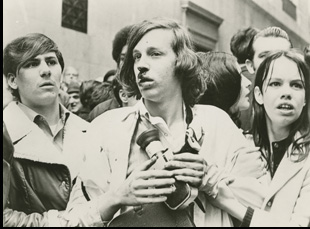
Marc Levin: Well, first of all, thanks to Martin Scorsese for allowing us to use the footage, but he did have one caveat, which was I had to get the permission of anybody that talked, so thanks to Harvey and his wife, Daphna, and to Jay Cox, who’s also in that scene, and what Harvey says in that scene still echoes to me — the guy was so pressured, he was already saying, “Hey, we’re not going score any points by calling these people motherfuckers or pigs or whatever in their face. That’s not the way to go about it.” And then the young woman who [responds] right after that, “They’re not the real enemy.” So that scene is a revelation. That whole Cinetracts Collective that NYU had put together, a group of filmmakers that Marty [Scorsese] was kind of a teaching assistant for, I didn’t know about and they had documented it.
David Paul Kuhn: When I was doing the book, I was pretty far into the research before I found that film because it’s not really publicly available and I was bowled over because, again, these are the artifacts that get you so excited and they had this footage of what was one of the sparks the day before and to see it just proved to me how cinematic this could be. And yes, when I first saw Harvey Keitel in that scene, as someone who was a reporter for a long time, a lot of Hollywood, when they pontificate on politics, they don’t age so well, or it doesn’t come off so well. Keitel ages really well. His gut insight in that moment, I think, was right on and he should be proud looking back that that was his first instinct, because that empathy that he found in that moment wasn’t common.
“Hard Hat Riot” premieres on PBS as part of “American Experience” on September 30th and will be available to watch online and on the PBS app thereafter.