





There is no dispute that the title character of “Little Amélie or the Character of Rain” is the center of the universe, though there’s reason to be skeptical that she is God as she describes herself when she’s very much entering a world she has no control over. At two-and-a-half years old, she can’t know any differently and when her parents Patrick and Daniele respond with haste to when she cries or laughs, there’s nothing to refute the idea she’s running the show except perhaps her pesky older brother and sister who occasionally command some attention as well.
In Maïlys Vallade and Liane-Cho Han’s enchanting adaptation of Amélie Nothomb’s novel, drawing on her own upbringing as a Belgian child growing up in Japan in the late 1960s when her father took a job abroad, the world seems a lot bigger when it exists only in its young protagonist’s imagination, describing the modest home around her as a gigantic universe full of various wonders in the film’s opening minutes. But as the film wears on, it’s Amélie’s mind that expands as reality inevitably encroaches and her parents have their hands full, leaving her in the care of her grandmother who comes to visit from Europe and Nishio, a nanny suggested by Keshima, the landlady for the village where the family stays and hopes to keep an eye on them as a whole with Nishio keeping watch over the kid.
While Amélie is appropriately mischievous for her age, there’s no reason to be suspicious about the family, though the fact that Keshima does speaks to the deep distrust that existed internationally after World War II and as complicated as those divisions are, Vallade and Cho Han, gifted storyboard artists making their feature debut here, finds that they can best be understood through a child’s eyes as she becomes conscious of them as much as anything else shaping her view of the world. She has a particularly sensitive guide in Nishio, who lost as much in the war as anyone did, yet makes a real connection with Amélie despite any cultural differences and their relationship flourishes as all the gorgeous greenery does outside the house. Quickly becoming a favorite at Cannes where it premiered earlier this year, followed by a premiere at Annecy where it became the animation fest’s Audience Award winner, “Little Amélie or the Character of Rain” is now arriving in U.S. theaters this week where its resplendent visuals can best be enjoyed on the big screen and Vallade and Cho Han graciously took the time to talk about making a film that respects its audience from kids to adults, finding creative ways to illustrate heavy subject matter and fashioning such an inclusive experience.
 From what I understand Liane-Cho read the novel at 19, which made me wonder whether it was an interesting dynamic between you as filmmakers when I imagine Maïlys was coming to this with less of a personal attachment?
Maïlys Vallade: No, not at all. We’ve known each other for many years, working together as storyboarders and we formed an [animation] family on a film of Remi Chaye [“Long Way North”], so it’s really in continuity. Seven years ago, [Liane] bought me the book and it was really exciting to adapt it. I never had read Amélie Nothomb’s book before. I discovered it, but [for] many years we have talked about the foundation of the [child] characters, the building of identity and talk about grief in life and this book was exactly what we could do together. And everybody told us that [this book] was unadaptable. [laughs]
Liane-Cho Han: When my son was just born and Maïlys had her daughter a few years ago, we were working [together] on “Calamity” at that time and I realized because my son was quite difficult as a baby [like Little Amélie], this book was so special. [In the book, Little Amélie] is God and then at that time, when I had my kid I realized, every kid believes they are God until they realize that they are not at some point in this transition between early childhood and childhood, even though Amelie is special and unique. Every kid goes through that. So at that time, I offered the book to Maïlys.
Maïlys Vallade: And this adaptation was really, really difficult, the most difficult we had to do. We wrote and rewrote [over] many years, analyzing the book to find exactly what themes we want to tell and [how] to adapt it cinematographically. Finally, between Eddine Noël, our art director, [Liane] and [myself], we wrote the final version because it had to be precise, but we know each other very well, so it was easy to do. But the production was fast and furious. It was made in 14 months [after developing the story and the storyboards] and because all the team [knew each other] very well, we didn’t have to discuss a lot.
Liane-Cho Han: This movie was the fruit of a very huge collaborative work with this artistic family we worked together with for so long and of course, all of them gave ideas to build this together.
Maïlys Vallade: Yes, we [actually incorporate a] conceptual step [in our process] where many people contribute in the story to give this nostalgia sensibility of remembering their own childhood.
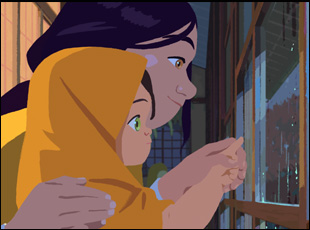
 One element I was really moved by was the literal child’s point of view where you kept the composition at Amélie’s eye level, which must’ve been difficult to envision as adults. There’s a remarkable scene where she walks around a couch and the emotion of seeing her parents suffering through a sad moment is amplified by how distinctly you see her only partially aware of what’s going on because she can only see so much above the couch. What was it like to figure out?
Maïlys Vallade: Our decision was to really be with the character, not necessarily her point of view, but at her height and this allowed us to intuitively be able to go from scene to scene like a child does, to be in the sensation of [when Amélie] hears something, she will go to something and she’s called from one place to the other.
Liane-Cho Han: That’s also what connects Maïlys and I is that we love to really be in the character’s point of view at her height, but not only physically, but also emotionally as well, to feel all this perception she has. Of course, the couch [in the house] is actually much higher than her, so that’s the way we wanted to frame her.
Maïlys Vallade: So it was pretty natural. We just tried to be Little Amélie when we built her because it’s just through her gaze.
 By the end of the film, it felt like you could walk around this house and the entire Kashima property where the family lives and know where you were going. What was it like to design?
Maïlys Vallade: It was a big challenge, because the original house from Amélie [Nothomb’s] childhood was razed, but our great artistic director Eddine Noël researched the Kansai region where the movie takes place and looked at a lot of documentation. We researched a really typical and very traditional old house and [Eddine] designed the house, piece by piece, room by room, depending on what we had to do inside the house. What was really important was that all the material [inside the house], like the furniture and the objects, were Belgian expatriate items, so it was a mix of the traditional [Japanese] house and the Western objects.
Liane-Cho Han: And it was [designed] in 3D, so you can print it if you want, or build it yourself, it’s so accurate. We also did that because 90% of the movie is in the house and it is very difficult to draw Japanese houses and to be in a specific point of view, so we wanted to be sure that all those shots were as respectful as possible for those proportions.
Maïlys Vallade: We also had to choose the orientation of the house [relative to the sun] so that when the light goes through the Shoji, the doors [of the house], that it would work at that moment of the story. We also thought about a garden in Amélie’s perception that would be limitless and infinite in the beginning that by the end, little by little, when she understands the reality of things, we will see houses in the neighborhood around [her] a little better as she realizes what reality actually is. So Eddine did really amazing work [researching] all the bushes, the plants, the flowers, and the elements of the house in that region to be very precise.
It was incredible. Another sign of where sensitivity and creativity collide is when there’s a sequence involving Nishio describing what happened to her family in the war and it’s expressed as she’s cooking where you get to make use of all the sounds that give real sensations to the story she’s telling. What was it like figuring out how to convey such a harrowing sequence in those terms?
Maïlys Vallade: In the book, this sequence is one of the most difficult to read because it’s very gruesome, but it was the best sequence to signify the situation of war, so we changed the place in the house [where] Nishio-san [told this story] and we were challenging each other [about] how far we would go to express war, but also be very respectful of the Japanese because we’re not Japanese.
Liane-Cho Han: Yeah, it’s true that we wanted to have as much respect as possible but not to make [the scene] too impressive or too graphic, and not to minimize the brutality of that moment. To be honest, I don’t think it was the most difficult sequence [to design]. What was difficult is we wanted this [scene] to be transgenerational, for children and adults and it was hard to [find] the right balance. For example we were a bit scared with the fish [having the head chopped off before being put in the pot]. Sometimes people want to censor it and at some point, we thought maybe we should cut this white radish [instead]. I’m from a Chinese family, so we used to cut the fish head all the time and it’s not very scary [and in the end] it felt really for us a natural way to be in the right spot to tell that story.
 Maïlys Vallade: The big question was the sound effects. In the beginning, we tried several things and we had the sound effect of the bombing [as the water boiled in the pot] but it was really too much. We really wanted to be in the interiority of Nishio-san at this time and just push the sound effect of the real thing she is cooking and [realized] it was enough.
Liane-Cho Han: It was a good way to be respectful with this situation and to be [inside the mind of] Nishio-san to use this everyday moment, [with] cooking to illustrate each sentence. For example, after [she describes] an explosion when she pours out the rice and she is trying to wash the rice under the water, [we needed to] make sure that the sound was built around the feeling that we are connected to her.
Maïlys Vallade: And the effects team did a beautiful [job] with this water. The most difficult thing in the film was this cooking [scene].
When this film is about what is gained from cultures blending with one another and you’re traveling around the world with it, what’s it been like for you to see the response to it?
Maïlys Vallade: This book [“Little Amélie”] is about Japan, but I think it can be many other places and we can have the same story because it is a realization of this place by a child and she [can see] Japan through the eyes of Nishio-san. I think many people we met through the world have the same sensation. It’s very moving for us to see that everyone understands this story and can relate to it.
Liane-Cho Han: Wherever we are, [whether] in Europe or now in the States, even though with all the differences of cultures we are coming from, it’s great to hear when people say that they forget that we are watching animation and they connect to these characters as if they were real people.
Maïlys Vallade: We feel the strength of the movie is to see through [the eyes of] this two-and-a-half year-old, and if we manage to make people understand the experience of being uprooted and being othered in an other culture, we have achieved something. If someone wasn’t able to understand it before and can understand it through her eyes, then that’s an accomplishment.
“Little Amélie or the Character of Rain” opens in select theaters on October 31st and nationwide on November 7th.