



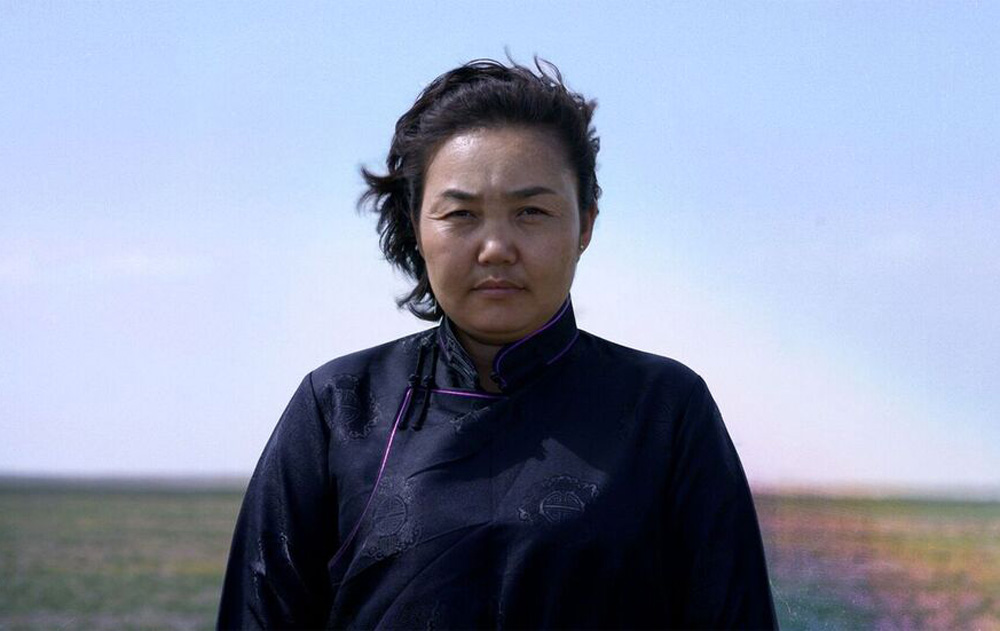

“This road puts a lot of food on the table for people,” Maikhuu says of the route she’s become intimately familiar with as a long-haul truck in “Colors of White Rock,” carrying a big rig’s worth of coal across the Gobi Desert from her native Mongolia to China where the mineral is prized. She has complicated feelings about what she’s doing because of the natural resource that’s being extracted from her home country where they are sparse to begin with and the clear environmental concerns that mining brings up, but there’s no arguing the present prosperity that has resulted from the pipeline as a community of truckers have made their homes in White Rock close to the minds, a place Makhuu remembers as having only a few yurts when she was raised as a child and now has hundreds to go by the extraordinary overhead shot director Khoroldorj Choijoovanchig initiates, observing a veritable oasis in the sand.
There are many breathtaking individual scenes in “Colors of White Rock” thanks to Choijoovanchig’s facility with drone cameras, often filming the spindly roads from above, but the director comes to find the most effective dramatic tool at his disposal is time, covering seven years in Maikhuu’s life as she heads back to White Rock where trucking promises a far better payday than previous gigs in hairdressing or driving taxis that she had had in the city. The job certainly isn’t ideal, particularly when being female puts her at greater risk than her male colleagues in the dead of night and the safety risks are already great when the tight two-way highways lead to plenty of accidents — when drivers are paid by completing the job, it incentivizes speed for making multiple trips. But Maikhuu has a family to think of with three children that she’s rarely around because she’s on the clock, let alone any of their fathers who seem to have scattered to the wind. (It’s her younger sister who takes care of them after she helped raise her.)
Not only does the time spent with Maikhuu in her truck give insight into a fascinating profession – a scene of the driver prying open the side doors of her big rig to let the shimmering black coal fall onto the grounds of a Chinese coal handling facility is a bit transfixing, as is the ingenuity required to bathe and and keep a short haircut without any normal place to do so – but the fact that Choijoovanchig returns over the years through COVID when over 85 percent of drivers are sidelined and eventually Maikhuu has to return to the life she previously left behind, getting to spend time with her family once more yet constantly having to worry about keeping a roof over their heads when taxi driving won’t cover all their bills. Enough is alluded to about the men in Maikhuu’s life to be mildly frustrated that none really ever make it into the frame, particularly when she gets pregnant once more, but the trucker is nonetheless able to carry the film as she does all the other heavy material in her line of work, revealing a pretty merciless industry where it becomes easy to understand why as dangerous as it is, the job promises just enough to keep employees coming back over the alternatives. “Colors of White Rock” covers its share of long and windy roads both literally and figuratively, but it’s bound to make the drive for people who can’t seem to find an offramp feel a little less lonely.
“Colors of White Rock” will screen again at Tribeca at AMC 19th St. East 6 on June 10th at 5:15 pm. It will next screen at Sheffield Film Festival on June 11th at 9 pm at the Light Screen 9 and June 12th at 12:45 pm at the Light Screen 6.