
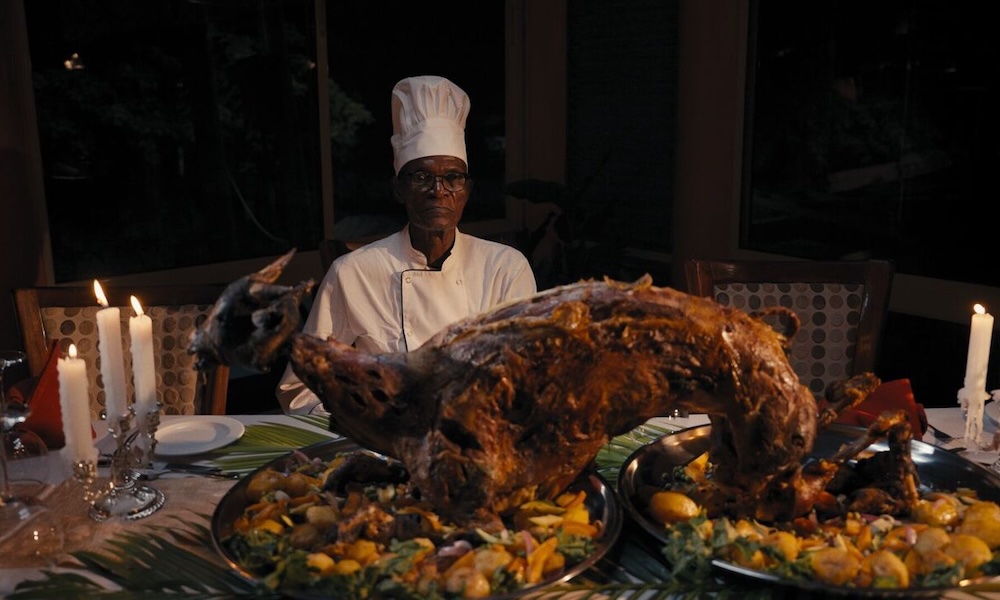

Coco Pacheco can recall Augusto Pinochet walking into his restaurant in “How to Feed a Dictator,” ordering the caudillo de congrio, a stew made of conger eel that was so beloved in Chile that it literally inspired Pablo Neruda to write poetry about it. The preparations were intense to serve a head of state, something that the president, swept into office by military coup, was well aware of when he wondered why there was no bill for his meal, but as Pacheco recalled, there was no way he would’ve charged for his services when he believed that Pinochet has rescued the country from communism and continues to speak highly of him until this day, though the thousands that were killed or disappeared in his name during his reign of terror in the 1970s and ‘80s has been in the public record for years. As Pacheco says, in his restaurant, they never talked politics.
The disconnect between how Pacheco saw Pinochet at his table and how the rest of the world now sees him as a mass murderer can be even more chilling than the beds of ice in his still popular seafood kitchen, one brought into particularly crisp focus in Andrew Neel’s deeply unsettling survey of chefs that were known to serve those now known to have committed mass murders such as Pol Pot and Saddam Hussein. Neel, who once trailed Alex Jones during his early years of peddling conspiracy theories around Austin and beyond in the 2009 doc “New World Order” and delivering the unsparing frat drama “Goat” in 2016, shows he hasn’t grown any less afraid of confrontation in his first feature in a decade, inspired by Witold Szablowski’s book of the same name to criss-cross the globe to observe blind allegiance to powerful figures at a time when fascism appears once again to be on the rise.
Each chef is asked to make a meal that was a favorite of the commander-in-chief, often reflecting an extravagance that wasn’t extended to the people they ruled over. (It turns out General Idi Amin always requested European cooking, so as not to be confused for any common Ugandan.) Italian chef Ermanno Furlanis can plausibly claim he had no idea what was going on in North Korea when Kim Jong Un invited him to make his favorite – pepperoni pizzas – at a moment’s notice when all he saw was the inside of the presidential palace, only learning once he went back home of his human rights abuses on the news, but others describe their work, dutifully serving dictators under extra scrutiny when there was always a fear that the food could be poisoned, Neel is able to show nations truly get cooked as if they were a crab in a pot of boiling water where the temperature is turned up so incrementally it only feels like a warm bath at first. Some chefs recognize now that they worked for a monster, but others still have no regrets, either when they felt they had no choice or the leader’s charisma continues to have a hold on them and the film breaks any illusions that there still may be when survivors of brutal regimes walk Neel through the sites where torture took place.
The bold approach makes a difficult subject far easier to take in, as has been true of much of Neel’s uncompromising work to date and with the film premiering tonight at Tribeca, it was exciting to talk to the director about finding an engaging way to tackle a political moment that has many tuning out, convincing the chefs to talk about their experience and dealing with a complicated production across continents.
How did you get interested in this?
My producer Michael Merlob introduced me to the book by the same title, “How to Feed a Dictator,” and I read it and thought there was no better thing I could add to the discussion of the mechanism of dictatorship than the story of these chefs. Telling the story of dictatorship through the everyman is something that we don’t hear that often, so that’s why I was interested in their stories and cooks have an intimate relationship with their with the dictators’ human needs, so that was also interesting to me.
What’s it’s like adapting a book into a nonfiction film?
The DNA of of the book is the same as the movie, examining the lives of quite ordinary, decent people under the the shadow of dictatorship. We ended up only actually using one chef that was in the book and in the film, we did a bit more editorialization [since] in the written word, you can leave things a little bit more amorphous and and allow people to completely put those things together themselves. In our case, we had we had talking heads to help guide people through that, [which] was maybe a necessary part of just making a movie out of it. But the feeling that I have when I watch the movie is very much a soulmate with how I felt when I read the book and I just wanted to bring that to life in a visual way.
What’s it like to reach out to the chefs? I know Ermanno Furlanis, the chef to Kim Jong Un actually says in the film he was thinking about bailing just a few days before the shoot.
Yes, Ermanno agreed to do the interview and to cook some pizza and then, about a week before the shoot, got cold feet and we couldn’t understand why. He’d written a book about his experience. He then told us that he thought that maybe we were Korean spies who were looking to exact revenge on him for talking about his experience. They told him when he left that he wasn’t supposed to say anything about it. And he did — that was a long time ago, but I think that is indicative of dictatorship. They instill fear that really lasts on a broad societal level. Dictators never die in a way. There’s the specter of the dictator lives inside us emotionally, even for this guy who just went there as a hired gun. I don’t think he’ll ever forget the the potential for violence that’s there. But we convinced him that we were not North Korean spies and we did the shoot.
In general, was it different for you to set up a global production like this?
I didn’t know what I was getting into. It was incredibly difficult. Obviously, just from a logistical point of view, it was very complicated. And then it was a bit tricky in terms of the visas and the topics that we’re discussing — in these countries, they are not comfortable topics and a lot of these countries still function under dictatorship or authoritarian regimes of one sort or another, so that was always something that we were navigating as well.
One of the things that was interesting is often the people on our team who are helping us make the film, the line producers on the ground, had been subject to the horrors of the regime. So sometimes that was uncomfortable because a lot of these chefs really liked the dictators they worked for. And the people in our team were listening to them talk about how they were father figures. That was uncomfortable, but it’s indicative of what all of the populations in these countries deal with for generations. Dictators leave these scars that, in this case I think, are unseen and best left unsaid for a lot of people. That’s how they treat it. So it was enlightening for that reason.
What your experience of going to these places when you’ve got this dichotomy of the chefs describing the time they spent serving a dictator versus witnessing what the place was like with survivors of the regime?
Yeah, we were as a team experiencing the same dichotomy or dialectic that’s in the movie. We were there investigating food half as a cooking show, yet we were also juxtaposing that with these awful acts of atrocity. The space in between this very basic relatable human need eating and preparing food alongside these dictators and what they did is exactly the space that I hope the audience is in when they’re watching the movie. It’s quite banal how dictatorships are sustained in terms of the larger population. There’s a moral conundrum that everyone is thrown into in these countries, whether they like it or not, and as a team, we experienced those polar opposites when we were shooting too.
Ethan Palmer, your cinematographer, has been with you for films in both the fiction and nonfiction space, and that versatility really shows when you can achieve the lush look of a “Chef’s Table” episode along with vivid verite. What was it like working with him to get those extremes visually?
First of all, Ethan was more than just a [director of photography] on this. He’s a an executive producer on it and almost every movie I’ve made with him, so he’s valued as a creative consultant and he understands tricky intellectual content. We were both aware of the perverse relationship between food preparation and life under dictatorship. There’s a visceral nature to what happens under dictatorship, that being murder and rape and theft and and torture. It’s all very immediate what happens to people. Food is that way too. It’s very physical. We prepare it, we eat it and when we were shooting, we were very aware that we were trying to create a cooking show environment, yet that was always infused with our knowledge of what we were going to juxtapose it against. Sometimes weirdly while we were shooting it, I think sometimes along with Raphael Laski, the other DP, it almost felt confusing to look at the images side-by- side. Early on in the day, you’d be seeing piles of bones inside a box with hundred dollar bills on top of it in Cambodia, and then later in the day you’d be watching a chicken carcass getting pulled apart to be in soup. That perverse relationship between the imagery was something that we were always thinking about when we were composing our shots.
Was there anything that happened that took this in a direction you didn’t expect?
More than anything else, I learned that one of the greatest tragedies of dictatorship that’s often unseen is the fact that dictators draw vast swaths of people — normal and good people — into an awful moral conundrum where survival and normal human needs like the desire to thrive and feed your family and make money and have a good life is all conditional on looking the other way. And whether you supported the dictator or not, you’re thrown into that situation. No one can escape it. There’s something really perverse about being morally corrupted without even engaging. It’s almost like a Faustian bargain when you didn’t even ask to talk to the devil. It’s an interior perversion that they foment. That was something that I had never really put my finger on, and watching these people struggle with cooking for these people and how they felt about it really elucidated that for me.
Unfortunately, this would’ve been timely any time in recent years you could’ve made it, but it seems particularly so now. What’s it like to get ready to share with audiences?
Obviously [here in the U.S.] we have a country with a president who has said they want to be a dictator. Donald Trump said, “I want to be a dictator.” So I would hope that people could watch this film and understand how easily that they could become a part of an apparatus that is necessarily violent and corrupt. As I said, whether you agree with the dictator or not upfront, you’re gonna be compromised, so I would hope that people would recognize that and it would further encourage our resolve to resist these authoritarians or wannabe authoritarians, or if one believes in what they’re saying, perhaps it could encourage them to consider the consequences. Because no one’s going to escape it. No one escapes the consequences.
“How to Feed a Dictator” will screen at Tribeca at the Village East on June 10th at 8 pm, June 11th at 6 pm and June 13th at 11:15 am.