
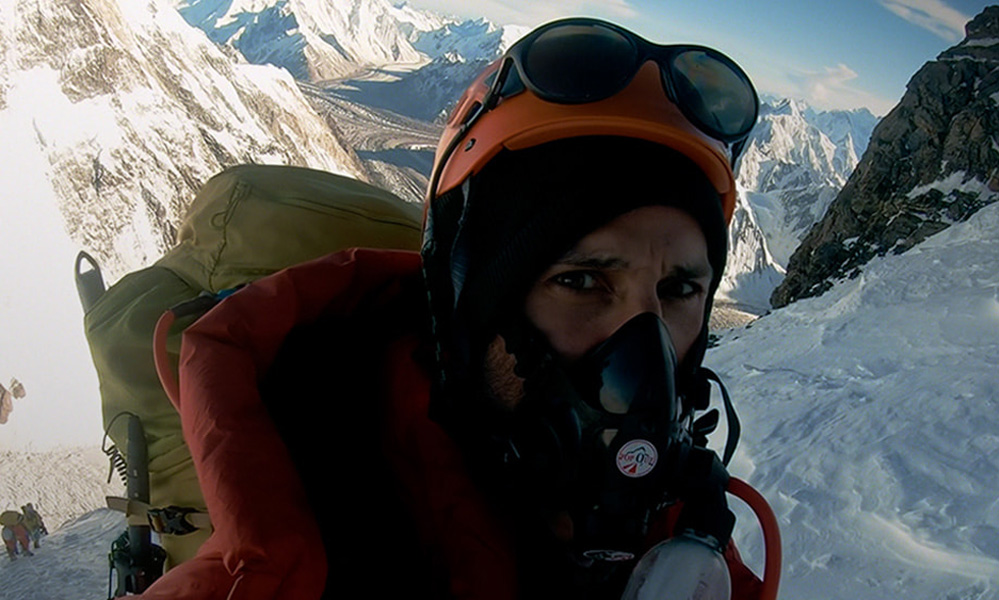

Amir Bar-Lev has long been a daring filmmaker, but not the kind you’d expect to be hauling a camera up the side of the mountain, which is why a casual look at his resume might not suggest he was the right fit for “The Last First: Winter K2,” documenting the harrowing 2021 climb by a variety of different parties hoping to stake a claim to being the first to scale the second highest mountain on earth in the winter when it is most inhospitable to human life.
“I feel really lucky that the people who brought me this story didn’t say to themselves, ‘Amir’s not a mountaineer. Why would he care?” says Bar-Lev, who mercifully could tell the story in retrospect with the number of climbers that filmed their efforts for posterity and even for other films. “They said, “He likes these stories that end up being existential parables or hold up a mirror to our lives. I’ve had a career where I’ve made films that each of them are about something completely different, but they’re all at some level this kind of a story, a non-fiction allegory.”
While mountaineering docs often leaves audiences in awe with what the human spirit is capable of, “The Last First: Winter K2” can inspire gasps for other reasons when Bar-Lev provocatively presents another side to the experience, considering how a race to the top of the mountain could lead to a fundamental undermining of the sport where collaboration has long been honored when the stakes are really life or death. When his latest film opens with a desperate call from John Snorri, an Icelandic mountaineer who wonders why there was no trail left for him by other climbers and ultimately perishes in the cold along with two others, it leads to a different framing for what follows. It still is remarkable to witness Nims Purja, the famed Nepali mountaineer successfully reach the summit first in “Winter K2,” but the film raises questions about what it took to get there when other mountaineers with far less resources – and some inspired by rock star climbers like Purja to attempt hikes they don’t necessarily have the experience to safely try – are left behind to fend for themselves in such dangerous conditions.
Bar-Lev previously made such harrowing and probing examinations of tragic events after the fact with “The Tillman Story,” in which the lionized war hero Pat Tillman could be even more greatly appreciated for not resembling the advocate for the war the military wanted him to be, and “Happy Valley,” which took the temperature at Penn State after the sexual predator Jerry Sandusky was brought to justice, and once again wisely takes the time to push past the image that’s been created over the years to downplay the dangers of mountaineering and treat those that have become popular as gods. When the director and his crew extend their lens to so many besides Purja to try climbing the mountain, including the local sherpas who never receive the attention they should when it’s the primary climber that gets all the glory, the film’s panoramic view makes it seem as if the film has reached a summit itself where both the beauty and brutality of the sport can be seen in full. Following its premiere at Sundance earlier this year, “The Last First: Winter K2” is now arriving this week in select theaters as well as streaming on Apple TV+ and Bar-Lev spoke about how as unexpected as the subject may be for him to tackle, it fit right in his wheelhouse, why “being a fly on the wall” is the least helpful advice young filmmakers could get and why this film is one of the most rewarding of his career.
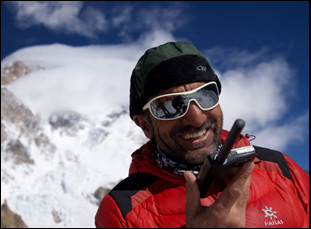 You’ve said you actually didn’t get involved until relatively late in the process. What got you interested in it?
This really was the most collaborative experience in my career. There were 60 people on the mountain, so there were 60 different stories we could tell and maybe there were 10 of us on the creative team, so over the course of a couple years, we endlessly debated whether to narrow the focus to one or two characters or widen it to many characters and what are the takeaways from this very complicated story and how to represent different perspectives that often were in opposition with one another. I said to my team at the end of this process, that was the hardest film I’ve made yet and the most enjoyable because it just really was a rich stew of very complex ideas – and that is what drew me to this story. I could see right away when I looked at this, that it was a story that I would find stimulating for a couple years to work on and that a viewer would find stimulating for a couple hours.
I really did feel that way about this because I could connect this to “The Tillman Story” or “Happy Valley” as far as a certain image being projected of something and you’re getting underneath it and covering documentaries for a while, I know what a popular genre mountain climbing is in documentary. Did it feel like touching a third rail to be critical of how the practice is often portrayed in other documentaries?
I had to do my homework when I signed up for this that involved watching a ton of mountain documentaries, some of which I love and many of which I didn’t. What I don’t like about them is they do have a good amount of artifice – and all nonfiction has artifice and everybody handles it differently – but the constructed nature of some of these stories that involve life and death where your presence is possibly causing people to make not the best choices is something that I think should bear some more scrutiny.
There is a feeling sometimes a little bit akin to snuff films for me. But I want to be really clear that’s a modern phenomenon and I see it as representative of something very old and perennial, which is that we’re fascinated with death. As humans, we are terrified of death, but we can’t look away and when people come around who feel like they’re not as as terrified of death as as we are, that becomes the stuff of legends, and when we encounter people who are grieving or very vulnerable, one part of us knows that it’s the worst thing in the world for that other human right now and we should give them privacy and another part of us wants to just rubberneck out the window of our car. We wanted to try to reckon with that a little bit.
We had two very dramatic things that came back to us in the footage. We didn’t film anything ourselves except for interviews essentially because we didn’t get involved until three years afterwards. But when the first death happened on the mountain, a lot of people filmed the body in ways that felt disrespectful, [like] selfies. One outtake, which we debated endlessly, was people posing with the body like you would pose with a dead rhino. And one side of me thought, that is so garish and gruesome that I have to put that in the film,” but then another part of me thought, I can’t. If I do that, then I’m participating in something that I don’t want to participate in. And then there was also the fact that I couldn’t explain it to anybody. At the end of the day, we decided if we can’t even make any sense of it, it shouldn’t go into the film.
Then somebody brought us essentially audio, but it was surreptitiously filmed iPhone footage of someone finding out at the moment of another death. And I’ve seen a lot of things in my life. That was the most disturbing material I’ve ever experienced – the 30 seconds or so of listening to to this agony. We thought that is so remarkable that somebody would have filmed that and then brought it to us, but then also we thought, “No, [we can’t use it] because we need to preserve the privacy of this person.” So in both cases, you see but don’t see what we have, what we saw and heard, but we explored it in the same way that a journalist should should explore the subject matter that they’re trying to bring to their audience.
I wanted to ask too what was the relationship like with Elia Saikaly, who was making a documentary of his own about the race to get to K2, or any of these other filmmakers that actually were planning to make full-fledged films and you inherited their footage?
There’s not too much to say about it because in fact most of those licensing deals happened even before I was involved. It’s a credit to my edit team that they helped me tell the story that I wanted to tell with footage that was not collected [by me] to tell that story. There’s a “Rashomon” aspect to it all, but also just a really good scavenger hunt of trying to find storytelling clues in a huge haystack. I started out by mentioning this but the collaborative nature of this particular film was so gratifying for me. It has been seven years since my last film and I noticed that In those seven years, I shifted. Maybe I matured a little bit. I’m now 54 and it was the first time I felt, part of what I’m here to do is to pass on what I’ve learned a little bit and bring other people into the collaboration more than I’ve ever done. I had the right people to do it with in this particular case.
It belied the Idea that there’s the creative part of your crew and then there’s the non-creative part of your crew and that actually the assistant editor is just as important as you are. It’s great that it’s coming across because a lot of these things [in this film] are things that I wouldn’t have either noticed or even done, but I allowed other people to be participants in this creative tug of war and I think it ended up working out.
When you’ve got that process where you first come to it through a lot of archival and then you’re building on it with interviews, was there anything that changed in your mind about what story you were telling?
Of course. If that’s not happening, then you’re definitely not doing your job. One of the things I always say is that old phrase that they teach you, “Be a fly on the wall,” is a really stupid phrase because you do have to come into these projects with not just a perspective, but also the knowledge that you are not a fly on the wall. You’re affecting the thing that you’re [filming]. On the other side of the spectrum, if you have such a point of view that it becomes a preconceived bias, or it’s a position in search of a film, that’s also a mistake. So the closest thing I could say to it is that it’s like being an improvisational musician. You can’t just disregard what key you’re supposed to be playing in, but you also have to listen to the other players and change what you’re doing accordingly. I love that about documentary. You come in with one set of notions about what the story is and if you don’t leave with a different one, then you’re either hardheaded or a polemicist.
The other great quality of your films is the feeling that people are really getting something off their chest or their shoulders by talking to you. What’s it like being in that position where your interviewees are actually unburdening themselves of these heavy things they’ve been carrying around?
I appreciate that you noticed the through line, but I do feel a little bit like a one-trick pony. And that’s fine by me. I’ve been texting with my religious studies professor from college that I just got back in touch with and I told him that I didn’t go into theology or philosophy or even academia, but the way of seeing the world that he and his department imparted to me — this combination of philosophy and anthropology — that’s what helped me understand the world and helped me make documentaries time and again, just to understand that what’s really going on and people are projecting meaning in different ways. But if you can think about things that way, then you look at football or art or mountaineering with a certain kind of critical distance and empathy. That’s what I’m trying to do always and what I look for in a story.
So interacting with real people in controversy or tragedy or grief, it’s an exercise in empathy, which is what we all need more of and you’re trying to cultivate empathy in your audience. It’s why you pull some people into the “cast” and exclude others. When we made “Happy Valley,” we barely really talked about Jerry Sandusky. The reason for that is Jerry Sandusky is not an interesting person for a film really because he’s a sociopath and what you don’t want is your audience to just leave the theater saying, “Well, thank God I’m not a sociopath” and they go on their merry way. If you at a slightly different part of the story and widen the aperture up to the people around, you get into more of the territory that you share with those people and that is interesting for your audience. You can’t just be a finger pointer. This story [of “The Last First”] was maybe the best for that of any film I’ve ever been a part of because there’s so many different perspectives and it’s connected to so many different parts of our life that it wasn’t very hard for me to not be too judgmental.
“The Last First: Winter K2” starts streaming on Apple TV+ on October 2nd and will open theatrically in Los Angeles at the Laemmle NoHo 7, the Roxie Cinema in San Francisco on October 4th.