





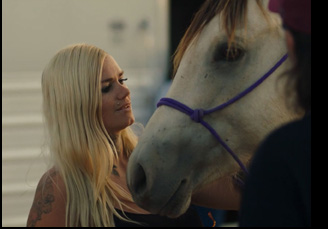
Kate Beecroft is fond of saying she didn’t go out looking for a movie, but a movie found her when she was passing through South Dakota on a cross-country drive and she was directed to the ranch of Tabatha Zimiga, a movie star if there ever was one with her half-shaved head and a full blonde mane on the other side and a poise that can’t be taught. It wasn’t that she just looked the part of someone worth watching for a few hours, but she had a story to tell as well, carrying on after her husband’s tragic death to raise her young daughter Porshia as well as any other young kids that found their way onto the property where they were assured to be looked over with the same care that she gave her own flesh and blood as well as the horses she breaks in for a living. To keep both the business and her family afloat, however, she didn’t do things the way they had traditionally been done, opting to make Shaboozey-scored TikToks to advertise the speed of her horses instead of quietly submitting them to auctions and encouraging her young to follow their interests rather than take after her.
Beecroft, who first started out as an actress when she wasn’t aware that directing was an option in considering pursuing her passion for filmmaking, did not want to make a documentary about the Zimigas, but nor did she want to add a Hollywood sheen to the proceedings with famous actors or attempt to overly script what was already a compelling family story. The happy medium she found from spending years with the family ended up as “East of Wall,” a bit of a hybrid with a fictional conceit that the Zimigas have a decision to make about their land when a wealthy cowboy (Scoot McNairy) comes along with a generous offer to take ownership of the property, which could relieve Tabatha of any financial burden of running the ranch full-time, but doesn’t square with her natural self-reliant streak.
As admirable as Tabatha can be seen in doing right by herself and everyone she takes care of — including those who might not be appreciative in the moment such as Porshia, who contends with puberty, and her mother Tracey (Jennifer Ehle), a tough customer in her own right — Beecroft shows a similar resolve behind the camera, envisioning the family on the frontier with the stature that John Ford would afford John Wayne, but equally conscientious of the real lives she was bringing to the screen and developing a process in which the sensitivities of her cast, both professional and nonprofessional could be considered, in fashioning a western unlike any other. After bringing audiences to their feet at Sundance earlier this year, “East of Wall” is opening up in theaters across the country and Beecroft spoke about how she was able to bring the Zimigas to the big screen while allowing them to simply live their life, shedding light on the female experience at various ages on the open range and when a day in the mud brought so much joy.
 How did this take shape? As I understand it, you only started writing years after first meeting the Zimigas.
Yeah, I was just on a road trip. I wasn’t expecting to find a feature. I was just trying to find something for my reel and then got directed into the Zimigas realm and I just felt totally in love with them. They were the kind of the faces and the spirits and the women that I’ve been dying to see on screen, especially in a modern day western. But did I think I was going to be spending three years in South Dakota living with a family and making a western? Absolutely not. I’m born and raised in Los Angeles. There’s no way I thought this was going to be my life. And when I started living with the Zimigas, I didn’t write the script until around two-and-a-half, three years in and it was because I just wanted to live with them and understand their way of life, their culture, what makes them tick, how they connect with animals, what it’s like living off land like that and the script I just based on moments that they’ve shared with me about the past and stories that they’ve had. Then I’ve witnessed so much with them over those three years, a lot of the scenes in there are things that I heard them say or moments that I witnessed. It was an amazing collaborative process and me and Tabby held each other’s hands the whole entire time.
When you’re inventing a process for this to some degree where you’re in the reality you’re depicting dramatically, was there a moment that you thought everything was actually clicking?
Yeah, there were so many magical moments, especially working with non-professional or first-time actors. When you’re living and filming on their ranch, there’s always movie magic and of course, there were times where I was like, “Oh God, can I pull this off? This is a lot for my first feature, I’m dealing with people who’ve never acted before, 12 crazy attack dogs and horses and moody teenage girls who sometimes don’t want a camera in front of their face.[We were also filming at] events like live rodeos and shooting at live sale barns. Sometimes I can’t even believe this movie was made. It’s a big risk of a film, but it was so magical and fun and I wouldn’t do it any other way.
 Not to single out Porshia, who’s great in it, but when you mention moody teenage girls as she plays in the film, what was it like to figure out how to give that character an interiority? There’s a lovely voiceover she does over scenes from the landscape tucked into the structure of the film.
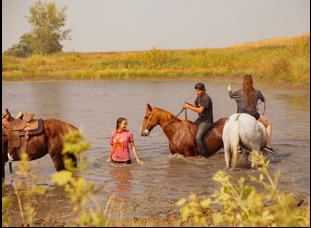
Porshia is very, very special. Now she’s a woman – she’s 18 now, but she’s very, very special to me and that girl’s gone through so much. I’ve always been fascinated on how when something traumatic happens to you so young, and you don’t understand. Your brain’s not even fully developed, so how do you mourn? How do you move through something when you don’t even have the words to express what happened because you maybe just don’t understand it? So that was inspired by how Porshia handles emotions and just conversations that I’ve had with her. The Badlands is basically her backyard and there’s things that she’s expressed to me before and she doesn’t usually verbalize what is going on with her emotionally, so it really comes out physically — the tightness or things crumbling or covering her ears. She gets overstimulated when she’s upset or stressed and the world feels like it’s crumbling down, so [that came from] how can I, as a filmmaker, make that cinematic in a way that is doing justice to her emotional and psychological state as a young girl?
It’s a novel solution that also seems to stem from the compassion you had for the Zimigas, not forcing anything on them to act out. From what I understand, the only scene in the film that’s improvised is also a key moment that I wouldn’t want to spoil, but involves Tabatha directly addressing her pain in the company of other women from the community. How did you think of putting that scene together of them swapping stories with one another?
Yeah, that was the only thing in the script that was improvised and there was no plan B, so I was like, “Oh God, I hope this works. It’s a lot riding on this.” But all those women there wanted to tell their stories and they were so brave in doing so and I think that they were really blown away by Tabby and her strength and how brave she was to go out and [say], “This is who I am and this is what I’ve gone through.” mental health is not something that’s really talked about in cowboy culture and in South Dakota, so for survivors of domestic abuse or any sort of violence, to be able to tell your story and to have control of that narrative is empowering to these women. So it was such an honor that they chose to share those stories with us that night and they’re in the world now. I’ve had a lot of survivors reach out to me talking about that scene and how it helped them talk about what they’ve gone through with their loved ones, so that scene is powerful and bigger than anyone there.
 Was there anything else that happened that you may not have expected, but made it into the film and you really like it?
Yeah, a lot of things in this film were things that were not planned for and were happy accidents. We had two days of live rodeo and just trying to sneak as much footage in as we could. One of the days, the weather was great, but then the next day, it’s raining and of course, I’m planning to cut these two bits together. But the rodeo arena is full of mud and I’m thinking, I have to have horses go through these [paces], but they’re going to break a leg. So we had to time everything right. The second the arena started drying up, then the horses could go through. And then I had another scene written, but I couldn’t shoot it [due to the weather] and I looked at the mud pit and I was like, “Okay, what can I do with this?” It was given to me for a reason. And I blasted Taylor Swift because the kids love Taylor Swift and I said, “Get in the mud,” and they all were so excited and they all just jumped in. It was obviously a producer’s nightmare, but magical for me and the cast.
That comes across on screen. After knowing that you had found movie stars in South Dakota, what’s it been like actually seeing Tabatha and Porshia appreciated as such?
They’re so amazing. They’re so strong and so professional, so it’s been fun and it’s only fully out in the world on August 15th, so let’s see because you’re going to be getting a different audience than at Sundance who love like slice of life films. It is docu fiction, but I’m sure some people are going to be like, “Wait, what? Because it’s not stereotypical storytelling that we’re used to.” I wanted to make a film that has a lot of heart and that people could relate to that because I think now we’re just watching films that feel like a video game. And I hope that people connect with [the Zimigas’] stories because they are very brave in sharing them.
“East of Wall” opens on August 15th in select theaters across the country. A full list of theaters and dates is here.