




Tamara Kotevska has learned from experience that you make your own luck. It took years working alongside co-director Ljubomir Stefanov for her breathtaking debut “Honeyland” for a fascinating story to develop of a beekeeper who witnessed the vicissitudes of climate change first hand as there was concerning lack of buzz around her humble home in Macedonia. After becoming the rare doc to be nominated for multiple Oscars, Kotevska wound up setting a camera up on the other side of the mountain to capture the storks that are revered in the country where residents are reluctant to remove nests that might crop up on their roofs and their return every spring after migrating for the winter is cause for local celebration. The footage of the majestic birds may have been remarkable, but not necessarily the basis for a full-length feature, yet quite literally they brought herald Dakar to the farm of Nikola Conev and his wife Jana where a story really could take flight.
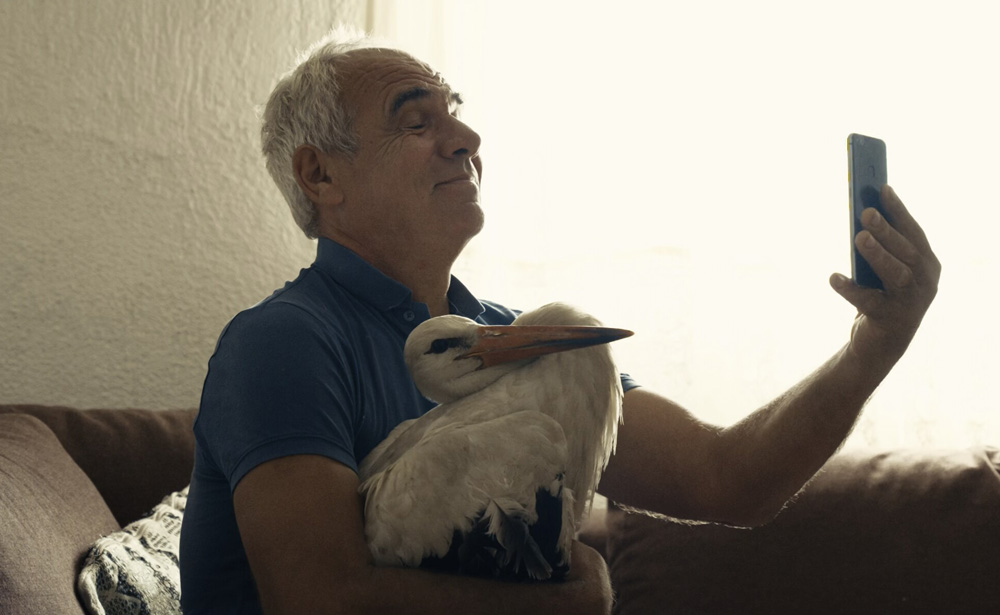
In the extraordinary “The Tale of Silvan,” Kotevska finds a story that is both timeless and of the moment when the Conevs’ way of life is under siege as fewer markets want to stock their produce, presumably because larger industrial farms have undercut their prices to dominate the space, and their children, indicative of a younger generation in general, see their future in more urban areas rather than taking over the farm that has been in the family for years. Still, Nikola is too proud to abandon the place he’s put so much blood, sweat and tears into, not to mention his ancestors and as he picks up odd jobs to sustain himself, he comes to befriend a stork that he rescues from a landfill. Perhaps he’s helping the stork out, but the stork returns the favor and then some when Nikola’s home grows more and more empty as prosperity seems to lie elsewhere and the farmer greatly enjoys the company.
In an increasingly isolated world, “The Tale of Silyan,” which takes its title from an old Macedonian folktale and told with such warmth, feels like a true embrace when Nikola, at his lowest point, can be buoyed by a most unexpected friendship and again, Kotevska finds a story in her own backyard that can speak to the whole world as rural communities face increasingly inhospitable environments to thrive and climate concerns are only adding to the pressure to leave. After becoming a favorite on the fall festival circuit with stops at the Venice Film Festival, Toronto and Chicago Film Festival, where it picked up a Silver Hugo in addition to recent nominations from the International Documentary Association and the Spirit Awards, it appears Kotevska could be an Oscar nominee again and it was a privilege to get to catch up with her and the film’s producer and cinematographer Jean Dakar recently to talk about how good fortune only came their way after spending considerable time on the project, andthe sensitivity involved in filming storks.
 How did you first get an interest in the storks?
Tamara Kotevska: Jean and I were already in Macedonia for another film we were supposed to shoot, which got canceled and a symbol of the [region is the] stork. We wanted to dive deeper in this world of storks to understand more how we can approach these animals and how we can shoot them. My first step was speaking to an animal activist organization that works with protected species and storks [specifically]. They really helped me to understand what’s happening in the world of storks in this moment, which is [the storks] are changing their migrational patterns because they start eating from landfills and they stopped migrating altogether and die out in the landfills in huge numbers. So I was quite intrigued to follow this particular story and the storks took us in the world of humans.
Jean Dakar: We wanted to investigate what’s going on. One of the main activities of storks is obviously feeding off farmers’ lands, so as we were doing that process, we discovered Nikola and his family. Technically speaking, we’d been filming them from day one, but Tamara and I also did a “casting” of the different families and the different farmers [in the area where the storks were]. And we decided to tell the story of Nikola and his family.
Was it much of a shift when you located Nikola and started following him?
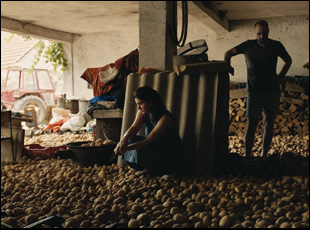
Tamara Kotevska: It was quite a shift. It did need a re-questioning of the structure and another long [period of] research about approaching farmers and the issues that are happening. I was consulting a lot of agricultural professors and journalists to understand how to approach the human world. And then there were a lot of changes being made throughout the process of [editing about] where this story should be going. At one point, I was thinking I will follow the family, but then I realized it’s more important for me and the story to be set on that land and to see what’s happening with that land as a main character.
 Did it require a different kind of cinematography, shifting from observation of nature to people?
Jean Dakar: There are similarities. The goal has always been to be close and intimate and there is a difference between nature photography [where] I always thought when you’re further away or with a tighter lens versus the shots when the camera is physically closer using a wider lens. That’s definitely something that we wanted to achieve in shooting the storks. It took quite a lot of patience because you have to really gain the trust of the animals unlike photography where you can have a hidden camera and the animal walks past and you flash it and you’ve got a shot. With film, you can’t just cheat it that way. You’re going to have to physically be close and truly make the animal feel comfortable so that you get a natural performance of the stork. Having said that, we’ve been using quite intrusive equipment, such as drones, which are very unnatural in the way they are flying. They make a lot of noise. So it wasn’t an easy task.
There are definitely parallels with the humans as well because this feeling of being close and intimate is something that you can’t really get [other than] by being physically close. It definitely takes time getting used to this whole filming process and establishing some kind of collaboration as a cinematographer and your subjects of how you can create some kind of dynamic of observational style filmmaking. And this collaboration starts from very simple [things like] try not to look into the camera all the way to the characters knowing and somehow waiting for you to set up the shot so that they can carry on the action. Having spent a lot of time with the family, becoming almost part of the family — we essentially were living at their house and it created some kind of bond and trust where our characters could also perform the most natural.
Tamara, from what I understand the idea of framing this as a folk tale came much later in the process. How did it come to mind as a way to set up this story?
Tamara Kotevska: This is the first tale I ever heard in my life when I was a child from my farming grandparents and it’s a very popular tale in Macedonia. But I never planned to use it until the third year of the shooting when Nikola found the stork and decided to take care of him. When I found a lot of similarities with the story, I thought it’s an amazing idea to use it because in the heart of the story is a very strong environmental message.
 Was there anything that happened that was unexpected and you could embrace and made it into the film?
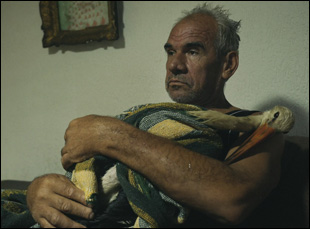
Jean Dakar: Yeah, honestly, it was when I found out that the phenomenon of storks becoming a part of a human’s life is actually not very uncommon. That scene of when Nikola went to the grocery store to buy these sausages, we saw another stork who was somebody else’s companion, so this kind of connection really happens. It was just quite a surreal sight. They’re like somebody’s Pokemon almost, because they’re wild animals, but they’re getting really accustomed and used to their humans, so that was definitely one of the more surprising moments during the shoot.
What’s it been like to share with audiences around the world?
Tamara Kotevska: It’s been true magic. This film resonates with such a large audience. The first time we premiered it in Venice Film Festival, the audience gave us a standing ovation of 10 minutes and we won an award and then we loved coming to the U.S. and realizing how the story resonated with the audience here so well and also in Toronto. We are hoping to get many more reactions worldwide.
“The Tale of Silyan” is now open in New York at the IFC Center and in Vancouver at the VIFF Cinema and opens on December 5th in Los Angeles at the Monica Film Center, the UW Cinematheque in Madison, Wisconsin, the Center for Contemporary Arts Cinema in Santa Fe, the River Oaks Theatre 3 in Houston and the CPX Yonge and Dundas Cinema in Toronto before expanding on December 12th. A full list of theaters is here.